What Happened When 99% of His Wealth Was in One Business with Jon Morris
00:00:00.000 — 00:00:15.600 · Speaker 1
I scaled and crewed a large agency. I come from a long line of people who have taken the risk and started their own business. I didn't have good financial systems in place and I didn't have good HR practices in place. I put a phenomenal plan together for 2020. There's only one problem with the plan.
00:00:16.760 — 00:00:31.680 · Speaker 2
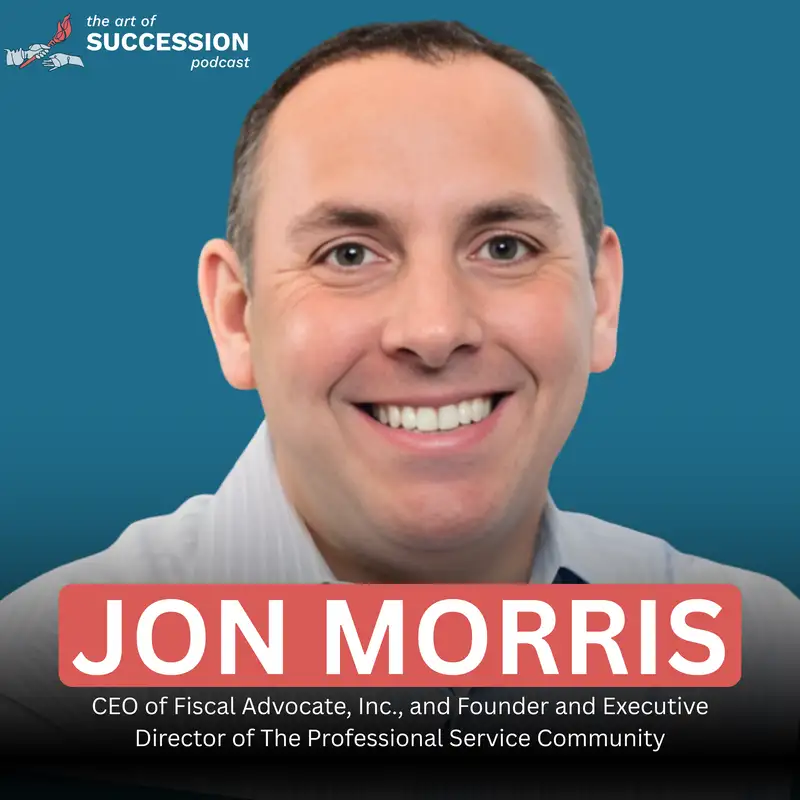
John Morris is the chief executive officer of Fiscal Advocate, Inc. and founder and executive director of the professional service Community. He helps professional service firms increase revenue and efficiency through tech enabled financial solutions and peer driven business growth.
00:00:31.720 — 00:00:37.160 · Speaker 3
How do you go from Everything is awesome right now to I want to start another company.
00:00:37.160 — 00:00:43.720 · Speaker 1
I love my clients, I love my employees, I love innovating, so I love what I do. I'm having fun.
00:00:43.760 — 00:00:46.760 · Speaker 3
What is one thing that you would want your successor to remember you for?
00:00:46.760 — 00:00:47.920 · Speaker 1
I would say.
00:00:49.360 — 00:01:29.380 · Speaker 3
As you've been listening to this guest, you're probably starting to ask your questions. How do I apply this to our own situation, our own succession story at the company that I'm working in now at GWC, we have built a custom GPT that you can find linked down in the description below on our website. We have loaded this GPT up with all of our knowledge about public accounting and tax preparation around succession planning.
We've also included the insights from the guests from the past two years of interviews at the Art of succession. You can find all of that at the custom GPT use at any time of day. Start to apply it to your situation. Ask it the questions that are keeping you awake at night. I want to thank you for listening so far and let's get back to the episode.
00:01:29.740 — 00:01:44.660 · Speaker 4
Welcome to the Art of succession podcast with Barrett Young. Join us as we explore the strategies, stories and insights that shape the journey of leadership, transitions and business success, no matter where you find yourself along the journey. This is the podcast where you'll find the tools to make it happen.
00:01:44.700 — 00:02:07.950 · Speaker 3
My name is Barrett Young and this is the Art of succession podcast. My guest today is John Morris, CEO of Fiscal Advocate. John started his first company from a $10,000 grant and grew that digital media agency to $40 million in revenue before selling that business. From there, he started Fiscal Advocate to help share those tips with other business owners looking to scale up.
John, welcome to the Art of succession.
00:02:07.990 — 00:02:10.149 · Speaker 1
Barrett, thanks so much for having me here. Real excited to be here.
00:02:10.190 — 00:02:31.030 · Speaker 3
Yeah, I'm looking forward to getting your insight, your tips. That's significant growth in a business. So I know that that's going to really benefit the listeners here. But I do want to hear for in your own words, like what brings you to the art of succession today? What what had you interested in, you know, coming on the podcast?
What do you really hope that our guests take away from this conversation?
00:02:31.070 — 00:02:50.750 · Speaker 1
I scaled and grew to a large agency and had a great exit. And I really like giving back. And I have a ton of learning in terms of growing the agency and a ton of learnings in terms of my succession planning to the next leadership in terms of succession planning for my own life. And I just thought it'd be a good opportunity to share some of my wisdom.
00:02:50.790 — 00:03:30.770 · Speaker 3
Yeah. Awesome. I mean, most of my interviews are with the acquirer, the acquisition side. Like I'm in the process of that, but I love to get somebody on the exit side too, because that's the that's the flip side of succession planning that's often the hardest. And the, you know, the biggest roadblock to getting this thing to go through is what is the next step.
How do I exit with confidence? How do I know this company isn't going to, you know, collapse behind me? So I, I always value this conversation. And so I do want to thank you again. So let's get into it. Like tell me your origin story. Um, how did you come to start a company and what brought you up to that point?
00:03:30.810 — 00:03:51.730 · Speaker 1
Uh, so I'm going to go back, like all the way really to my childhood. So both my parents were entrepreneurs. My grandparents were entrepreneurs. I come from a long line of people who've taken the risk and started their own business. And so I always dreamt of owning my own business from a very young age. You know, I didn't know what business or why I wanted to own a business, but I knew I wanted it.
00:03:51.890 — 00:03:53.490 · Speaker 3
That doesn't matter as much.
00:03:54.570 — 00:05:13.640 · Speaker 1
Uh, so I actually like when I graduated college in 1996, which shows how old I am. Uh, I started my first digital agency two days after graduating, so I took a day to move, and then I started my first agency. And in 1996, I didn't even know about the internet until January of that year. So just to give you an idea of like where the world was, that's what kind of got me into digital marketing.
I then decided I wanted to go into finance, and so I went to University of Chicago to get an MBA, uh, with a concentration in finance. And I got an internship at a hedge fund, and I was bored out of my mind. Uh, I kept on interviewing all these CEOs and CFOs. Was like, you know, I really want to be back in their seat.
And University of Chicago had an annual business plan competition, and I entered it. The idea was to teach digital marketing to small businesses, which morphed into a digital marketing agency. And that's where, as you mentioned in my intro, I took $10,000, turned it into 40,000,016 years. And The Secret, which is funny because he came back to me wanting to go into finance was I just think we made decisions better and faster because we were able to take financial data and know how to use those numbers to, you know, create an edge or a competitive advantage relative to our competition.
00:05:13.680 — 00:05:22.000 · Speaker 3
Okay. Starting that first digital agency, I mean, did you go to was your original degree in just business management or was it actually in marketing?
00:05:22.000 — 00:06:22.460 · Speaker 1
I fell into digital marketing. So my degree was in economics, and I really wanted to work for one of the major consulting firms. So McKinsey, Deloitte, you know, etc.. And I was fortunate enough to make it to the final interview of every single place I applied, and I got rejected from every single place I applied to.
So I'm 22 years old. My great aunt gave me a briefcase as a graduation present, and I decided to create a computer company. I knew nothing about computers. I bought the book HTML for dummies and it basically sat in that briefcase. I'd walk around like reading HTML for dummies. And, uh. And I was 22, probably looking more like 16, you know, than 30.
Um, but I was nerdy enough that people actually believed that I might know something about computers. So I started building the ugliest websites you've ever seen. Like, if you could think of, like, the 1990s, like high school version of a website, that's what I was created.
00:06:22.460 — 00:06:26.500 · Speaker 3
Oh, yeah. Everything's hard coded. CSS is like magic or hasn't even like.
00:06:26.540 — 00:06:28.340 · Speaker 1
I don't think CSS existed at that.
00:06:28.340 — 00:06:28.700 · Speaker 3
Point.
00:06:28.740 — 00:07:07.400 · Speaker 1
Yep. So I'm building these websites and I'm doing a decent job on the sales side. And everyone just kept on asking me, well, how's my website going to get filed? And I didn't know the answer. No one knew the answer. And so I started researching all the ways to get into the top of the search engines, how to do, you know, banner advertising and all the different ways that you can get exposure.
And so I really was truly one of the pioneers of search engine optimization. You know, going back to the mid 1990s. So I fell into digital marketing. Uh, not knowing that that would be my career for, you know, the next 20 some odd years.
00:07:07.440 — 00:07:12.240 · Speaker 3
You closed that company to, to after you finish your finance degree.
00:07:12.280 — 00:08:12.930 · Speaker 1
Yeah. So I, I became a.com casualty. So in 2000, 2001 I think it was 2001 September, I lost 80% of my revenue all in one month. And it was all with three clients. And even just the way I described it to you a second ago as a.com casualty, it really is kind of putting the blame on someone else and not me. And so after I licked my wounds and I finally was able to do soul searching and realize, no, I kind of was the one who screwed up.
And I didn't have good financial systems in place, and I didn't have good HR practices in place. And so when I like the big learning from net traffic, which was the name of the agency to Rise Interactive. My second agency was I wasn't going to make those mistakes again. And so I had much better financial systems and I had much better, uh, HR policies.
And I was capable of making tough decisions and letting people go if they're doing a bad job. And, you know, some of the things I was afraid to do in my early 20s.
00:08:12.970 — 00:08:30.130 · Speaker 3
Gotcha. Okay. Um, probably like a lot of business owners, did you go into the finance side because you you're like, I'm clueless on this side of the business. And you hear, like, the, uh, accounting or finances, the, you know, the language of business. Is that what drew you to that? At first, I.
00:08:30.130 — 00:09:04.310 · Speaker 1
Think I'm just a numbers person in general. Like, you know, I, um, anything that revolves data and insights I enjoy. And so I think I've just wired for the finances, uh, but, you know, like when I say, like, my finances weren't in great order, like, you know its more. I didn't have good budgeting. I didn't have good cash flow management.
You know, there were things that you know, people don't realize how important they are until, you know, they realize how important they are.
00:09:05.350 — 00:09:18.870 · Speaker 3
And you're doing it all yourself at that point, too. So it's like, I need to bring in sales. I need to get these websites out the door. I don't have time to to do this other piece of it, but you didn't have the data you needed to see the the writing on the wall.
00:09:19.190 — 00:09:43.550 · Speaker 1
Exactly. And, you know, look, you talked about most people you have here are the acquirers versus the sellers. I can tell you if you're ever interested in selling, if your finances are not in order, you're probably not going to get the deal done because it's about trust, you know? And if they're looking at the numbers or the numbers don't make sense, they're just going to walk away because like, don't go find a company that does have good finances in order.
00:09:43.990 — 00:10:23.090 · Speaker 3
Yeah. I mean, if it takes you a couple months to put together a request list or even just a couple of weeks there. Like, what kind of state is this company in if it's if it doesn't have monthly financials, internal financials? Um, yeah. For sure. So what was it about the business idea? Because this is interesting.
I love, um, I've done like Startup Week and there are a number of things like this. Um, what was it about the business idea that captured the grant and that obviously you're going to have better internal controls, better financial systems in place. But what was it about web 2.0 or post com bust that caused you to go back to it again, other than just wanting to be an entrepreneur?
00:10:23.290 — 00:11:41.540 · Speaker 1
Okay, so I actually did not want to be an entrepreneur anymore. So okay. But I went to business school, I, I just wanted to win the competition. Okay. So I it had really zero interest in starting a business at that moment in time. I plan on doing on campus recruiting and working for a large company, and that was my vision at that moment, uh, the original idea of teaching digital marketing to small businesses I don't think is a great idea.
I'm just going to be honest, it's not like there was anything groundbreaking about that. What we did differently, and the reason why we took second place in the competition was all about momentum and execution. So everybody in the class was working on their business plan, and I had a partner at the time.
We were working on the business, and in a two week period we built a, you know, a fully functioning website. We developed a two day curriculum for our, you know, digital marketing seminar. We sold out, sold it out. We launched an email campaign. You know, we received rave reviews. I was I really believe that one slide that just talked about all the things we did in two weeks.
And,
00:11:42.740 — 00:12:24.200 · Speaker 1
you know, the way the competition works is round one. They would just ask you You like they you go in front of the judges and it's a freebie round. You know, they demolished us. I'm not joking you. One other professor said, I think this is the dumbest idea I've ever heard, and it was slightly different than what I ended up winning with.
Um, and then there were concerns like, well, how do we know you can sell it out? How do we know that you're the person who you know is the right person to teach it? And so any of the things that people were concerned about, we put on our list and we reduced the risk of all those questions. And so that's how we ended up doing well in the competition.
00:12:24.240 — 00:12:32.720 · Speaker 3
Are those I'm not familiar with this one necessarily, but are you required to take that $10,000 and use it as seed money, or is it just you guys did a good job?
00:12:32.760 — 00:12:34.320 · Speaker 1
I could I could walk away.
00:12:34.360 — 00:12:34.880 · Speaker 3
You could walk.
00:12:34.920 — 00:12:40.800 · Speaker 1
Okay. So, um, I actually, I, I gave half the money to my partner who didn't want to continue.
00:12:41.080 — 00:12:53.860 · Speaker 3
Oh, okay. So you bought him out effectively with your your side of it? Yeah. Um, so you didn't want to be an entrepreneur. You just wanted to win. So was it during that two week process that you're like, there could be something here.
00:12:53.860 — 00:13:25.740 · Speaker 1
So the the whole competition, I think about eight weeks or so, maybe even longer. Okay. It was the final two weeks from when I got my butt kicked in that first round to when I had to present again. I had the two weeks to work on it, but it was when I finished second. And you know, the judges are like major venture capitalists, very, you know, seasoned entrepreneurs and all these people believed in me.
And I was like, well, maybe I have something here, given that they all believed in me. And,
00:13:27.180 — 00:13:39.940 · Speaker 1
uh, I remember one day I got a call from my mom and she's like, you know, we'd like to take you out to dinner. And I get there and it's my mom, my dad, and my grandma. And it turns out it was an intervention to convince me not to launch the business.
00:13:40.020 — 00:13:40.860 · Speaker 5
Oh my gosh.
00:13:40.860 — 00:13:42.660 · Speaker 3
Okay, all these experienced.
00:13:42.660 — 00:13:45.950 · Speaker 5
Entrepreneurs that you looked up to your entire life are Like, don't do this.
00:13:46.670 — 00:14:38.030 · Speaker 1
And you know what I explained to them was? You know, the only thing worse, in my opinion, than going bankrupt is to be a business of the living dead. And I think it's really easy, if you're an entrepreneur, to be a business of the living dead. And what that means is that you make just enough money to never make any money.
And that's how I felt my first agency was we made it just enough money to always be poor and never have any money. And so I wanted to make sure that I didn't repeat that mistake with rise. And so what I explained to them very clearly was that I had yearly milestones from a financial standpoint, that I had a hit, and if I missed those milestones by a single dollar, I'm going to enter the job market.
Um, now, what they were concerned about was,
00:14:39.590 — 00:14:57.890 · Speaker 1
um, I had one opportunity to participate in on campus recruiting where they're bringing in all these corporations. And. They were concerned that, you know, I was going to go focus on the business. Miss, that on campus recruiting opportunity, uh, which I ended up missing. But I hit my numbers, and so I kept it going.
00:14:58.210 — 00:15:08.170 · Speaker 3
Yeah. Gotcha. So you're going to miss out on the the alumni connections of this business school that you just went through, the opportunity that it opens for you.
00:15:08.210 — 00:15:22.770 · Speaker 1
Exactly. And, you know, look, they're bringing in Google, they're bringing McKinsey, they're bringing in, you know, Goldman Sachs, like they're bringing all these major companies. And, uh, it's not like you still can't apply for a job, but, you know, it's easier at that moment in time.
00:15:22.810 — 00:15:37.850 · Speaker 3
How did you launch the first one? I mean, what did you put in place other than the or maybe just the financial reporting, but like, did you bring in another partner? Did you shore up weaknesses? Did you. Would you do with that first that first year?
00:15:37.890 — 00:16:31.390 · Speaker 1
So first thing I did was listen to the market where there were As I was putting on these two day seminars, uh, the attendees kept on asking, couldn't you just do this for me versus teaching me how to do it? And I decided that was a better business model. And so we switched to being an agency. Um, it was just me for the first year, and then I eventually hired, you know, some interns and some junior people to help me with just small things.
You know, eventually I hired, uh, a person named Scott Conine as an account manager, and he was my first great hire. And he he became the CEO of the company. You know, I knew very clearly what I wanted. I wanted people with analytical ability. So I took a data driven approach to digital marketing, which was not being done at that moment in time.
And,
00:16:32.790 — 00:17:20.920 · Speaker 1
you know, in 2006. So I started in 2004 and 2006, we fired 50% of the people we hired, and everyone thought I was nuts. you know? Yeah. Remember, it was zero credibility at this moment in time. And I knew what I wanted. I knew what great was. And I don't know if you're a sports person, but, you know, if you think about a sports team, you want every single person to be a superstar on that tune.
And so I didn't have superstars. So I eventually created an exam that tested people's analytical ability. And what I found was I went from people being good at faking being analytical to not being able to fake it anymore. It had a 22% pass rate and I was great. And that's when I was able to start really hiring phenomenal talent.
00:17:21.319 — 00:17:26.520 · Speaker 3
And this is kind of like reinforcing your mind. You're not going to repeat the mistakes of the first time around.
00:17:26.560 — 00:17:27.240 · Speaker 1
Exactly.
00:17:27.240 — 00:17:36.720 · Speaker 3
If somebody's not performing, not where they need to be to get us to meet your goals that you set, we need to get rid of them sooner than later and then eventually keep them out in the first place.
00:17:36.760 — 00:18:45.830 · Speaker 1
Here's what I'd say to, you know, to your audience listening. Whatever your job is, I want you to think about the worst part of the job. So when when owning a business, in my opinion, the worst part of the job is that you have to fire employees and not just employees, their their employees. You love their employees that you've been in the trenches with, their employees that you deeply care about.
That's the worst part of the job. And the second question you have to ask is, can you do it? You know. And if the answer is no, then you shouldn't be a manager. You shouldn't be a CEO. You need to find someone who can do that job. Um, and so I did a lot of soul searching before starting rise, determining that I'm going to build an all star team and I'm going to be okay, you know, make really tough decisions.
And anyone I hire, because I did hire family members, I did hire, you know, really close friends. I had a conversation with them of letting them know my approach, letting them know that, um, you know, our friendship got you the opportunity doesn't mean you get to keep the opportunity.
00:18:46.070 — 00:19:31.390 · Speaker 3
I mean, that's a good reminder. I have to remind myself. And I talk to, you know, peers and clients about this as the owner of the company. Client selection and employee selection is really, like the one thing that only you can do. Like you like you. To your point, if you just want to make a lot of money and be really good at your job, go work for somebody else.
Make them make those tough decisions. An employee can't fire another employee that comes down on us. You know, client selection. It comes who we let in the door and how we show them. The door is really like our core competency as business owners. How do you go from, you know, I've set annual goals to we're going to really blow this thing out of the water.
It's not just going to be a two, three, $5 million agency.
00:19:31.430 — 00:19:39.210 · Speaker 1
So a couple things. One is I've, I've quite an expression called double wind. Uh, and,
00:19:40.370 — 00:20:29.730 · Speaker 1
uh, I used to do, uh, triathlons, and I did a half Ironman once, and the first 28 miles of the bike ride was straight into the wind, and I normally go 20mph, and I was only going 5 to 6mph. And then on the way back, I the wind at my back, and I was going between 30 to 35mph. Business is very similar. The amount of money that was leaving linear TV and going into digital media was massive.
So there was a massive shift in spend, and I happened to be at the right place at the right time. The second thing is I had a few clients that went on a tear, uh, and I was luckily able to keep them for many, many years, you know, 13 to 15 plus years. Uh, and so,
00:20:31.010 — 00:20:39.510 · Speaker 1
um, double wind as I had wind at my back in terms of some of the clients I wanted, and I had wind at my back in terms of the industry I picked.
00:20:40.590 — 00:21:55.040 · Speaker 1
Before I get into like how great it was at digital marketing, how great it was at finance, how great it was at any of these other things. That is probably the most important thing that any business can do is pick an industry with wind at their back. You know, I would much rather have a C level team and an A level industry than an A level team in a sea level industry, uh, because, you know, it's you know, I'll just give this a good example.
If, you know, Barrett, I was like Barrett, like the two of us are brilliant. Let's go into business together and we're going to sell advertising in Yellow Pages. It doesn't really matter how smart we are. Like that product is done. So I think that's the first thing. The second thing is we really were ahead of the curve in terms of a data driven approach to digital marketing.
It was this conflict of granularity where we get to the most micro level of what your advertising spend is like to the most by new cases, and we're able to determine you what your return on ads been was and make decisions in a much more mathematical, logical way than a lot of the other people were making decisions.
So I thought we had a superior product all the way throughout our 16 years.
00:21:56.400 — 00:23:47.880 · Speaker 1
Uh, the second thing, though, is and that's really how Fiscal Advocate came to be, we were great at understanding all the benchmark numbers and how you use those benchmark numbers to make decisions. And I'll just give you two examples. The first one is as a percent of revenue, I highly doubt there was a company that spent more on sales and marketing as a percent of revenue than we did.
And so imagine you're a $10 million company. The average company spends 8% of their revenue On sales and marketing. So out of 10 million, you're spending $800,000. We were spending closer to 20%. Now, the trick was a few different things. The first thing is we were gross margin obsessed. So we figured out ways to service our customers more profitably without having to give up quality of work for them.
And so that gross margin obsession allowed us put more money in to sales and marketing than anyone else. So that was number one. And that's the most important one if you're looking for a trick. The second one is we ran the business like a private equity company. And what I mean by that is a typical agency is supposed to make 20% EBITDA.
We targeted 5%. And so, um, that extra 15 points allowed us to invest in R&D, and it allowed us to invest in sales and marketing. And so those are kind of the some strategies I pursued. Now I would have cut back and gone back to 20% EBITDA as opposed to 5% if the growth wasn't there. But it was proving to work like we went from one 1 million to 2 million to 4 million to 8 to 12.
You know, all the way up to 40.
00:23:48.200 — 00:24:02.360 · Speaker 3
Yeah. You're not saying be foolish, be foolhardy and just stick to the ratio because the ratio has to work. But you're saying because you have the information and it's proving you're that it's working for the poor, the fuel on the fire in that case. Yeah.
00:24:02.400 — 00:24:23.080 · Speaker 1
I spent over $1 million on the technology we tried to build, and we had to flush the whole thing down the toilet. I once doubled my sales and marketing, and I got we were generally doing about $6 million in incremental revenue, and I got $6 million in incremental revenue, even though I doubled my sales and marketing.
So, you know, sometimes I made some big bets that didn't pay off. But I also was willing to make big bets.
00:24:23.240 — 00:25:07.210 · Speaker 3
I want to go back to this C-level team in an A level industry, though, because that that can be frustrating, especially in succession planning where there's a lot of emphasis on legacy or the way we've always done things. You hear those things repeated. Digital marketing, I mean, sure, over the past 20 or 30 years has seen major shifts every five years or so.
But talk about an industry where it's like, no, we're still doing X, we're still plumbers, we're still building houses, we're still doing these kind of things. And then also the the fear or the risk or even just the reinforced like voice from the top saying, you're going to screw this up, you're gonna ruin, you're gonna, you know, kill the goose that's laying the golden eggs if you change things too much.
00:25:07.250 — 00:25:20.970 · Speaker 1
So I've never suggesting higher a C level team. Sure. Okay. And I don't even know about what? Acquire a sea level t. What I was trying to get across is that I think the industry is actually more important than the team.
00:25:21.090 — 00:25:22.250 · Speaker 5
Right. But I'm saying, what if.
00:25:22.250 — 00:25:30.890 · Speaker 3
I know I'm stuck in a sea level industry? Like how do how do you shift the business? How do you find the A level opportunities in the sea level industry?
00:25:30.950 — 00:25:37.709 · Speaker 1
Great, great question. So I got bought out by Quad or Quad Graphics, which is a
00:25:38.830 — 00:26:11.190 · Speaker 1
publicly traded printing company that most of your audience probably have not heard of. They're actually the largest employer in South, um, southeast in Wisconsin. They have 22,000 employees, 4 billion in revenue. They're the largest printer in the United States. Any magazine that you have ever read, they print so well, they're at Sports Illustrated, time, Newsweek, you know, the list goes on and out.
Let me ask you a question. When was the last time you bought a magazine?
00:26:11.230 — 00:26:15.790 · Speaker 3
I get I get a lot of free ones in the mail from other things that I sign up for, and I throw them away.
00:26:15.790 — 00:26:41.569 · Speaker 1
So they're in a major transformative moment where they're no longer in an A-level industry. What they did is a few things that I think were very brilliant. The first is they're in a revenue declining industry and they're in a revenue declining business. They made a rule that no matter what, we are going to have 10% EBITDA.
And they stuck to that over and over and over again. And
00:26:42.970 — 00:26:50.130 · Speaker 1
they used then and they focused on free cash flow more than anybody have ever seen. So they really focus on growing their cash.
00:26:51.570 — 00:27:08.250 · Speaker 1
They use that to go into the marketing industry. Okay. So they bought Rise Interactive. They bought a company called IV. They called a company called periscopes. They bought a series of agencies, and I believe they are now the 16th largest agency in the world.
00:27:09.530 — 00:27:10.170 · Speaker 1
So,
00:27:11.210 — 00:27:25.610 · Speaker 1
uh, what you need to do is make sure you're maximizing your, your cash to go invest into a new, hotter industry that ideally is complementary to, you know, your core business.
00:27:25.690 — 00:27:35.260 · Speaker 3
You might be in a C level business or a B level business, But there are opportunities tangentially to that that are riding that way. Finding that wind.
00:27:35.300 — 00:28:15.580 · Speaker 1
If you manage your cash really well and you're profitable. Yes. But that's one of the things I tell people is there's only three KPIs I care about. One of them is how much cash you have to your relative to your monthly overhead. I want our clients to grow their cash, and I want them to grow it in a significant way because it creates optionality.
Achieve the benchmark numbers in your industry for profit margin. And then when you achieve the benchmark numbers in your industry for revenue growth. And those are the three major KPIs. If you can focus on those three KPIs, um, it makes it easier if all of a sudden you're in a really crappy industry to get into a new industry.
00:28:15.620 — 00:28:33.760 · Speaker 3
I mean, we're already kind of getting into fiscal advocate here at this point. But talk to me about did you just see the the the trend was waning or what brought you to say? I want to close this one. Was it just more excitement over the the numbers?
00:28:33.800 — 00:28:57.680 · Speaker 1
Like three reasons I sold. Reason number one, you know, I started a rise single. No family. All of a sudden I have a wife, I have kids, and I have this illiquid asset with my wealth tied up to it, where it was 99% of my wealth. And so I wanted to diversify. So that was reason number one.
00:28:58.760 — 00:29:28.180 · Speaker 1
Reason number two is my favorite time of the year, like, or my favorite day of the year is the first business day of the year. And I typically do about six months worth of planning to be ready for what I call as game day. So the first business day of the year is game day because the game has started. And in 2019, I put a phenomenal plan together for 2020.
There's only one problem with the plan.
00:29:29.220 — 00:29:30.980 · Speaker 3
You're not in control of it.
00:29:31.020 — 00:30:44.870 · Speaker 1
No, no, it was the exact same plan as 2019. There was nothing different, and I just felt a little bored. I also. There are four stages of a CEO, and I made it to the third stage, which is a mature business. And at that stage, you have amazing leaders in every single component of the business. And what I learned is that none of them wanted me to meddle in their stuff, like they were great at what they do.
They wanted me to set the direction and let them, you know, get to work. And for, I'd say, 99% of the world. That might sound amazing. Yeah. Like, okay. Like, I don't have to be in a sales pitch anymore, and I don't have to talk to clients anymore, and I don't have to do this anymore. But I really like being in the trenches.
And so I was I was bored and I didn't feel like I was growing. So that was reason number two. And the third one was there were some family things going on where one of my daughters, I really felt needed me at that moment in time, and I wanted to have the time to be there for her. So those were the reasons why I chose to leave.
00:30:45.190 — 00:31:23.670 · Speaker 3
I mean, that's clearly you're an analytical person. You've said you're setting goals you're planning in June for next January, I love that. Um, that game day idea, the fresh balance or the fresh personnel concept there. Um, you're right, though, most business owners would be like, nope, this is great.
Family needs me and I'm not needed at work, so I can just coast. I can just, you know, collect the ownership, the rewards of being an owner here. How do you go from everything is awesome right now. And my family needs me. And I've got these other things I want to do, but you're not at a position where you're going to retire for the rest of your life.
Or
00:31:25.090 — 00:31:29.050 · Speaker 3
how do you go from that to. I want to start another company. I want to be a founder again.
00:31:29.170 — 00:33:11.550 · Speaker 1
So a few things happen. I think, first of all, my brother in law, who was the president of the company at Rise and eventually became the CEO of rise, uh, and by the way, I mean just did an amazing job. Like he crushed it the next six years after I left. You know, the one thing he says he's really disappointed in me is that I took zero time off.
I literally took like three weeks off and started Fiscal Advocate right away after sunrise. And he's like, you know, like, why didn't you do anything fun? And so a couple things we're talking about April 2020, which is the beginning of the pandemic, right? So first thing is generally things that were fun at that moment in time involved a golf course or an airplane or, you know, like and I didn't have any of that at my disposal.
So, uh, but let's just say the world was totally open like it is today. Um, I'm having a blast, and that was fun for me. This is fun for me. I love my clients. I love my employees, I love innovating. Growing up, I played a lot of strategy games. I think this is the ultimate strategy game. It just never ends when I go to bed at night, you know, like I'm still like thinking about all the things I want to do and, you know, ways to maneuver the business.
I also feel the impact. You know, I have had clients that were on the verge of bankruptcy that are now making millions of dollars in profits, you know, like I and I helped guide them through that. Like, that's an amazing feeling. So I love what I do. I'm having fun. Uh, so, uh, that's how I got kind of into this right away.
00:33:11.590 — 00:33:16.630 · Speaker 3
So it was the vision for what's next that helped you exit then? There wasn't.
00:33:16.670 — 00:33:23.680 · Speaker 1
Actually. So I even though I started this three weeks after, it took three weeks of figuring out what I was going to do.
00:33:23.720 — 00:33:25.040 · Speaker 3
Oh, okay. So you didn't have this?
00:33:25.240 — 00:33:54.280 · Speaker 1
I didn't have a plan. There was a I had a business coach that would, every three months, help me plan the next three months and every three months for, like, the last three years. Like, you know, John, the insights you guys have is like nothing I've ever seen. You could start a business just selling these insights.
So I'm trying to think about what to do next. I'm an analytical mind and I thought that would be fun. And so that's what I did.
00:33:54.320 — 00:34:34.340 · Speaker 3
So okay I want to tap into the knowledge here on the, the the scaling of the business because that's now what you do through fiscal advocate. So setting your KPIs saying don't go below this. You know cash is king. All of that stuff. We hear that stuff so much and it can be oppressive so much that we hear it all the time.
Like you have to hit your numbers. You have to have this put aside. How do you take a company from. I'm, you know, Go. I'm near bankruptcy to positive. Million dollars in the bank. Cash, all that kind of stuff. How do you break that down? What tips do you give them from your experience and working with your clients?
00:34:34.700 — 00:35:07.540 · Speaker 1
The first tip I give them is that this is a partnership and that I'm going to give you guidance, but if you don't follow that guidance, um, we're not going to be successful. And there's especially when you're financially distressed, there's a lot of fear. You know, people are calling you begging for money.
You're dealing with the stress of that. You're worried about making payroll. Uh, just you don't feel like, successful, you know, like there's this feeling like I screwed my business up. Like there's all these things that go on, and,
00:35:08.860 — 00:35:30.080 · Speaker 1
you know, the numbers are very clear. Like, it's what was. What's different about what I do is it's very similar to rise. I get into granularity, I get down to like what you should be spending on your HR department. What are you spending on your finance department? You know, so there's benchmark numbers of what you should spend.
And,
00:35:31.520 — 00:37:52.310 · Speaker 1
you know, just to give you an example of the company I was just telling you about, there are $10 million company, and they were spending $1 million a year on their finance department. And, um, and they typically should be spending 5% of their revenue on their finance department. That's why we got down even lower than that.
And, you know, they had these government contracts. And what they were being told was that these government contracts are so complex from the financial industry that, you know, they need all these people to handle that work. So I dug in and I analyze like the volume of transactions, and I analyzed like the systems.
I had input and I was like, it really wasn't any more complex than anybody else. Like, you know, like. So you were able to reduce that substantially. Uh, where I generally find the biggest problem is on the service side of industry is that people are, uh, not servicing their customers profitably enough so their gross margin is too low.
The only way you can generally fix that is you go win a ton of new clients, and you don't hire any more people, or you reduce your expenses. And most people don't have just a massive pipeline just sitting around waiting for them. So you have to cut costs. And I've heard every excuse in the book about why they can't cut costs, why they're the unicorn and they're special, you know, and and that, you know, in their industry they can operate at a lower percentage than another industry.
And, you know, if you're below a 40% gross margin in the service industry, you're most likely losing money. And so, you know, the example I gave with, you know, the person I was talking about. They listened and they were amazing partners and they executed, and they were able to figure out how to deliver their customer for their customers in the in the budget that I asked them to deliver for.
They were willing to make the tough decisions and let go of people they care about. They're willing to restructure the finance department and get it under the right cost metrics. And I have other people who won't listen. And I equate it to the same thing as going to the doctor. How many times do you think doctors have given medical advice, you know, to somebody and they just don't listen to the doctor?
00:37:52.350 — 00:38:16.970 · Speaker 3
I mean, for those listening that are not in service businesses, we're talking about payroll here when we're talking gross margin. And so you're either overloading or you're in your case, you're saying cutting unnecessary salary. How I mean, is it just a focus on timesheets? Is it a focus on this is what you need to.
Yeah. So how would you recommend that for a business.
00:38:16.970 — 00:39:09.050 · Speaker 1
So you need to get more granular. So step one. Uh, and I'm just going to talk about the service based industry. I recognize that you have listeners, but uh, this will apply to everything that anyone who's listening is. Oftentimes your expenses come bundled. So typically your payroll, whatever payroll provider you're doing is going to have one line item on your income statement that just says payroll.
And so the thing that you have to do is unbundle your payroll. And you have to move all the people that do client work to the client work bucket and all the people to do sales to the sales bucket, all the people do marketing to the marketing bucket. And so by unbundling this, you're now able to learn, uh, how much you're spending versus what the benchmarks are.
You can't do that until you unbundle it. So,
00:39:10.130 — 00:41:03.280 · Speaker 1
um, in a service based company, 80% of your costs, though, are people. And there are people you love, and they and they're people you care about. And so when we went through this exercise, you know, I don't remember the exact numbers because it was a few years ago. But, um, you know, their gross margin was probably like 20 to 30%.
And we want the gross margin to be 50%. So that means that for every client they won, they were they were dedicating 70 to 80% of the revenue to working on the client, as opposed to 50%, which is what they got. So that's the first thing is, once you know this, then you have to go by line of business. So in the scenario that I'm talking about right now, there was a specific line where they actually had a negative gross margin.
And but they had no idea because they didn't unbundle it. Um, then when you figure out which group is the group that's not profitable, then from there you need to start looking at, well, why is it not profitable? Uh, one of the things that you want to look at is org structure. Most of the times you're having senior people do, junior people work.
So what you want to do is, um, have a certain ratio. I generally recommend for direct reports for every manager at a minimum and a maximum of seven direct reports to a manager. But you can start getting scale out of your manager, where oftentimes you'll see people that only have one direct report per manager and they have five managers.
It's like, well, you probably only need one manager with five direct reports. And those are those are the tricks that you can do to save cost. There's automation you can do. There's pricing issues. There's near shoring. There's other elements that you could do. But you know, we know that at least what the problem is.
And then we keep on digging and getting more and more granular to understand where to improve.
00:41:04.440 — 00:41:25.180 · Speaker 3
How do you go from being a CEO of a $40 million company to being in the weeds again, other than it's exciting and that makes it fun for you. You had teams, you had so many things automated. You had you. You got to solve the problems you wanted to solve to next starting over and the mindset shift necessary for that.
00:41:25.220 — 00:41:55.420 · Speaker 1
You know what? It actually wasn't a big transition. What I'd say, though, is there's certain things that I believe that were absolutely crucial that I spent money on in the early stages of this business. You know, eventually I took the cost out of the business. So I signed up for a bunch of SaaS systems that I had at rise that I felt like was so necessary.
And I slowly whittled that down to, you know, just the core things that we need. Um, but I do think it's very hard to transition from larger company to smaller company.
00:41:55.780 — 00:42:03.980 · Speaker 3
Yeah. I mean, what lessons did you say? We're not going to repeat this or you just shared one that you said, we have to have this, and then you realized you don't.
00:42:04.300 — 00:42:43.910 · Speaker 1
Well, you know, it's funny at rise in the early years, I have to say I don't think it's the best saying, but it was my saying, um, which is if you think you need it, you probably don't. And the idea was, you know, I'll just give you an example. I sponsored an event and everybody had, you know, like a tablecloth over their table.
And I was like, well, I got to go get a tablecloth. You know, I was like, well, you know what? I found out that I could still win customers without the tablecloth, and I might look a little less professional. But, you know, you know, you start worrying, what are the crucial things that you need versus the things that you can get by on, you know, bubblegum and duct tape in the beginning years.
00:42:44.990 — 00:42:57.830 · Speaker 3
Talk to me about the shift. I mean, you have a finance background, but what you weren't expecting, when you get into the weeds on all these other businesses that you didn't necessarily encounter at rise. Talk to me about that shift.
00:42:57.870 — 00:45:13.320 · Speaker 1
You know what I've learned in this new era? And it's it's really thinking about like, my product roadmap or my service offering for the future is I've come to the conclusion that I really don't think people want to be sophisticated in terms of how they run their business. I think what they want is to be slightly more sophisticated than they currently are, and have it be easy.
Sophisticated financial analysis is actually a lot of work. You know, it is organizing data and structuring it and keeping it up to date and putting it all in the right systems. I don't think people realize that when they first get started, they're like, oh my God, this sounds amazing. But then they realize it's major change management.
And so, you know, what I think people really want is simple, you know, how do I get the insights? But I don't have to do all the work that gets those insights or what are baby steps and insights. So that's I would say one of my key learnings is I thought that, you know, the clients are with me, have been with me for years.
They love the system and they're all in the system. Um, but it takes a special breed, a company to really want that. And so I spent a lot of time, you know, in the vetting process, like when someone calls me explaining what to expect and, you know, and then the other one is we talked about is I see people who also are not willing to make the decisions when it's like, right.
You know, I'll give you an example of a client where I showed them all the data and I basically said, for every customer, you win based on how much it cost to acquire that customer, you need to hold on to them for two years before you'll break even. And the analysis or or the benchmark is that one year is the worst case scenario.
We don't want to go beyond a year in holding a customer. And I really want to get you to six months or less. But they came up with excuses about how their industry is different and their business is different. And, you know, like it's, um. And I was surprised by that. I was not expecting that.
00:45:13.360 — 00:45:31.000 · Speaker 3
Working in Rye is obviously in marketing for for other companies. You're dealing with business owners, you're dealing with their, you know, their goals and everything for their company. But now you're an analytical person. You love the finances of a business, and you're talking to people who do not love the finances of the business.
00:45:31.040 — 00:45:31.520 · Speaker 1
Yeah.
00:45:31.560 — 00:45:32.320 · Speaker 3
So
00:45:33.640 — 00:45:44.640 · Speaker 3
how did you have to grow in that role? How did you have to shift your own thinking? Because you just said you've presented the information. It's black and white right in front of there, and they're looking up, for reasons.
00:45:44.800 — 00:45:50.160 · Speaker 1
I've said, spending a lot more time in the vetting process of explaining what to expect.
00:45:50.160 — 00:45:52.040 · Speaker 3
And I'm before they become a client.
00:45:52.080 — 00:46:19.460 · Speaker 1
Yeah. Before they become a client, you know, where before I just was like, yeah. You want to sign up? Let's get going. You know, and, uh, and it's interesting, but I'm about to win a new client and it's going to be an opposite problem with them. They are wildly profitable, but they spend no money on the business.
And, you know, convincing this person to take some risk, I think, is going to be the challenge in his scenario.
00:46:19.500 — 00:46:22.460 · Speaker 3
I mean, why should they take the risk if they're wildly profitable?
00:46:22.500 — 00:47:50.480 · Speaker 1
They're wildly profitable at the size of a founder led company. So if they ever want to get larger beyond this person doing everything themselves, they won't be successful. And I'm very transparent about that. You know, I had two clients of mine, one that was $5 million and wanted to get to 100 million in revenue, and one was $5 million and never wanted to be larger than 6 million in revenue.
And neither answer is wrong, but I'm probably a lot more valuable for the company than I have to go from 5 to 100 than the one that wants to go from 5 to 6. You know, when I was talking to this, you know, there right now, still a prospective client, I was very honest. Like, you got a great business, like you're profitable.
It was kind of like the question you ask me. You know, you're putting a lot of money away. Like, you can just keep on doing what you're doing. I was like, but if you want to get me involved, you know, and you want to go from where you currently are to a bigger number, to a bigger number, to a bigger number, I can help you do that.
But you're also going to have to invest in order to do that. Meaning you're going to have to give up some of that money to get you to the next level. And so we'll see what it you know, we'll see what happens. But I was very transparent of are you willing to do that. Can you do that? Uh, don't hire me if I'm going to start making suggestions.
And you're like, you know what? At the end of the day, I'm just too scared to spend the money.
00:47:50.520 — 00:49:00.450 · Speaker 3
Yeah, I mean, it's a good point. Everybody has. Oh, I'd love to double the size. I'd love to grow. I'd love to. You know, that's that's my goal. And then you ask them why. And you, you you're confronting them with the cost of that. A buddy of mine, his partner, her saying is always do you want what that means?
Like this is what this means for your company. It means you can't pull out 100% of the profit every single year. It means you have to, like you said, go from 15% down to 5% because you're reinvesting it all. If we're not confronting them with that truth, then they're just going to grow for the sake of growth.
And, you know, you've shared some cases here. All of us have been in business for any amount of time. No, there's bad there's bad revenue out there. There sure is that we should stay away from. But if you're just growing for the sake of saying, yeah, I'm a $10 million company, it's like, cool, but what's your profit on that money?
So vetting process again coming down to your the you're the gatekeeper of the company. You you control who bring who comes in and who who gets escorted out. Um, anything else that, um, you know, fiscal advocate has taught you that you maybe didn't realize fully was, oh, you know, was happening with you at Rise?
00:49:00.490 — 00:49:12.230 · Speaker 1
I think it goes back to the comment I had about the wind, You know, in my opinion, I've picked a fairly old, stodgy industry. I'm like, you went.
00:49:12.230 — 00:49:15.150 · Speaker 3
From an a. Industry to a C industry.
00:49:15.190 — 00:49:59.790 · Speaker 1
Yeah, I was probably a B industry. Like it's not collapsing. There's still lots of people doing it, but there's there's no wind at their back. You know, I do a ton of annual planning. And when I do the annual planning, you know, everybody is like determining what their AI strategy is going to be for 2026. Nobody is like, what's my fractional CFO strategy going to be for 2026?
Right. And so, you know, I always thought it'd be fun to come in with sophistication and technology into, uh, you know, an older, stodgy industry. But I found that without the wind, it's just a lot harder to get the pipeline that you need to grow the business.
00:49:59.830 — 00:50:13.120 · Speaker 3
I mean, I joke about it. You know, I love this industry. I absolutely love what we do, and I think it's way more exciting than we get credit for. But you're right, nobody's like, oh man, if I double my house or CFO spend, then we can grow to be.
00:50:13.280 — 00:50:15.640 · Speaker 1
We're gonna grow like crazy this year. We're gonna.
00:50:15.680 — 00:50:33.200 · Speaker 3
Grow. So how do you how do you create the wind in that situation? This goes back to not that original question of if you are in a bad industry you're not acquiring, or maybe you are. I know you've built a platform, right? Is that how you create the wind in a less than a situation?
00:50:33.200 — 00:53:24.370 · Speaker 1
So a couple things. One, I look at the services that are selling of our current like offering, and the one thing that is consistently selling, which is not scalable, but it's the reality is hiring me as an executive coach or advisor or strategic planner. I have a massive pipeline of opportunities in that area, and I fought it for the longest time because I want to be a CEO and not an executive coach.
But I was like, you know what? The wind is blowing there. And like, let's not ignore that opportunity. So that's one thing where we did identify wind in a kind of windless industry. The second thing is, as we talked about AI, we just went into beta this week with an AI, CFO copilot. So this is connected to our budgeting and forecasting software.
But you can also upload any of your financial data and any question that you have. Think of it as like ChatGPT, but substantially more accurate and with the ability to input your financial data. Connect to our financial data systems as well as we're going to be doing more and more connections. And I can't tell you if it's how well it's going to do, you know, because I haven't gone to market yet.
We're just going to market. Uh, but the idea that we chose to do it was because we know that that's where the wind is. We know that that's what people like. I firmly believe Eve that the way that people do financial analysis today is going to be very different than tomorrow. And I think that this is a platform for the future.
So that's us investing in the wind behind us. And it's going to give you, in my opinion, a fairly cool example. Um, we have two entities, one in Colombia, one in the United States. And when we close the books, we, um, we have to do a consolidated statement and it takes time for us to do it. So we went into our AI, CFO Copilot tool called Luca.
We uploaded two documents that were both PDFs, and in seconds they completely consolidated the report. Uh, but the best part about it was the number was different than the number we had when we consolidated it manually. And we consolidated it manually because we, you know, we were testing to see if the tool would be accurate.
So we're kind of frustrated and we're trying to be like, well, you know, it was close, but it was still not 100% the same. Well, it turns out we made a mistake and it was 100% accurate and we were 99.9% accurate. So that was a proud moment for us because we are now able to do complex, time consuming analysis at a faster rate and in a more accurate fashion.
00:53:25.010 — 00:53:56.010 · Speaker 3
I mean, that's a good point. I you know, I'm in I'm on the valuation side of this profession. And I get people like, what if people you use an AI for their valuations, how, you know, how are we going to put roadblocks. How are we going to put, you know, parameters, boundaries around that and everything. And my perspective is how are you going to be a valuation advisor in ten years?
That's not using AI? I mean, that borders on like malpractice. That would be like somebody saying, I'm hand filling out a 1040 or a partnership tax return with pain and paper.
00:53:56.010 — 00:53:58.010 · Speaker 1
Still, I'm still using typewriter.
00:53:58.390 — 00:54:35.870 · Speaker 3
Yeah. You're missing things because of your own biases, your own training, your own, you know, just the way you've always done it. And I think it's going to be a monumental shift. Like you, I'm excited about the future here because I think my I'm thinking more creatively and I'm, I'm catching things that I necessarily would have missed without it.
So yeah. Awesome. John, I appreciate the time. I mean, this flew by so fast, but we do need to bring this one. Uh, wrap this one up before we jump into the lightning round and finish the episode. Is there anything that I haven't asked about or anything that you wanted to add before we finish this up?
00:54:35.910 — 00:54:40.790 · Speaker 1
No, I think you've been incredibly thorough, and I, you know, I hope the audience enjoyed it.
00:54:41.350 — 00:54:50.670 · Speaker 3
Um, I do. This just did come to mind because you've been through an exit already going into the second company, are you starting with the end in mind, or is it.
00:54:50.710 — 00:54:54.150 · Speaker 1
Okay that actually that actually is something I would love to talk about?
00:54:54.190 — 00:54:54.830 · Speaker 3
Sure. Yeah.
00:54:54.870 — 00:55:00.570 · Speaker 1
I really recommend that. When you start a company, you do not think of the end in mind.
00:55:00.770 — 00:55:02.370 · Speaker 3
Okay, interesting.
00:55:02.450 — 00:55:15.970 · Speaker 1
So when I started to rise, I would tell people from the very beginning that I have a 20 year time horizon, and every year I added a year. And my, my exit strategy was I was going to die one day.
00:55:17.050 — 00:56:06.500 · Speaker 1
I really believed that, like, I wasn't looking to sell the company. Uh, in this company, I have investors and some of them are private equity. And I'll have to think of an exit for them someday. And I want to deliver a return for them. But I'm trying to build a great business, and that's the key message I want to get across.
You know, focus on building an amazing business. And I promise you, the exit will take care of yourself. If you can come up with ways to win customers and make it so that whatever you sold them, the experience of what they get after they bought it was better than what you sold them. You know, now you're talking about building something that's unique and special.
And so I have a very long term horizon on anything I start.
00:56:07.580 — 00:56:30.780 · Speaker 3
Interesting. Um, do you temper that a little bit? Because the flip side of that is I'm never going to leave this. I'm going to be here until I die. So we're just going to continue doing what, you know, what's efficient. So what's bringing in the money? You're you're very much not saying that. You're saying no, you should optimize this thing and you should find the target client.
You should serve them amazingly.
00:56:30.820 — 00:57:32.800 · Speaker 1
Yeah. I talked to you about game day and, you know, talk to you about I do six months worth of planning for game day. I have four goals every year for my business or a revenue goal, a profit goal, a cash goal. And what I call is an infrastructure goal. And the infrastructure goal is really simple. All you have to do is answer one question how is my business at the end of the year going to be better than it was at the beginning of the year, and you budget to make that real.
That's, to me is the fun part. That's the innovation. You know, that's coming up with AI, CFO, copilot and I got a resource planning tool coming out so that, you know, I and all this incredible innovation because I'm making it to our businesses better at the end of the year than it is at the beginning of the year.
So I'm not suggesting that you do the same thing over and over and over again. I think that's how you become obsolete. And if you think about the story I told you, why I left rise was because 2020 was the same as 2019. It didn't feel fun and special.
00:57:33.160 — 00:57:40.320 · Speaker 3
Yeah. Okay, good. So you I mean, that's that's your personality. That's the goal setting and everything there. But yeah,
00:57:42.280 — 00:57:58.820 · Speaker 3
in my for me, beginning with the end in mind is the reminder. Don't settle. Continue to work your way out of lower level tasks. And I feel like that's the reminder a lot of business owners need when they're just like, nah, I'm going to die here. I'm just going to keep doing the same work I do.
00:57:58.820 — 00:58:07.260 · Speaker 1
After seeing how, like what I said puts it, you know, my whole point is like, if you think like, I'm going to sell in five years and you're focused on the exit.
00:58:07.380 — 00:58:08.100 · Speaker 3
Yeah.
00:58:08.140 — 00:58:39.940 · Speaker 1
I want you to be focused on building a great business. That's the point I'm trying to get across. The other thing that I like to tell people is the ultimate boss is the income statement. The income statement is a completely objective boss. If year over year over year, you have the exact same revenue with the exact same profit, then you as a CEO are not delivering as a CEO.
And even if the CEO is the owner, I want you to separate yourself out and think like the owner has hired the CEO to run the business and their job is to grow it. If they're not growing it, then let's find someone who can.
00:58:39.940 — 00:58:45.459 · Speaker 3
I totally see the value of yours too, because it's when you are just looking for the exit it you're
00:58:46.540 — 00:59:30.190 · Speaker 3
you could have sold rise a lot sooner than $40 million if the exit was the only thing driving that decision. And I do think a lot of business owners who are younger business owners are the ones that grow up in a startup culture. They are just like minimum viable product three years. Sell it and get out and move on to the next thing.
But there is wisdom in saying no. Invest your life towards this thing. Keep keep digging in until until you don't anymore. So okay, awesome. Love it. Thank you so much for sharing that too. Um, um. All right. Well, if there's nothing else, are you ready to jump into the lightning round and. All right. Very good.
Uh, so first question is coffee or tea? And how do you like it prepared, John?
00:59:30.190 — 00:59:37.150 · Speaker 1
So I had a chai latte today, so I'm going to go with tea. But if you ask me, yesterday I had just a latte, so I would have gone with coffee.
00:59:37.190 — 00:59:44.990 · Speaker 3
Chai latte is my go to, uh, any coffee shop too. So nice. Um, pie or cake? And do you have a favorite kind.
00:59:45.030 — 00:59:49.350 · Speaker 1
Uh, chocolate cake and not a big pie fan, so. No, that's an easier one.
00:59:49.430 — 00:59:57.930 · Speaker 3
Okay. Chocolate cake and chocolate icing, like, all the way through. Yeah. All right. Very good. Um. Do you. Uh, what's your favorite holiday and why?
00:59:58.210 — 01:00:08.530 · Speaker 1
You know, when you when you asked that question, I was funny. That was the one that stumped me the most. I'll go with Thanksgiving. You know, I just I like all the food. I like the time with my family. Uh, so I'll go Thanksgiving.
01:00:08.730 — 01:00:20.450 · Speaker 3
Okay. Good enough. I mean, that's that tends to be my most popular answer on this show, so I'll, uh. Um, do you consider yourself a morning person or a night person? And do you have a favorite routine you look forward to?
01:00:20.490 — 01:00:44.250 · Speaker 1
Uh, definitely a morning person. Uh, it's funny, my wife is a night person, and she starts asking me to do all these things at nighttime, and I'm exhausted, and I. And I don't think I really have that much of a routine. You know, I would say I work from home, I come downstairs, I get my kids to school. Um, I think I could I could envision what I'd want my my morning routine to be, but it's not what I get.
01:00:44.290 — 01:00:50.550 · Speaker 3
You've shared a lot already on the show, but what is a common belief among entrepreneurs that you would want to challenge.
01:00:50.670 — 01:00:53.270 · Speaker 1
I would say unrealistic revenue growth.
01:00:53.910 — 01:00:54.590 · Speaker 3
Okay.
01:00:55.230 — 01:01:12.990 · Speaker 1
So I'm in the budgeting and forecasting space. What I find is that, you know, the amount of times people plan for a number and actually hit that number is very low. And it's always because they're just way too optimistic about what they think they can do from a revenue standpoint.
01:01:13.030 — 01:01:24.390 · Speaker 3
Is that, uh, do you do you go industry by industry on that, or are you looking at benchmarks again, or how how do you get some realism built into that? Because we're entrepreneurs and we're optimists.
01:01:24.430 — 01:02:50.700 · Speaker 1
So what I generally look at is how much how many new clients do you win per month on average, and what's the average order value? And you know, like we're in January right now. Like what's your pipeline look like and what's your historical looks like. And how are you changing the math. You know, like if this is a real story, I know this is a lightning round, so I'll do a lightning fast $12 million company.
I don't remember the exact year, but it was a few years ago. We were doing there plan for the next year and had told them they were going to do 9 million in revenue, and he didn't really like that answer. I say it was an $11 million company who wanted to do 12, and I told him he was going to do nine. And the challenge was he had three, $1 million customers that he lost.
And his pipeline in January was very thin. And his average order value in terms of customers he won was like $100,000 a year. And so he would have had to magically, instantaneously go from winning two clients a month to winning seven clients a month at the same average order value. And so, um, you know, those are the things it's not based on math, it's based on wishing.
And when you look at the math, oftentimes it's just not a feasible goal to achieve. That doesn't mean you can't make investments that you change the math, but it's generally not an instantaneous thing. It's more of a ramp.
01:02:51.940 — 01:03:01.540 · Speaker 3
Yeah, you need to see that proven out over the first year or two, three years before you can. Yeah, that makes sense. What is one thing that you would want your successor to remember you for?
01:03:01.580 — 01:03:13.140 · Speaker 1
I would say mentorship and wisdom shared. And I would say I'd probably say the other thing is, uh, always do the right thing. And, you know, I,
01:03:14.700 — 01:03:51.320 · Speaker 1
I deeply care about my client and people care about my boys. One of the things that I'm most proud of at rise in the Exit was how many careers I made for people. You know, I can't say I made it like we made for people by growing the business. And, you know, I would want them to carry on that legacy. And I think the other thing is, um, if you think of a sales person as the promise maker and the person who has to deliver for that person as the promise keeper, I really want the Promise Keeper to deliver a better experience than whatever the promise maker said, just philosophically.
Building something special.
01:03:51.360 — 01:03:53.320 · Speaker 3
Where are you finding creativity right now?
01:03:53.480 — 01:04:28.640 · Speaker 1
I think creativity is everywhere. But to me it's it's all on the innovation side. You know, um, what I'll have people do as an exercise is think about the solution you're really trying to solve. You know, so in my case, I'm trying to help professional service companies increase cash profit margin and revenue growth.
So I know the service group or I know the customer and I know what I'm trying to solve. And now I'm constantly just thinking about new things to offer or things that are already offering and making it better and better. And that's creative, you know? That's that's fun for me.
01:04:28.680 — 01:04:32.160 · Speaker 3
John, what do you have coming up in the next year that's got you really excited?
01:04:32.480 — 01:05:00.970 · Speaker 1
So we have figured out a method for innovating a much faster velocity than ever before. And so I'm envisioning a lot of new technology coming out in a much faster pace. We have the AI, CFO copilot coming out. It just won a debater this week, so that's about to get watch. We have a resource planning tool coming out.
We have a whole bunch of other products coming out. So I would say the speed of our innovation is what excites me the most.
01:05:01.290 — 01:05:07.050 · Speaker 3
Awesome. Well, this is your opportunity, John. Where can people go find out more about you and everything that you're doing.
01:05:07.050 — 01:05:22.410 · Speaker 1
So three different ways. The first is you can go to Fiscal Advocate Comm. We have a great resource section. You can go to LinkedIn and connect with me or follow me. I post every week at LinkedIn and then shoot me an email. John at Fiscal Advocate. Com I'd love to hear from you.
01:05:22.490 — 01:05:36.170 · Speaker 3
Very good. Well, John, I want to thank you for coming on the auto succession. This has been a great conversation. Um, uh, gained a lot from your wisdom just growing and scaling businesses and how you help your own clients do the same. So thank you so much for being on here.
01:05:36.410 — 01:05:38.650 · Speaker 1
This has been awesome. Thank you so much for having me.