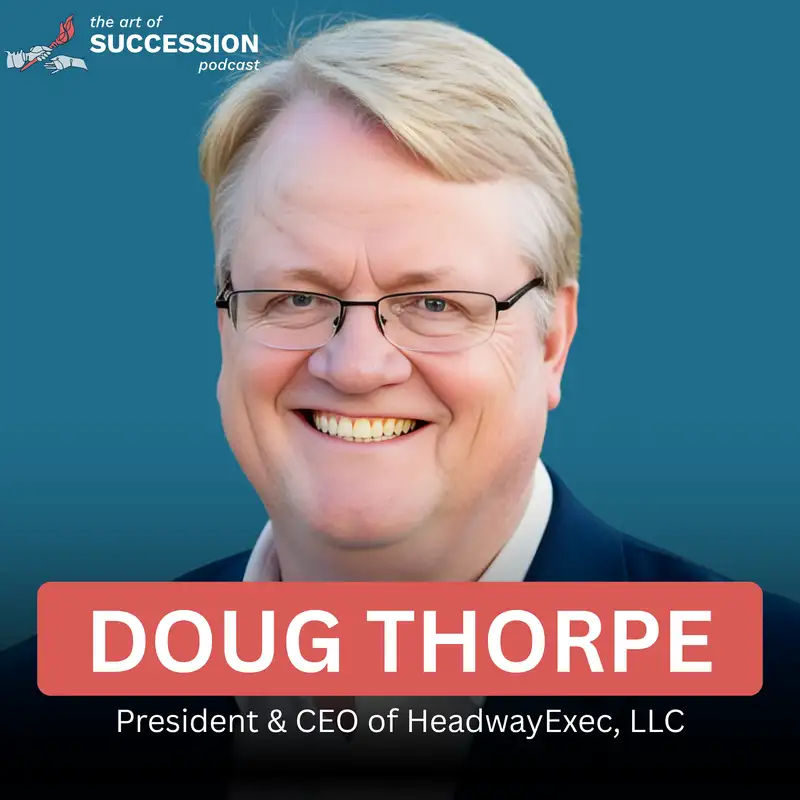
The Succession Strategies for Founders to Scale Businesses and Let Go of Control with Doug Thorpe
Host: Barrett (00:00):
If you're like most of our listeners, you love the idea of running the show, but you're constantly second guessing yourself if you're ready or the person for the job. Are you missing a key skill? Are you aware of the things you need to know like reading a financial statement or financing the operations of a business? We are here to solve that for you. Our new free ownership readiness diagnostic rank you from one to four on five foundational pillars of successful business ownership. It is the ultimate confidence builder that will tell you, yes, it is time to have that conversation or no, these are the areas that you might need a little bit more time to develop. If you're interested in taking that assessment, you can find the link for that down in the description below.
Ai Intro (00:39):
Welcome to the Art of Succession podcast with Barrett Young. Join us as we explore the strategies, stories and insights that shape the journey of leadership, transitions and business success. No matter where you find yourself along the journey, this is the podcast where you'll find the tools to make it happen.
Host: Barrett (00:54):
My name is Barrett Young and this is the Art of Succession podcast. My guest today is Doug Thorpe, business coach and five times entrepreneur. Doug has a background as an officer in the US Army and a career in corporate banking, and now he works with businesses in leadership development and succession planning. Doug, welcome to the Art of Succession podcast.
Guest: Dough (01:13):
Thanks, Barrett. It's a pleasure to be here.
Host: Barrett (01:16):
Thank you very much for being a guest. I want to start off with my initial question. I lead every episode with this. What brings you to the Art of Succession podcast today? What is the one thing that you want our audience to gain from this episode?
Guest: Dough (01:30):
Well, having a passion as an entrepreneur, I know the struggles it is to watch your great idea, take legs and grow, and there are some challenges every entrepreneur faces and that's what I'd really like to talk about today is how to successfully navigate each of the major milestones in your growth as an owner.
Host: Barrett (01:56):
Okay, very good. So let's talk about some of those milestones just briefly in your own history that's led you to where you are today. Do you want to give me a summary, a quick summary of your history? What brought you to this?
Guest: Dough (02:07):
There are several different ideas about the stages of a company development and company growth. The one that I tend to lock in on is the notion of startup grow up, scale up and enterprise, and I like to keep things simple. I've seen a seven part model, but I just use the four part. So in the startup phase, the owner founder is probably chief everything officer and is really touching, doing and being everything that business, even though they may already start adding some staff, but you're trying to get your baby idea birthed into this world and get it going, and as soon as you successfully do that, then you've got the grow up phase. Just like a young person goes through their primary years in school developing and figuring out the world around them, so does a small business. The market is going to start really informing you about what you're doing and whether it's catching traction or not, and the adjustments you might have to make along the way are very critical and important, and then when you finally start getting some momentum, you can move to that scale up phase and that's where hopefully if all things are going well, you start seeing the double digit increase year over year as your business continues to scale and expand and then ultimately you get to that enterprise phase and that's where you've really got the need for a robust infrastructure to keep the business going.
(03:53):
So I was first introduced to some of the rub and the conflict in an entrepreneur's mindset When I was in banking, I watched some businesses go through those four stages and some executed very well. They matured and grew through each phase and I had wild and wonderful success, but I also saw businesses that would flame out at each of those gates and it bothered me as a banker because you never want to have a failing business on your book of business if you're a banker, but it frustrated me. It's like how did this great idea, this great thing just crash into the mountain? And what I discovered was inevitably the common denominator was the owner, founder and their unwillingness to make some changes in pivots in the way they were looking at the business and in the grow up scale up phases, both a lot of times owners kept a grip on the business and so if you drew the org chart of the company, it was an hourglass with a tight pinch in the middle and that was the owner who wanted to touch everything, be a part of everything, still do most everything, and that's not a sustainable model and you're certainly not going to get the exponential scale that you might want.
Host: Barrett (05:23):
Yeah, it's kind of like that idea of what got you here won't get you there. The leader that you've been to this point is not the leader your company needs in this next phase. Are you willing to make those changes?
Guest: Dough (05:35):
And some of the most mature thinkers in that area even are the ones that go so far as to say, I think I need to hire A CEO. I'm not capable anymore of running this enterprise, so I'm going to reach out. It's more important to me as a founder investor to see this thing continue to grow, so I'm going to start bringing in the senior leadership that is necessary to allow that to happen. And it's kind of the idea a hundred percent of nothing is still nothing and 50% of something really large can be very meaningful.
Host: Barrett (06:17):
Okay. Share just a little bit about your own history. What led you to leave corporate banking after a career there and start your own entrepreneurial journey? Just a little bit of highlights
Guest: Dough (06:30):
For me, Barrett, we were touching on it in the green room as we were getting started here. I tell the story, I'm the only child of a hardworking single mom who actually quit her day job when I was still in elementary school to start a business and still being in fourth or fifth grade when that happened, I didn't really understand what it meant. I just knew mom was around the house a little bit more doing work as opposed to going into an office. But as I grew and got to look back on that, I realised the significance of it was both a responsibility, but it was also a kind of freedom that she generated for herself and that got me that fueled the entrepreneurial fire in me and even though I came out of college and went into the army and then went into commercial banking, I still had that fire burning after I quit or left the banking world and started a consulting business and I've been fundamentally independent, independent entrepreneur ever since.
Host: Barrett (07:42):
Okay. About what time did you make that transition? What year was that?
Guest: Dough (07:47):
Well, it was quite a while ago. I left the bank after 20 years and that was in 1998 and I've been an entrepreneur the whole time ever since.
Host: Barrett (07:58):
Was that what drove your mom the freedom or was it necessity or how do you equate your mom becoming an entrepreneur with your own shift out of commercial banking after 20 years to become an entrepreneur?
Guest: Dough (08:12):
I think in my mom's case and somewhat in my own, she had a passion for the work she really wanted to do and she was an interior designer and she was very gifted and skilled at it and she was doing it for a home builder, but inevitably the architects and even the home builder company owner himself would veto some of her ideas and there was a lot of that kind of pushback going on, which frustrated her because her name would end up getting stamped on a design and even though it wasn't the idea that she really had, and so she didn't like that, and so that's what fueled her desire to go independent so that she could be more free with her own design ideas. In my case, I did what many old bankers do. I started a consulting business serving my bank clients and that over many years turned into the coaching and advisory work I do now because what I was discovering was a lot of my business leaders that were consulting clients, they didn't really need the technical delivery part of what I was doing as much as they needed an independent set of eyes and ears to listen to what they had going on and they wanted to talk about their challenges and I guess I had a trusting phase for something, I don't know what it was, but I would go on these consulting engagements and I would get the invite to come into the office and shut the door and they just wanted to bear their soul about what they might've had going on either at the company or even in their personal lives.
(10:01):
And after many years of doing the consulting, I got tired of the travel that was involved with that and said, well, maybe this thing called coaching is a better solution for me, and I have ultimately had a desire to help people grow and be able to show up as their best self in whatever circumstance they're in. So that's what led me to the coaching part of it. And at the same time when I was looking at wanting to work with entrepreneurs, I realised my banking background had a big value for them because I could blend both and really optimise the opportunity for helping them solve problems specific to their business, but also directly involved in their own leadership development to run those companies.
Host: Barrett (10:52):
I gotcha. How do you draw the distinction between consulting and you said travel at the time and then coaching and then not needing to travel. How do you distinguish those two in your mind?
Guest: Dough (11:05):
In the consulting realm, it was inevitable. We were called upon to be on site with the companies and doing hands-on implementation of different things or project execution in the coaching and advisory world. And of course simultaneously the whole world has changed a little bit in regard to the willingness to be virtual. So the topics and issues we can cover in the coaching mode and advisory mode are conducive to virtual connection as opposed to having to be on site. Now, that's not to say I haven't gone on site in my acquisition part of my practise where I am supporting buyers who are acquiring companies. I do go onsite with them and we'll do leadership team meetings, we'll do workshops, we'll do various training, but the work leading up to that is all done virtually.
Host: Barrett (12:11):
I got you. Okay. So that shift has been more recent in the past eight, 10 years or so towards webcams, virtual meetings, things like that. You're able to do more of that from home, have a little bit of broader spread with the number of coaching clients you take versus I can handle three consulting clients one day a week kind of thing during that. Okay. So your shift towards consulting it sounds like was just a little bit, you wanted to touch on more areas than were within the realm of a commercial banker helping out a client, so they had other issues other than just the lending. And you said I could start to advise on that and I can start to get into that.
Guest: Dough (12:52):
Right.
Host: Barrett (12:54):
What was that shift like for you after 20 years? I mean, was it obvious? Was it just like a set retirement date or did it start to develop and you're like, I think I could give this a try? Did you build it on the side and then go full time? What did that look like for
Guest: Dough (13:07):
You? I did a little bit of building on the side. I was wrapping up an engagement. I was actually on the island of Puerto Rico doing an engagement and at night in my hotel room I was researching and doing my work on framing and shaping the coaching business and up to it and including standing up a website and exploring what I needed to do. I wanted to commit to go get training and certification as a coach. And I am certified by the International Coaching Federation and several other associations relative to coaching. I'm part of the McLean Institute at Harvard Medical School. They have an institute of coaching. I'm an affiliate there. I've done work with Franklin Covey, Lee Hecht Harrison, and some of the big global brands in the coaching and talent development space.
Host: Barrett (14:10):
Okay. How have you seen, other than virtual, how have you seen the demand or the need for small business coaching shift over the past 30
Guest: Dough (14:22):
Years? I think we've gone through a wave of, first it was a hard sell to be honest. People really weren't thinking about it at all. And in fact, when I was exploring the move for myself, there's a gentleman I value as a close friend and somewhat a mentor that I was talking to, and he told me, he said, you'll never be able to sell leadership. And I said, really? Why do you think that? And he said, in his humble opinion, only 5% of the CEOs in America, and that's broad scope, only 5% even talk about leadership. The other 95 don't think about it at all. I was a little bit of a contrarian on that point with him. I said, well, not I disagree with you. I think they'll be thinking about it. And to some degree, I think he was right. My early years purely putting out leadership development, leadership training really did feel like it was falling on deaf ears. But when I started talking about the advisory work to help your business transitions and your business growth and scale, then all of a sudden that started resonating and it was to be blunt, and I don't mind putting this on public airways, it's sell 'em what they want, but give them what they need.
Host: Barrett (15:57):
So early in that phase, it was more like, no, you need something tangible process improvement, something that they can actually measure an ROI on and they're not going to be interested in this soft skills thing. Do you think that that's a shift in you as a coach and they start to see the value in your expertise and experience in that, or do you think that it's also just been a cultural shift over the past 25, 30 years to those CEOs waking up and realising we need leadership too?
Guest: Dough (16:27):
I think it's a both, and I've definitely had to approach it differently for my own business, but I do think the market has shifted likewise. I think particularly one of the big things that is going on right now, there are a lot of individuals that are in their late thirties, early forties that have been in corporate America. They're tired of that game, they've accumulated a little liquidity, and now they're looking at the market to go out and buy cash flowing businesses. This whole phenomenon, universities are calling it entrepreneur through acquisition, and that is the space. I've done some work in the last couple of years, and so my point in saying that, so my client typically has come from a corporate environment, so they've got to be reprogrammed for that corporate think and reengaged at the entrepreneur level to realise what it's going to take to go in and transition and already running business.
Host: Barrett (17:37):
Yeah, I definitely want to get into the E two A space and your work there. I want to talk though still focusing on your shift to startup. What were some of the lessons that you learned that was like, oh wow, you're no longer in the commercial banking space. You're now killing, having to go out and hunt and kill what you eat kind of thing with clients and produce results for them. What were some of the surprises just as you had to develop your own skills, your own shift in mindset?
Guest: Dough (18:11):
Well, a couple of the big takeaway lessons are the obvious that a lot of people do end up talking about speaking as an entrepreneur. Number one, cash is king and you never have enough cash. You think you might, but you're not. And really mastering the art of cashflow management is a very significant milestone in being able to own and operate a business successfully because you run into the temptation of saying, oh, I got a big ticket paid, so now my bank account got bloated a little bit so you're feeling good and you may prematurely go out and commit to a new piece of equipment or another major capital expense when in fact you're going to need that cash over the next 30 to 45 days for other obligations. And if you're not keen on proper cash flow analysis and management, you're going to run into that cash bind. And you may even be sweating being able to make a payroll without leveraging something, and you can talk about it all day long, but until you're laying awake at night wondering how you're going to make payroll on Friday, you don't understand what it's like,
Host: Barrett (19:43):
Especially as you're stepping into a consulting business, which is very much like set time limit, project base, not recurring monthly revenue for the rest of time. That had to be a wake up call for you of like you said, cash is in the bank. I'm good for the next two or three months, but you need to start looking at what's the next project, start to develop that next proposal while you're still executing on the current one too. At the time, were you thinking in terms of scaling up, were you thinking in terms of growing up or how long did it take you to move from that startup phase to that grow up phase and was that always the intent?
Guest: Dough (20:25):
Well, one of my ventures actually was the creation of a service company, and it wasn't just consulting, it was actually a business process outsourcing model that was domestic outsourcing. In my banking days, I was heavily involved in real estate and mortgage finance. That was one of my verticals that I was involved in. And there was an opportunity to build a service platform to support other financial institutions and mortgage brokers that were originating loans. And the model that emerged was a back office outsourcing play because for a mortgage lender, the cost of running a back office is a sunk cost, and if your volume is seasonal, your volume is spiking and dropping over time, you're eating a lot of that cost. So by outsourcing that function, you can make it a true variable cost to your operation and improved your margin. So that was our value proposition, and I began building this company and at our high watermark, we had 35 employees. We were serving about 200 institutions nationwide, and then the wonderful crash of oh eight happened
Host: Barrett (22:03):
Bad time to be in the mortgage industry,
Guest: Dough (22:06):
Bad time to be in the mortgage business, and it was coincidental for us. We were in our fifth year of operation and fifth year by all stats is a pretty meaningful milestone for small business. Many small businesses don't make it to five years, but there we were, that 2008 was our fifth year anniversary and the market crash happened around us,
Host: Barrett (22:31):
The 35 employees. I mean, did you have other partners in this? Was it you as the CEO? What did that look like and how did you as the leadership team work through the crash?
Guest: Dough (22:44):
Well, first on, I did not have direct partners, but I did have four other investors with me. It was my wife and I had started the company and we had our money in it, and we had recruited four other investors to join us, and they were limited partners, if you will, and silent members of leadership. And when the crash of oh eight really started in August of 2007, specifically in the mortgage business, the mortgage market shut down and in August of oh seven and in a 45 day period August going into September, my lender companies lost cumulatively lost 75% of their volume, and that was a direct correlation to my business. So we lost 75% of our opportunity in that same period. In response to all that I got on the phone and I called the CEOs of all 200 client companies I had, and I asked them what they were seeing in the horizon, and it was bleak. It was not good. So I ended up, when I finished that round of calls, it took me several days obviously, but I called my four investors and I said, guys, we're done. I've got confirmation from my clients. This is not getting better. It's going to be a long trough that we're going to live in, and I can't write any more checks and I'm not going to ask you to write any more checks. I think we need to execute our wind down clause in our agreement and call it a day. And they agreed.
Host: Barrett (24:35):
Wow. Okay. So pretty much in the span of two months, you went from the full operation to fully closing the thing down. Based on 200 conversations with people in the weeds on this, how did you work through that personally as a leader, your own development and then come out on the other side and want to continue?
Guest: Dough (24:59):
Well, what happened for me, and to this day, my wife teases me about it. I said to her, she said, what are we going to do? And I said to her, well, I'm a smart guy. I've got a good resume and a background. I'll probably find something in another three to six months. And that didn't happen. Unemployment at that point, early oh eight was up in the high double digits in a lot of markets. My own market here in the Houston area was about 18% of its high point, and a lot of white collar jobs were affected that way. And I got involved with a faith-based ministry that was helping job seekers, and I started attending some of their workshops. But the problem was in the Houston geography, this particular organisation was 45 miles away from me one way, and that summer in oh eight gas was four and a half dollars a gallon, and if you're unemployed and gas is four and a half, you don't drive 90 miles round trip every week.
(26:11):
So I talked to the leadership at this organisation, I said, would you guys essentially franchise? I'd be interested in coming on board and running a branch of this out in my county because there'll be a lot of people in my geography that need this, but they too are not driving 45 miles to get it. And the organisation said, no, but Godspeed, do your own, do whatever you want to do. So my entrepreneurial juices kicked up again and I talked to four or five good friends, colleagues and supporters, and they funded the creation of a nonprofit that we started in my county, and we designed our own programme for coaching people about their job search function. And over the next three and a half years, we coached over 4,500 people through our programme.
Host: Barrett (27:15):
Wow. So you were one of these, you were the target market in this case, and you built your next job serving that target market. Then when unemployment is that high, I mean, how do you pivot? How do you determine leave it all behind, scrap the previous career and it's time to shift when so much identity, especially as a white collar professional, myself and a man and a Christian, all that kind of stuff, so much of who I am is wrapped up in the work that I do and the joy that it gives me. How do you work through that, just through that period?
Guest: Dough (27:59):
Well, it's interesting you bring that up. That was actually the first big revelation that I ran into operating this thing. And it didn't take me long to identify that that was the number one problem. Unemployment was not the problem. It was loss of identity. That was the problem. And we rapidly studied that and put a programme together. We created our own version of a six-step programme for job search success. It was an acronym that we used called Strive. And the first two steps had to do with reassessing your life, reconnecting with your own sense of personal purpose and direction before you even start writing a resume and going to the market. Because if you've truly lost your identity wound up in the job you had or the title you carried, you don't know what you're selling anymore. It's not sufficient to say, I want to keep being an engineer.
(29:13):
I want to keep being an accountant. You have to truly reconnect. And interestingly, as we guided people through that journey, we saw people doing one eighties in their career path. They dealt with the inevitable truth that the market put you out on the street. It was through no fault of your own that you lost your career there. Why not repurpose and redirect what you want to do for the rest of your life? And a lot of people took us up on that and totally reframed and retooled. We helped them with how to translate whatever their technical experience had been in their jobs into language that could fit for the transition. Not too different from what military veterans face when they leave the military and go into the civilian world. There has to be a lot of translation done to talk about skills you learned and abilities you've got. It has to be taken out of that military speak and put into more corporate language. But we did the same thing with other people in their career paths. We were very successful. We actually had a very high success rate of people landing new opportunities even in a bad market.
Host: Barrett (30:38):
So in the way that my identity is, I'm an accountant and I've forgotten what that actually means, like the tasks, the doing of being an accountant, I just am one. And when the market says we don't need accountants anymore, they're saying we don't need the things that accountants do, and I'm taking that as they don't need me anymore. But you're saying you've got to shift and say, no, you are still Barrett. You do accounting things, and if the market says We don't need accounting things, we need to shift what those accounting, how those accounting things translate over to what the market is still asking for and not take that as the market doesn't need accountants, the market doesn't need these things that you've always defined. This is what an accountant does. That's right. Yeah. Interesting. So you said three and a half years for that programme. What was it about 2011, 2012 that caused that to wrap up or brought your time there to an end?
Guest: Dough (31:40):
Well, the economy did recover and rebound and unemployment went back to normalised numbers. So our participation rates were really low at that point. And I feel bad saying this as a coach, but what we were starting to experience, the only people we were seeing is what you might call the chronically unemployed. We were seeing people that truthfully needed more counselling than they needed coaching, and they were carrying bitterness and frustration about having been laid off and they were two and three years without jobs. And so it was a whole different population that was coming in at that point, and that was beyond the scope of what we had organised. So again, we did an orderly winding down of it and just hung it up.
Host: Barrett (32:37):
All right. So at that time, is that when you started to shift towards leadership coaching and where you are today after that phase? Yeah,
Guest: Dough (32:46):
Personally, I really got connected with the coaching aspect of what we were doing in our nonprofit and really found my own sense of purpose and fulfilment in doing that work as opposed to the technical mortgage transaction banking kind of function. And yes, so that really put my journey into the coaching in high gear. I was still taking on some consulting assignments at that time to pay the bills, quite frankly, and I did have some great opportunities that came to me, but all the while I was knowing I really wanted to move into the coaching world permanently.
Host: Barrett (33:40):
Gotcha. What's that shift look like for you in practical terms of looking at a job and saying, no, that's more consulting versus how you market your coaching services, how you price your coaching services, the expectations that you build around that?
Guest: Dough (33:55):
I still offer a little bit of a hybrid in the advisory work I do now for on the E two A space and the small business owner, my ideal candidate is the owner that's operating at about 5 million a RRR up to about 50 million a rrr. And those size companies, they have some notion of a leadership team already established or needing to be established. And that's really where I can come in and I've got a couple of different programmes that address that, but it's more training, coaching and solicitation of team meetings, team development than it is consulting.
Host: Barrett (34:44):
Gotcha. Okay. When you say that you're working with an owner that's got five to 50 a rrr, but then also you're on the E to a space in there, are you helping that owner identify somebody within their leadership team to step into the role of future owner or are they two completely separate pathways? Two
Guest: Dough (35:06):
Separate pathways ultimately, but to your point there, for the owner that has that size business, there's inevitably an opportunity to talk about succession planning and whether that's generational succession or bringing on a partner or finding a future buyer, a lot of the work I do is helping those owners really be sure that their business is ready for sale if they're thinking about exiting. Because what I see is all too often the owner founder that's been at it 15, 20 years probably hasn't checked all the boxes on infrastructure documentation systems process that makes it a transferable asset, and they still have too much of their own fingerprint on everything going on. And so even though they may want to exit in order to optimise the value of that exit, there's some work that has to be done and it may be a 18 month or two year journey to make those changes so that you can optimise the value of that exit.
Host: Barrett (36:26):
Yeah, I see an interesting kind of dichotomy in this space of you've got these established businesses over here and you've got owners saying, I can't find anybody in my company that wants to step up and take the reins unless it's a familial succession. And many times even with familial, they're like, my son doesn't want to run the business, my daughter doesn't want to run the business. So you've got that side where they're like, I've got a money making machine that nobody wants to step up and lead. And then on the E to a side, you've got people who have no experience in the industries that they're looking at, they've got an MBA, they just want to buy a cash producing machine over on that side, and they want to step in, but they don't know anything about the industry. They wouldn't want to step in and be part of a five seven year succession plan. So it's kind of interesting, you've got these two camps and they both have very different purposes and very different pains, but what is it about your work with a five to $50 million company, the lack of the systems and everything that's there that you would start to help them find that buyer internally before saying, no, we just need to find an external buyer to come and buy this?
Guest: Dough (37:43):
Well, you raise a good point, and a lot of times it is a function of how much delegation and empowerment has the owner founder allowed for the leadership team that's in the company. And sadly, more often than not, they haven't allowed a lot of empowerment. They've found good followers to follow their recipe for success, but it's not the kind of person that's going to step up and take on leadership obligation and ownership. And that's a whole different mindset. So what I've seen is I've gone into these companies and on paper, yes, they have a leadership team air quote around that, but they are just solid doers and followers of what the owner dictated about practise and procedure. And the thing that has to happen to your question is the owner's got to take a different look at some of those people to say, do they really have the potential of stepping in and taking this over and are they wired mentally and emotionally for taking on the risk of ownership?
(39:07):
And that's the big wild card, and that's why the E two A candidate as a buyer is actually a better proposition for long-term success on that because they're standing up saying, no, I want to do this. I see this in my life journey. And okay, no, I don't know anything about running an HVAC company or a plumbing company, but what I encourage those buyers to do during due diligence is a heavy evaluation of the talent on the bench and try to really lean on the people that are going to be left behind in the transition and see what you can do to really leverage their willingness to move forward. And if you don't have that on the bench, if it's truly a team of nothing but technicians, no disrespect to those guys, but if that's all you've got, then that's probably not a good company for you to target.
Host: Barrett (40:14):
How much of your work on the seller side, how much of that is just also talking to employees to spark that idea? I mean, I see both sides. I don't have anybody in my business that wants to run the company, but then you also have employees that are like, I would be interested, but I have no idea how to start that conversation. Because you start to deal with sellers and they're like their own mortality, their own, what am I going to do next? Again, that identity side of it. And so you do have team members that were like, I didn't know it was an option, and then all of a sudden you tell us you're selling to a roll up or selling to PE because you never even asked. I didn't know how to start that conversation. So how much of your work do you do on that side talking to employees and people in the leadership team?
Guest: Dough (41:01):
I will talk to owners and ask them that question, have you talked to any of your people about this? Is there anybody at all that you've at least presented the possibility? And if they are truly one of your technical strengths and might be interested, what can you do over the next, again, I'll say 18 to 24 months to coach 'em up and bring them in and share more open kimono a little bit about what it does mean to run this business and see if they're truly interested.
Host: Barrett (41:41):
I mean, how do you start that conversation in baby steps so that they're not immediately terrified that you're asking me to buy into buy a $20 million company now I've never even considered it. How do you do that conversation over those 18 to 24 months without scaring 'em off initially, but
Guest: Dough (42:04):
Being
Host: Barrett (42:04):
Realistic about what's required of running a company?
Guest: Dough (42:07):
Yeah, a little bit of that is is just simply reading the room and getting a pulse on who the players are and having chats with them about what they see. And to that point, let me spend another light in here. What I have observed almost a hundred percent of the time when we've taken a buyer in from outside to take over and we start doing the development of the leadership team, when we bring those people in that have been at the company for a while and had good responsibility, they might be a field supervisor or some notion of a team leader and we start talking about the business, they've got pent up ideas that never got to see the light of day, but they know the business from the front line, the hands on, and they've got good suggestions for what small tweaks could make big differences in the margin on the business and the net return. So when a new owner gives them a chance to voice those things, all of a sudden there's a new level of energy in the company and the companies inevitably take a little bit of a bounce of productivity and profitability right after a purchase because those individuals are now given a voice and their one idea becomes a winner, and now they're excited and now they go back to the drawing board and they start thinking about other stuff.
Host: Barrett (43:46):
I like that it is, I am an outsider. I need that fresh perspective rather than where before with the previous owner, it's like, I've been doing this twice as long as you've been alive, you don't have new ideas or So they do get a little bit of ownership, a little bit of empowerment through the new external buyer coming in. I like that. That's interesting way to consider that. I want to shift over to the E two A, the buyer side just a little bit. When you are encountered with all the online content about this marketplace, buy boring businesses, buy cash flowing businesses, all this kind of stuff, how much emphasis do you place on proper alignment with the business and what your own interests are? Because there is so much emphasis, no, you just need to buy these businesses and let 'em run themselves and walk away from 'em rather than, no, you're going to step into this and you're going to run this business and you need to actually care about what it produces, what it does, and what you're going to be showing up to do for the next 15, 20 years. How much work do you do with a buyer on that side?
Guest: Dough (44:52):
A lot for the buyer that may approach me right out of the gate and say, I see this in my long-term future. What can you do for me? How can you help me? We start with an individual investor thesis and just like good P and VC firms do, they create a thesis over what they want to be about. And we go over questions like, what could you see yourself doing and what kind of businesses could fit in that envelope? And I tell a personal anecdotal story about this. I know that roofing companies can be good opportunities in terms of these E two A by opportunities, but I personally am not going to climb on a roof and I can't in good faith ask somebody. Now I have to hire roofers from time to time to work on my house. It's just a reality, but I don't want to have an ownership obligation in something like that. And so in my thesis, roofing companies would be off the table. I'm not going to take a roofing company, but any other home service company I think I could rationalise. And there are many more. There's 20 something other related service businesses that fit that bill, but in this personal investment thesis, it's that idea of pausing a minute and say, what do you believe in? What do you think you could see yourself doing? And if you had to go in every day and talk to somebody, what kind of people are you going to want to be talking to?
Host: Barrett (46:43):
I like that. That's good. Talk to me just a little bit about risk and expectations and how you prepare a buyer for that side.
Guest: Dough (46:54):
That is one observation that I've got about my last, I'll say three years in the E two A space. I have known some of these programmes that are out there where buyers are encouraged to pay nine, 10, $12,000 for a training programme on how to be an entrepreneur, but I haven't seen any of those programmes do a good job of asking the tough question, what is your risk tolerance? When you think about risk, and I'll go back to my example of making payroll on Friday, what if you didn't have enough cash on Monday and you know had to make payroll on Friday? What would you think about that? How would you feel? What do you see happening? And there aren't enough of those questions asked on the front end for these people signing up for a lot of these programmes and spending large dollars to get equipped to do it. I'm an advocate of trying to, and perhaps it's doing a personality assessment test or something like that, but those are tough questions that have to be asked, and I have seen individuals get all the way to the closing table and actually take the keys on a business and discover that they have a near zero risk tolerance and the first time their lead tech walks in and quits, there's a panic and it's not healthy and it would be a challenge for anybody, but if you have a zero risk tolerance, it's almost terminal.
Host: Barrett (48:46):
Yeah, I was actually thinking the opposite direction of they're over leveraged, they just only see the upside of these deals and everything, but you bring up a good point of they just have no readiness for risk or being uncomfortable either. That's the flip side of it. I'm thinking of you're going in and buying a business financing 98%, 95% of the business, but you've never been through a.com bubble or a housing crisis or COVID or anything like that. And to be prepared on that side as well of no, you need to make sure that you are willing to do what it takes to make payroll this week to see your team through well,
Guest: Dough (49:29):
And there's some other related intangibles that need to be questioned and challenged and things like I have seen situations, people coming out of the tech world, they've been coders and developers their whole life now they think they want to go own a business, but they hate talking to people, and that's a recipe for disaster.
Host: Barrett (49:53):
For some people, it's as scary as getting up on a roof. I'll go up on the roof, just don't make another person be up there that I have to talk to all day long. Yeah, no, I mean that's a good point. That's part of the alignment is you do realise what field you're getting into, what's required of the people in that field and what's going to be expected of an owner that
Guest: Dough (50:13):
Field, and that gets us back to that personal investment thesis. What can work for you? And again, no disrespect to the technology guys, it is just you got to be careful what you're going to go after. If you want to buy a fledgling tech company, great. It could be a good fit for you. You might speak the language and be a perfect fit, but you're probably not going to do okay in B2C environment with the homeowner screaming on the phone at you.
Host: Barrett (50:48):
We're coming up at the end of our time here. Doug, was there anything that I haven't asked yet that you wanted to touch on?
Guest: Dough (50:55):
No, I think we've done pretty well. Baird.
Host: Barrett (50:58):
Yeah. Can I ask, just because as a consultant, as a coach, we deal with this in public accounting as well. Do you have your own plans for succession or is your succession which you've invested into your clients up to this point? It's so easy when if you're a solopreneur, if you are a coach, you are a consultant. It's just like, no, this is my business and when I'm done, I'm done and close the doors. How have you thought about your own continuity, your own succession legacy?
Guest: Dough (51:31):
That's a great and very fair question, and I would tell you that in my case, I don't see a big succession handoff and turnover. They're in one segment of my business. I do have a team of other subject matter experts and coaches that I leverage on engagements depending on the scope that we're dealing with. But I think when it's good, Lord calls me out, it'll just be a shutdown.
Host: Barrett (52:06):
Okay. You have an approach, you have a method that you've developed over the past 30 years. Are you passing that along? Are you doing things to say this is like the Doug Thorpe method that somebody has learned
Guest: Dough (52:20):
Through
Host: Barrett (52:21):
Mentoring and things like that?
Guest: Dough (52:23):
If anything, I've shared it with my leadership development clients, my executives. I've showed them tools and methods that I've used, and in following up with them, I hear them talking about taking, carrying it on, and sharing it with their teams and their subordinates. So if that's happening, I'm happy about that and I call that a win.
Host: Barrett (52:49):
Okay. Very good. Well, I appreciate the time. We're going to jump into a lightning round if you're ready for that. I follow end every episode with my guests with a quick lightning round, so if you're ready to go, we'll go. Okay. Alright. Coffee or tea and how do you like it? Prepared?
Guest: Dough (53:06):
I'm a southern boy. Sweet tea. It's got to be ice cold and flavoured just right.
Host: Barrett (53:11):
Excellent. Love it. Pie or cake and do you have a favourite kind?
Guest: Dough (53:15):
Got to be cake and it's got to be chocolate.
Host: Barrett (53:18):
Okay. Chocolate cake and chocolate icing or,
Guest: Dough (53:20):
Yep, yep, yep.
Host: Barrett (53:22):
Okay. Do you have a favourite holiday and why?
Guest: Dough (53:26):
I think for me, Christmas is probably the main one. Again, going back to my young days, Christmas, my mom made Christmas incredibly special for us and it's always stuck with me and I tried to do the same, my wife and I, and we put on a pretty big celebration just for family. We don't do big outside parties, but we have a family day for Christmas. I've got five kids and seven grands, and we do have a full day of activities and there's games. There's games associated with getting to open gifts, there's scavenger hunts and all kinds of things that we typically do.
Host: Barrett (54:11):
Very nice. Love it. Are you more of a morning person or a night person, and do you have a favourite routine? Oh, nighttime. I'm
Guest: Dough (54:20):
After being in the military for many years, I swore I'd never get up before sunrise, and I've tried to live by that as best I can.
Host: Barrett (54:31):
What is it about nighttime that you love? Especially
Guest: Dough (54:35):
When things kind of calm down for the day? I find it is a great opportunity to think and ponder, and I'm a bit of a deep thinker and a curious nature about me, and I might do some of my reading or research in those nighttime hours.
Host: Barrett (54:54):
Awesome. Great. What's a common belief among entrepreneurs that you would want to challenge?
Guest: Dough (55:00):
I think we touched on it briefly, but I struggle sometimes to put it in words, but it's that pride of ownership that can bite you. And I would caution people that are entrepreneurs to be very careful. It's one thing to have a vision and a value that you want to promote, but you got to open the door. You got to be willing to propagate that and not hold it so tightly that you can't get others involved in the journey.
Host: Barrett (55:31):
Okay. That's great. What is one thing that you would want your successor to remember you for?
Guest: Dough (55:38):
I think mainly just a desire to see others operate in their best way possible, helping others be their best self.
Host: Barrett (55:51):
Gotcha. Great. Where are you finding creativity right now?
Guest: Dough (55:55):
I'm actually hooked on ai. I have been an advocate. I have enjoyed experimenting with it and challenging various prompts, and I've kind of gotten to a place different platforms I see doing different things for helping my own creativity, and so I'm trying to leverage that as much as possible, but really enjoying that part of the journey.
Host: Barrett (56:24):
Awesome. Myself as well. I might have to do a follow-up episode just to geek out on that together. What do you have coming up in the next year that's got you really excited?
Guest: Dough (56:35):
My wife and I have finally booked our crews to Alaska. That's been a bucket list thing for she and I and we're really looking forward to it. We just got that finalised actually this week as we're speaking. I know this show will go out later, but yeah, we're looking forward to that.
Host: Barrett (56:54):
Okay. Is that a wedding anniversary or just
Guest: Dough (56:57):
A trip? No, it was just a desired destination or experience really. It's not a single destination.
Host: Barrett (57:04):
Yep. That's one of the few places that are in common between my wife and myself as well. Awesome. Very good. I hope you enjoy that. I know you will. How can people find out more about you, Doug? And now where can I point them?
Guest: Dough (57:18):
Fastest way is my website and then that's simply doug thorpe.com and that's Thorpe with an E on the N-T-H-O-R-P e.com. And I'm on LinkedIn and all the social channels, and I have my own podcast as well over on YouTube and all of the main streaming channels, but the website's the fastest way.
Host: Barrett (57:41):
And we talked before the episode, you also have a cohort starting up in January in the new year?
Guest: Dough (57:45):
Correct. I run a mastermind. I call it my Headway Elite Group. It is for those mid-market small business owners. It is a peer-to-peer advisory that is blended with some opportunity for B2B networking. That's one aspect of our design that some groups disallow or discourage, but in our group, we certainly allow it. And we're part of a larger national group as well that has some periodic conferences and gatherings. So it's a great opportunity to grow business and work together with other leaders. Great. Well, I appreciate
Host: Barrett (58:24):
Your time, Doug. This has been a great episode, and I want to thank you for coming on the Art of Succession.
Guest: Dough (58:29):
You're very welcome, Barrett. I thoroughly enjoyed it. Thank you.