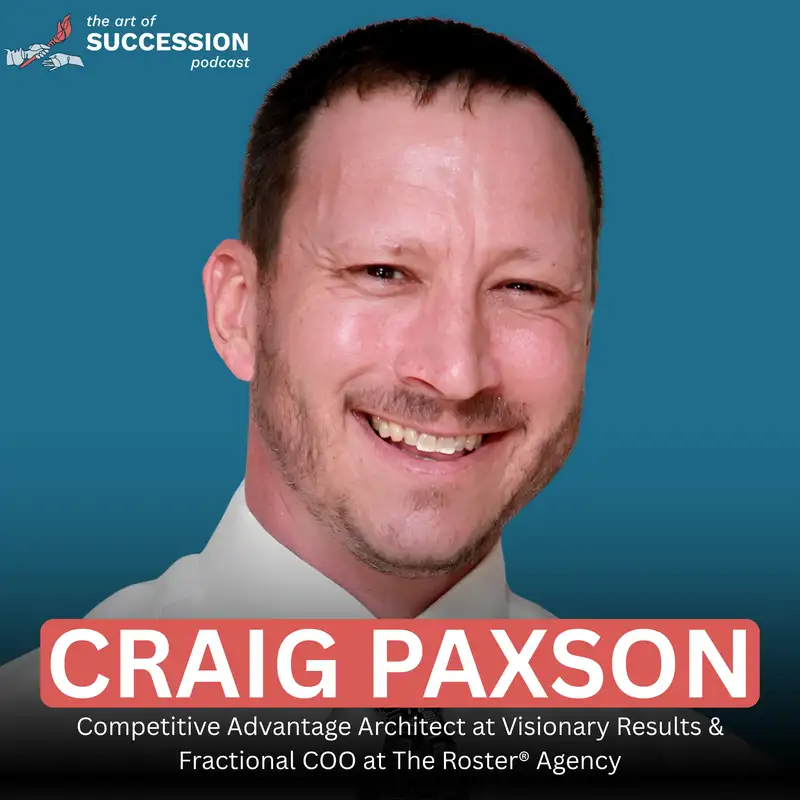
The Leadership Decisions That Saved a Failing Company During a Succession Crisis with Craig Paxson
00:00:00.040 — 00:00:14.440 · Speaker 1
The most important thing for a business is to create a competitive advantage and then build the business around it. The company was losing money the year before I was there. There was not a lot of pressure or priority put on making things run smoothly.
00:00:14.480 — 00:00:18.120 · Speaker 2
What is a common belief among entrepreneurs that you would want to challenge?
00:00:18.160 — 00:00:24.960 · Speaker 1
Hustle? Yes, working hard is important, but if you're hustling because you don't have a competitive advantage, that's the wrong kind of hustle.
00:00:26.000 — 00:00:40.920 · Speaker 3
Craig Paxon is a competitive advantage architect at Visionary Results and a fractional COO at the roster agency. He helps business owners uncover overlooked competitive advantages, build market driven strategies, and create sustainable growth without relying on price alone.
00:00:40.960 — 00:00:52.080 · Speaker 1
To me, strategy is this how do we win in the marketplace? Competitive advantage is not a marketing thing, it is a business. Everything stems off of that. The marketing stems off of that. The operation stems off of that.
00:00:52.120 — 00:00:57.760 · Speaker 2
How do you sell that to the rest of the team? How does that work its way down to the operations in the team?
00:00:57.800 — 00:01:03.360 · Speaker 1
The two tools that I use, one of them is my version of the value proposition, which is really these seven different questions.
00:01:05.040 — 00:01:45.080 · Speaker 2
As you've been listening to this guest, you're probably starting to ask your questions. How do I apply this to our own situation, our own succession story at the company that I'm working in now at GWC, we have built a custom GPT that you can find linked down in the description below on our website. We have loaded this GPT up with all of our knowledge about public accounting and tax preparation around succession planning.
We've also included the insights from the guests from the past two years of interviews at the start of succession. You can find all of that at the custom GPT use at any time of day. Start to apply it to your situation. Ask it the questions that are keeping you awake at night. I want to thank you for listening so far, and let's get back to the episode.
00:01:45.520 — 00:02:00.280 · Speaker 4
Welcome to the Art of succession podcast with Barrett Young. Join us as we explore the strategies, stories and insights that shape the journey of leadership, transitions and business success. No matter where you find yourself along the journey, this is the podcast where you'll find the tools to make it happen.
00:02:00.320 — 00:02:48.040 · Speaker 2
My name is Barrett Young and this is the Art of succession podcast. My guest today is Craig Paxon, a competitive advantage architect and the founder of Visionary Results. About ten years ago, Craig was asked as a consultant to step into the role of CEO of a private equity owned licensure company, where he helped turn around their income statement and then led them through a successful acquisition.
And today, he's built on that experience to coach companies on identifying their competitive advantage. Craig, welcome to the Art of succession. Thanks, Barrett. Glad to be here. The first question I always lead with, with my guests is like, what interests you about guesting on podcasts? What brings you to the art of succession?
Like, what's the number one thing that you hope our listeners would pick up from our conversation today? Yeah, I.
00:02:48.160 — 00:03:37.850 · Speaker 1
I love talking about the stuff that I'm interested in. I mean, so that is the number one reason that I want to be on a podcast like yours, right? And I love seeing the the small businesses, the owners that I work with really get it and make a transition in their business and in their life. So I think the most important thing for a business is to create a competitive advantage and then build the entire business around that competitive advantage.
And the most important thing for a business owner is to protect their time so they can create that competitive advantage and protect their time so they can build their business around it. And so I love talking with business owners about those two things. How do we create that competitive advantage and how do we make it so our businesses built on that advantage?
Yeah. Awesome.
00:03:37.890 — 00:04:06.130 · Speaker 2
I mean, I love this topic to just finding your niche, finding your niche, finding who you serve, the purpose you're in the marketplace for. You reference Seth Godin before we started recording, one of my absolute favorites, just knowing who your tribe is, who you're there to speak to because we offer average services for average people for average crisis is just not a successful value proposition for the for the majority of businesses.
So I'm looking forward to this conversation.
00:04:06.170 — 00:04:10.010 · Speaker 1
We offer average service for below average prices.
00:04:10.810 — 00:04:14.290 · Speaker 2
That typically ends up how it how it ends up.
00:04:14.290 — 00:04:15.130 · Speaker 1
So that's right.
00:04:15.170 — 00:04:31.650 · Speaker 2
Awesome. So let's let's get into just a little bit about your background. Like I mentioned in the intro, you were a consultant and then pulled into a CEO role where you already doing like competitive advantage coaching at the time, or talk to me just a little bit before that moment?
00:04:31.690 — 00:06:02.370 · Speaker 1
Yeah. No, I was not. I actually was doing some, some process improvement type stuff for that particular company going and trying to revamp their processes. A couple of their clients were not happy with the way things were going, and so I would run in to try to, to revamp the operations. Yeah. So, um, I was, you know, for, for many years I was in, in manufacturing, printing and health care.
I'm on the operations side. Right. So, um, one of the biggest print on demand, and really, the initial print on demand, uh, company was called Ingram Lightning Source. If you go to, uh, Ingram Spark, that is them. I basically started the manufacturing side of that of that organization when I work with IBM and then grew that company and then moved over into healthcare and ran an operation doing bill review, basically looking at bills that came in and making sure that they were priced appropriately according to the to the insurance contracts, etc. through a bunch of processes, improvements and outsourcing.
I took that organization for about 150 people down to 25. So, you know, at some point it was like, well, we don't really need Craig anymore. And I said, well, I think I can do what I did here with other companies. So I started doing consulting work in that area, really trying to improve processes and reduce costs.
And so I was doing that for a number of years before I became CEO of the company that asked me.
00:06:02.370 — 00:06:14.850 · Speaker 2
And how long were you with the company, the the private equity company that asked you to step into CEO? They saw something in you in that role, and I just wanted to like, get some setup for that. Huge responsibility.
00:06:14.890 — 00:06:55.580 · Speaker 1
It was literally a matter of months. The CEO was out on medical leave and was not going to return. The CFO was the acting CEO, and within a matter of months he was like, man, I don't really want to do the CEO thing. And it's not not what I like. How about if you do it? And I said, well, I can do that. 50 people, $8 million in revenue.
That's nothing. I you know, I had hundreds of people working for me before I had, you know, managed hundreds of millions of dollars in, in assets and income before. So, you know, I always thought, yeah, this would be easy, right? I can do that. So I interviewed with the, the PE firm, the board of directors, and they offer me the position and I took it.
00:06:55.580 — 00:07:12.860 · Speaker 2
And you were in there for the process improvement. Up to that point. How did you other than just needing somebody to step into that role? What was the PE company expecting from you that was different in your role as CEO? What did they see to, you know, to move you into that position?
00:07:12.900 — 00:10:32.260 · Speaker 1
Yeah. As one of the one of the principals of the firm said they needed somebody to come in and make the trains run on time. Right. So that's really that was our focus, right. The the company was was losing money, lost about a half $1 million. Um, uh, the year before I was there, you know, there was not a lot of pressure or priority put on making things run smoothly.
Right? I tell this example of, you know, the when I first stepped into the role, I learned that the prior CEO said overtime must be approved by me. Right. And so that was like the very first thing that I said, I'm not. How do I know if you need overtime or not. I don't know. I don't know the individual situation for, uh, how things are going.
Near departments. How far behind you are, uh, what your labor situation is like. How do I know? And so I started really delegating not tasks but outcomes to specific department managers. Right. And so basically, over the course of several months, we came up with I always say we was really me come up with.
Every department really had three metrics. Right. So one of them is the number of applications or people who went through the system. One of them was the turnaround time for for how fast those applications got through. We were contractually obligated to have a certain amount of turnaround time. And the other thing was their labor cost, right.
And it was the manager's individual responsibility to balance those three things, to make sure that that we could, you know, make money that we were having, that we were getting everything through. We weren't we weren't spending a bunch of money. And the turnaround time was such that the that we were meeting the contractual obligations.
Right. So, you know, at first, yeah, I developed a metric of number of applications per labor hour. Right. And so that became our guiding force because if, if by budget can make money, if we had to be, say, at 1.6 applications per labor hour, and we were currently at 3.2, which is where we started, doubled the number of labor hours per application, we need to drop that, right.
We need to figure out ways to make that better. So how do we improve that? How do we reduce the number of labor hours per application. And so over the next couple of years that was our focus. How do we do that. Because one that reduced the cost, but two, it also increased the turnaround time. Right. And made the turnaround time better.
I mean, you know what, Little's law, it's probably not familiar with it, but it's a thing that's manufacturing law. That is the relationship between throughput and turnaround time or cycle time and volume. So those three things together. And so I that was our focus for the next couple of years was on that.
And me really driving the the managers of each of the individual profit centers, each of the individual departments to manage those three things. So now they wanted to call for overtime. That's wonderful. That might decrease your cycle time, increase the amount of volume that you had putting through, but also can increase your cost.
Hey, you make the call, not me. You know your business better than I do. You make the call, right? So yeah, that's a long answer. Um, I guess to a short question, but that's kind of kind of like what was the focus, uh, when I first started? Yeah.
00:10:33.020 — 00:11:13.230 · Speaker 2
I mean, you did a pretty amazing turnaround. I think you said you went from that half million dollar loss the year before to $300,000 worth of profit. So about 10% improvement on the bottom line over a two year period. Uh, here, as you know, in this role. When you when you came in as a consultant, were you at the C-suite level for the consulting, were you like, in the in the departments where.
I guess what I'm trying to wrap my head around is a company that's losing a half million dollars a year. What how do they make budget to bring in a consultant to bring in process improvement?
00:11:13.270 — 00:11:13.830 · Speaker 1
Yeah.
00:11:13.830 — 00:11:19.910 · Speaker 2
Uh, consultant in the first place, because that's challenge. That's like. Right. We're already losing this much money.
00:11:19.950 — 00:11:21.190 · Speaker 1
We're right.
00:11:21.230 — 00:11:23.870 · Speaker 2
Yeah. How do you how do you convince them to make a move when.
00:11:23.870 — 00:11:24.750 · Speaker 1
When one.
00:11:24.750 — 00:11:25.150 · Speaker 2
Of your.
00:11:25.150 — 00:12:51.710 · Speaker 1
Largest clients, probably the second largest client, says you either approve what you're doing here or we're leaving, you find that you find money to bring somebody in. Like, so, you know, a $3 million a year client says they're leaving. And are you willing to spend $100,000 on a consultant to come in and fix it in order to save that $3 million?
Right. And that's really where it comes from. We've all been in that situation, right? The client says that we got. We got to figure out how to make it work. And they knew they didn't have the internal capacity, the internal, I don't want to say smart thought, not the right word, but that energy that, you know, sometimes you don't.
You need an external view. You need somebody to come to the outside. You can see things you can't see, bring a different perspective, a different methodology to that. Right. And so that's, you know, they figured it out, right. You know, half $1 million in loss is not the same as not having money in the bank.
Right. So I'm you know, there there was the cash there to pay me to do it. You know, one thing that I've learned about private equity as well is that, you know, a lot of private equity firms are willing to invest a little bit more. Yeah, they're going to take a little bit of they're going to take some ownership ownership for it.
Right. But if they need to invest a 50,000 to 100,000, $1 million into an organization in order to, you know, make that organization succeed, a lot of them are willing to do that, just might dilute the shares of the non private equity owners and that. But, you know, if that's what they got to do to make sure business succeeds, they'll do it.
00:12:51.750 — 00:13:26.310 · Speaker 2
Yeah. Yeah. They're a little bit more inclined to see an ROI on an investment like that where, unlike us, you know, closely held business where it's like, well, that's $100,000 that could be coming to my, you know, my bank account, my, you know, personal drawn out of the company. So. Okay. How did your relationship with the team change going from being a consultant to now you're the CEO?
I mean, did you meet any kind of resistance? There was everybody like, we know, we know the ship is sinking. We're glad we have somebody in this role that wants this job. What did that look like?
00:13:26.350 — 00:14:54.840 · Speaker 1
Yeah, I know, that's a great question. It was really positive. Um, one of the one of the the business segments I'll call owner managers was like, yeah, you're the right person for this job. And everybody else was was was positive, right? There was really nobody who said, what the heck is this guy doing here?
You know, over the previous six or so months, I had proven myself. I didn't think it was that long. You know, I had proven myself to them. I had gotten to know them on a personal basis as well as, you know, as well as from what I could do from a consulting standpoint, my knowledge of how business is run. They saw the value that I could bring to that.
You know, and I think for a lot of us, some of my heart for for teaching. Right. They saw that I wanted to help them improve. It was not just about me, about the business of proving right. It was about them. Improve them. And, you know, that's one of the things that I was most proud of when I left was the fact that the managers of these individual profit center departments became so incredibly good at doing their job.
Going from not being able to read a PNL to understanding all the drivers in their department of that PNL right. What drove their their costs? What drove their income? Right. And being able to to make changes on their own, knowing they were pulling the right levers. And, you know, that was the most exciting thing.
And I think that people could see that before I even stepped into the role.
00:14:54.880 — 00:15:03.960 · Speaker 2
Yeah. How did you how do you teach that? Because, you know, there's definitely a lot of resistance to that kind of change. Like, well, my job is to,
00:15:05.240 — 00:15:39.560 · Speaker 2
you know, only take this one aspect. Now you're giving them department level control over a PNL, over a profitability over their area. And I can imagine there's got to be resistance of somebody coming in and saying, why is it taking so long? You should just be doing it faster. You know, the initial result is, well, you have no idea how long it should take.
You haven't been doing this every year. So how do you come in and say, we need to cut this time in half and actually, like, get everybody on board with that and cut that waste. Cut that, you know, and do it smarter, not faster kind of thing like that or smarter, not harder.
00:15:39.600 — 00:16:41.280 · Speaker 1
There's two answers to the question. One of them is sort of the the hard answer. I don't mean hard like difficult. I mean hard like numbers. Right? And then when there's the sock, answer about the people. Right. So let's talk first about the hard numbers. Right. So it was very easy to demonstrate based on what von, that we expected to get very easy to demonstrate how profit what the profitability that we expected, how that translated into cost, how that then translated into the number of, of, you know, the labor cost, right.
Which was 90% of everything that we did was labor cost. Right. So, you know, if we knew we had to make this have this amount of profit, that's this amount of labor, that's this amount of of labor cost, we can translate that into hours per application, right. Hours per incident that would go into the through the factory.
And so, you know, that was that was the hard part of it was figuring that out. Right. The soft part was
00:16:42.600 — 00:19:20.569 · Speaker 1
Mentoring the people to under to really get to the point where they understood the relationship between all the different levers. Right? So once a month, what we did, we completely transformed our closing process so we could close within ten days. Right. So end of the we're closed within ten days. End of the month.
Um, so that means that the week after that, we had what I called our business review week. Right. And so every month I would sit down with the department owner, the CFO myself, um, the IT person, and we would have a conversation around that department. Right. How well they're doing. Um, there was a very I don't say strict format, but there was an agenda to it.
And there's very first couple of months. Well, we we did literally was teach the managers how to read a pan out what everything meant. Right. That was the very first thing we did. The CFO sat down and walked through what is a PNL. So they understood even if they'd have accounting classes in school, you know, they could really look at the piano for their department and understand every single line item, what it meant, where it came from.
Right. And that so that teaching of it was the start. They had to understand before they could actually do anything, make responses to it right. Over time, they gradually so, you know, they would get now this pnl before we had the review meetings so they could go through and they could try to figure out what was going on with the PNL.
Right. And I like to say over the course of time, it came from them not even knowing that there were questions to them, knowing that I would ask questions, and them having no idea what the answers were to them, knowing the questions that I would ask and not knowing the answers to them, knowing the questions I would ask, and knowing the answers to finally them asking the questions themselves.
Right. And they went through that transition over a period of, you know, a year or two years to where eventually we came down to where instead of it being an hour or two for every single department, every department was an hour combined that all the departments come into one meeting because they knew the answers.
They had already made adjustments. They had already decided what to do about different things. Right. So you know that ownership of seeing, understanding how to walk through the PNL, understanding the metrics that they had around turnaround time, understanding all of that stuff, having that ownership enabled them to now go in and
00:19:21.690 — 00:20:14.170 · Speaker 1
figure out, what am I, what do I want to change about this? Right. Over time, our metrics became a little bit more. I will say Carnivale is not the right word, but a little bit more inclusive. They could sing and say, hey, that wasn't on me. That was somebody else's department. I'm going to go and talk to talk to that person and say, hey, This $100 wasn't my expense.
It was your expense. We need to make sure it gets in the right thing. Right? So they started understanding that. They started looking at things like our call system was shared between all the departments. How do we allocate that cost out? So we know that it's Department A is getting a bunch of more phone calls and apartment B, how do we do that?
They would figure that out themselves. I didn't have to direct them in that. They just knew like that was an important cost lever. And they wanted to figure out how to make how to improve it themselves. So they did it. And, you know, that was the funnest part for me. I get so excited to talk about that stuff.
00:20:14.250 — 00:20:36.370 · Speaker 2
Yeah. Yeah. That's impressive. Was I mean, did you how did you motivate them in the shifting of their roles other than just like they understand it now and they're proud to report their results and everything like that. I mean did you do incentive structures. Did you, you know, pit departments against each other?
What are some warnings possibly you learned from that process also what not to do.
00:20:36.410 — 00:22:10.770 · Speaker 1
Yeah. And there was a quarterly bonus system. It was purely at the corporate level. It was not department versus department. It wasn't like department. A kid could make bonus and Department B couldn't. I mean, it was it was we're all or nothing with everybody. So there wasn't that element of competition except for competition versus what we were trying to achieve versus the budget versus the metrics that we were trying to achieve.
Right. We had certain metrics that were dictated by the budget or dictated by contract with the clients. And so making those was the competition. Right. And so a lot of it is just. Patrick Langone, another one of my favorite authors, right. He talks about in what he did call the three signs of a miserable job.
And then he changed the name to, um, The Truth About Employee Engagement. The first title, Patrick, was much better. But, you know, one of them was is not feeling like your job has a purpose. Right. And so the way that I think a lot of times we try to get around that is okay. You don't feel like your job has a purpose.
So what I'm going to do is I'm going to give you a monetary incentive instead of giving a purpose, etc., right? But if we could track back, you know, the reason that you're doing this job is not just so you can have money, right? In some cases it's like, hey, look, if we don't do our job, then this state isn't going to have nurses that are licensed to actually go to work in hospitals.
That's a pretty important thing to do, right? So we got to make sure that we're doing that on a timely basis. Right. So figuring out what that purpose is is the motivation. Not, you know, something monetary.
00:22:10.810 — 00:23:42.460 · Speaker 2
Yeah, I really like that because it is so easy to compare employees across each other, compare departments to each other and can cause some like negativity. Or, you know, you mentioned the reason I asked is you mentioned your managers like starting to go to other departments and say, well, no, this is your cost, this is your cost.
And unintentionally, leaders can do that. Sometimes you have two people start at the same time and like one takes off and the other one, you know, is a little bit lagging behind. And that can just breed, can ruin company culture, can breed like just the kind of it's me versus them rather than it's us versus, you know, the, the world kind of thing.
And especially coming in as a new CEO, not having worked in that company for years and years and years, that can be really difficult to get them on the same page and see that you're there for the for the sake of the ship. You're not put in place there by the PE to make sure they're doing what they're supposed to be doing.
Like you care about the organization, you want to see it succeed. So and I do want to shift towards like what you're doing now and everything. But I know also you mentioned in your intake form there was a huge event that came in shortly after you took over that these pivotal things, their crisis situations, they're also a make or break like prove the, you know, proof the purpose of the organization as well.
So do you want to you want to set that up and share what happened there?
00:23:42.500 — 00:28:25.190 · Speaker 1
Yeah. And before I do that, I you know, I think a lot of times the care of an organization is like the care of our teeth. Right? If all you do is go to the dentist and you never brush your teeth, your teeth are going to fall out. If all you do is go to is brush your teeth and you never go to the dentist, your teeth are going to fall out.
So tooth care requires daily habit brushing, flossing, and big events. Going to the dentist, right. And that's the that's the same thing with organizations. Either we we create a big event, a big thing, or that big thing happens to us. And how we prepare or respond or make that big thing is really important.
But it's not more important than the daily things that we do. And I'm like, right. So, uh, there was a hurricane that that devastated Puerto Rico about ten years ago, and that wiped out the vast like that was by far and most profitable client, one of our larger ones and by far the most profitable client. And so, you know, it supported a lot of the overhead, right?
So, you know, all of a sudden a bunch of your profit is gone. What do you do? You know, and so so we had to respond to that. Right. We we unfortunately had to lay people off. Right. There was nothing we could do about it. We had to cut overhead costs even though it was overhead costs were supporting every part of the business because, you know, a lot of our of our profit was gone.
The profit that was supporting that, those overhead costs. Right. And so how you go about and you know, I yeah, I can get into the details around exactly how many people and all that kind of stuff. But the most important thing is this is that people, everybody knew we had to do something right. People were in tune enough with with how big the client was that they knew we had to do something.
The important thing is how you do it, right? What was our response in taking care of the people that we had let go? What was our response in taking care of of vendors that we had to change relationships with? Right. And so that that compassion and care in doing something that had to be done that was painful, I think was as crucial in the turnaround and response to the hurricane as the actual doing of letting people go, of cutting expenses.
Right. And so that, I think, built our my credibility as much as anything built my trust. What the organization, as much as anything as they saw one. Craig is willing to make the hard decision. Craig is willing to do some hard things, but when he does his hard things, he doesn't in a way that is compassionate and caring and shows that it's more than just dollars and cents.
Right. And so, you know, I was in some ways fortunate. That's hard to say when you're talking about people's livelihoods and especially in a hurricane when people died and stuff like that. But, you know, there was I was fortunate that I had a big event that I could respond to that proved that I was actually a good CEO, right?
That I was willing to do those things. Yeah. I say that with again, I said, you know, with a bit of of distress because we are talking about livelihood and lives. People died in that hurricane and we don't have to have a natural disaster. We don't have to have that something that big in our organizations. We can create those big moments.
Right. We have a quarterly meeting, right? That's the going to the dentist part of of the tooth care, right? The care of the organization. Yet we have those big events. We have the quarterly meeting. We have, you know, something big that happens. The owner, the CEO stands up and talks to everybody. And you know, we do these big things and maybe everybody goes away motivated and stuff, right?
Or maybe they don't. If it was if it was a bad event. But the way that really works now is if the everyday things that we're doing the every day flossing and brushing of the cultural teeth, if we continue to do that stuff, those what happened in that big event now carries on. Right. And so if that big event is something externally imposed upon us, right?
A big customer leaves a natural disaster, you know? Right? Whatever it is. Right? If that big thing happens and we can respond to it, we can respond in a way that's consistent with all of those little things that we're doing every single day. That's when the culture really thrives. That's when people are saying, man, I love working there.
00:28:25.230 — 00:29:27.710 · Speaker 2
Yeah. No, I mean, it's a great point. I mean, nobody likes going to the dentist especially, you know, where it's a bad checkup and you got bad news and root canals and all that kind of stuff. But when you can prove to them, no, that was like we we are setting a new baseline for moving forward. And so we're every dentist visit is going to improve from this point forward.
It does. It proves the organization is able to survive. It proves the organization is able to come out on top of other companies that had not had those daily and monthly habits in place either. Right. I mean, everybody's got these things in their lives. It's like you look back on them, you're like, I am thankful.
It's kind of this, you know, perspective thing that you were talking about. You say it with, you know, I never want to have to go through that again. I would not wish that on my worst enemy kind of perspective like that. But I'm also at the same time thankful that I went through it because of what I learned and who it changed, how it changed me as a leader, as a person that's come out on the other side.
00:29:27.750 — 00:29:28.470 · Speaker 1
That's right.
00:29:28.590 — 00:30:25.510 · Speaker 2
Yeah. And that, you know, that takes maturity. And people again will hear that and they'll be like, you're insane. But once you've gone through that, you are required to be a, you know, to grow, to develop. And it is the testing. It's the hard things. You know, you go into the gym and you lift the same exact weight for five years.
Those muscles aren't doing anything. They're not being pushed. They're not being exercised. It's got to be progressively get harder and harder and harder for you to grow as a leader. So thanks for sharing that story. I guess. How long did it take after taking over a CEO, turning around the company, facing this large client, you know, crisis and everything like that, to then usher that company through an acquisition?
And what did that process look like? How did you guys shift the purpose of the company and how did you communicate it? Like, I know, imagine with PE, that's always kind of on the, you know, on the horizon. But talk, talk me through that process a little bit.
00:30:25.550 — 00:33:11.560 · Speaker 1
Yeah. Um, you know, and I think, you know, in my situation, because it's the firm was owned by by PE, right, by private equity. It's not like I was the owner who was now selling my business. Somebody else. Right. It was not my baby that I had raised since it was a, you know, a newborn, right. So it's a little bit different perspective than like selling the business for the first time, right?
Um, yeah. You know, the PE firm had bought several years before a kind of a, a semi sister company to my firm and was looking. Now, how can we combine my company, this other company, together. Right. How can we join the forces, get some kind of a synergy? Um, and I started doing some due diligence around. How do we make that happen?
Right. Um, they found another company that was more than twice the size of my company. That sort of fit that bill. If we put my company, this other company, and the our sort of sister company together, there might be some kind of a good synergy there, right? So they approached the ownership of that company, said, hey, how do we do this?
Right. And so I don't want to go too much out of school with what I am saying, um, for confidentiality stuff. Um, but over time, you know, it, it that process took about a year before the sale was finalized. Trying to think I'd say this. Yeah, there was financial stuff that happened. Right. Um, between between the PE firms, between the owners of the other companies, etc..
I learned a lot about about acquisition, about waterfalls and options and stuff that I didn't think I'd ever want to know, but I'm glad I do now. But, you know, that was the one thing. But I knew from conversations with with the PE firm that really my role and my company's role in this kind of combined organization was to be the operational make the trains run on time portion of the business.
So so the focus of my business didn't really change. It was still about making the trains run on time. And so that remained to be our focus. Right when I first started the CEO, before this merger thing was ever even on the table, I said, look, until we can make the trains run our time, until we can actually operate efficiently, there's no reason to scale.
We scale and just add more stuff here. We're just going to add more stuff to a failing organization, and we're just going to we're going to be worse. So first we got our fix internally what we're doing. Then we can scale. So we fixed it and the scale turned out to be you know this the merging with this other company, you know.
But my organization's focus was that making the trains runner time, making things efficient, making things timely, that would continue to be our focus even after the merger.
00:33:11.720 — 00:33:46.920 · Speaker 2
Gotcha. Okay. I presume it was the merger that led to your your exit and then being back out into consulting, you're brought in to your previous consulting agency when they're losing money. So many business owners think that they already have a competitive advantage of, you know, we provide, you know, top level service or we're really relationship based.
So how do you convince them what they think is their competitive advantage isn't necessarily their true competitive advantage? How do you how do you teach someone or show somebody that they're in need of your services?
00:33:46.960 — 00:33:58.000 · Speaker 1
They're running iOS and they think they have their three uniques. And I run a simple Google search of their competitors and substitutes and show that all their competitors.
00:33:58.000 — 00:33:58.360 · Speaker 2
Have.
00:33:58.360 — 00:34:13.760 · Speaker 1
Variations of that same thing. Right? They all say we have superior customer service where strategic. I met with a I met a guy a few weeks ago, the networking event, and I said, how come people pick your firm as opposed to others say, well, we're strategic. I don't even know what that means. But I said, if I went to an.
00:34:13.760 — 00:34:15.520 · Speaker 2
Ambiguous term, it's like.
00:34:15.560 — 00:35:26.730 · Speaker 1
Right, exactly. I mean, no, it's not, it's there's no. So I have a cloud script, to be honest. And I run that cloud script on, you know, the zip code there, NAICs code there, specialty couple of things and I can come back with their competitors and what their competitors say. You know from you know, Google and Yelp and Reddit and their all the websites and stuff and show that know you're no different than anybody else.
And so now I guess what you're doing you're competing on hustle owner connections and price. Right. And competing on price is the worst thing that we can do right. So or owner hustle owner is like, man, if I don't get out there and sell the I don't have a rainmaker out there pounding the pavement selling, you know.
And yeah, that's important. You people have to get to know who you are. But at the point where you look as same as everybody else, it always comes down to price. And that's that's not a point that anybody wants to be right. So now convincing somebody that they're not different than everybody else is one thing.
Convincing that they need to be is something else, right. You know, when one of one of my things is that I tell everybody, you know,
00:35:28.170 — 00:36:11.890 · Speaker 1
you can. We can find a place that is different than everybody else. We can find a place where your firm looks different than everybody else. Here's the question. Do you have the courage to be the only one doing it right? And if you look at all of the great companies, you know, whether they're new or old, every single one of them had the courage to take a contrary stand to do something different.
Right. And that's what made that company great. And so you have to have that competitive advantage. You have to have the courage to be the only one doing it in whatever aspect that it is. Right. So, you know, I. Go ahead Barry. Yeah. You guys follow up question.
00:36:11.890 — 00:36:52.370 · Speaker 2
So how do you convince that? I mean, I presume competitive advantage architect. This comes from Patrick Lynch's book about competitive advantage, but it can be terrifying to be the only one in your market, especially if you're not seeing it immediately pay off. You're having you know you're building something for 2 or 3 years.
The signals haven't been there. Other people are looking at you like you're crazy. They're cleaning up with all the business that you're saying no to. So, I mean, walk me through what this process looks like. Walk me through just what we're looking for to indicate we're on the right blue ocean. Right. Because you could you could choose the wrong blue ocean in that direction too.
So.
00:36:52.370 — 00:40:45.220 · Speaker 1
Right. Absolutely. Yep, yep. I always start with the market. Right. So for a lot of people when they do strategy, whether it's a coach or a consultant, especially a lot of of consultants, they start with what are your goals? Right. What do you want your business to look like in the next 5 or 10 years? Right.
That sounds wonderful. But is the market going to support that? And so, you know, I give this example, several years ago I met a company. They were they were running a very popular business operating system. They said, we're going to double our EBITDA. I said, that's awesome. Yeah, we're going to double the 20%.
Cool. So I went and I looked up in the database, best in class EBITDA for their industry was 14%. I said, so you're you're telling me you're going to be 50% better than the very best company in your industry? Well, how are you going to do that? What makes you. Oh, we didn't know that. You didn't go and look at the market first.
In order to do any kind of strategy, in order to to understand what you're trying to achieve, you have to grant it in the reality of what the market can support. So the very first thing that I do with my clients we're going through, through our strategy is we we they're I have a three by three grid. The the vertical axis is what I call the market read.
Is the market shrinking? Is it stable or is it growing? Right. We have to understand that now we can either do that just through to understand that we can do it through just a qualitative hey, how do you feel? Is the market growing, you know, shrinking or is stable? I do a bunch of research, you know, using things like Ibis world or things like that biz minor to figure out, you know, in their local market with their industry.
What does the is the market one of those streets. The other thing is the competitive reed. Right. How differentiated is the market already. Is it commoditized. Does everything look the same? Right. So basically a commoditized market you could think you know grocery stores right. It's very commoditized market.
Right. Is this an emerging market. Right. Is there a little bit of differentiation but not a lot. Or is it very differentiated. And so based on those two axes we now come up with with nine different cells. And everything that we do now depends on those cells. Right. So if we're let's say we're in a stable and a stable and emerging cell, I call that choose your ground.
That cell is choose your ground and the depth of your commitment towards being different. Determine survival. If you are not committed to being different, you're not going to survive because over time, competitors are going to enter. Substitutes are going to come in to the market. That is going to make this go from an emerging to a commoditized market.
And so you better be committed towards being doing something different. Right. And so we take those now those nine cells and those nine cells now drive whichever one we're in drives everything about creating that competitive advantage after that. And there is a series of steps now that we go through using using from what is in those nine cells to figure out where can we be different.
Right. Every cell has a little bit different. The steps are all basically the same. But the questions that we ask and each step might be different. Right. So now we're going to pull in a bunch of Michael Porter stuff. Now we're going to pull in some some Porter's Five forces, some Pestel analysis, different things like that to say, okay, what is the market say what are the forces in in the market?
What are the competitors doing that we can now capitalize on to make ourselves be different? And then we come up with that. What is that difference? And that now becomes the stake in the ground that everything that we do depends on that. What is different. Right. Why do customers choose us as opposed to choosing every available alternative or to.
And if they if you can't answer that question, nothing else matters.
00:40:45.260 — 00:41:22.260 · Speaker 2
This is more on the marketing, the the sales side, but how do you coming from a process improvement background that you've got now, how do you sell that to the rest of the team? How does that work its way down to the operations and the team to of. No, no, you used to deliver it this way. But now we've we've set that stake in the ground.
This is our competitive advantage. You can't just repeat the way that you were delivering this thing a year ago. You've got to shift it in this direction. How do you sell that to the organization so that they start to see, oh wow, we're different than we were pre this project?
00:41:22.300 — 00:41:48.300 · Speaker 1
Yeah. So you know one thing that that I want to back up on a little bit is that competitive advantage is not a marketing thing right. It is a business thing right. Sure. Everything stems off of that. The marketing stems off of that. The operation stems off of that. How how the company is financed stems off of that.
What the what the labor policies and compensation stems off of this competitive advantage. Right? Everything comes off of that.
00:41:48.660 — 00:41:51.500 · Speaker 2
Thanks for clarifying that. That that does help a little bit.
00:41:51.540 — 00:45:32.469 · Speaker 1
And so, you know, one of the things so kind of the two tools that he's one of them is my version of the value proposition, which is really these seven different questions. Who do we sell to. What do we sell them? What do we offer? How is it priced? Pricing is not just amount, it's amount, timing, duration or frequency.
Why do people need this? Why do people need this service. Right. So you can say why do people need a pickup truck? Okay. Why do people choose us? Why do people choose Ford versus Chevy versus Toyota? Right. So differentiation need differentiation and then trust. Why do people trust us. Right. And trust has two things.
Trust has a backwards component experience. Google reviews certifications right. Things like that. And it also has a forward looking component of brand promises. Right. So a brand a brand promise is a guarantee plus a penalty. Right. You're probably old enough to remember the old Domino's 30 minutes or spree, the best brand promise ever.
When I was in college, it was like you call up Domino's. If you didn't have your pizza in 30 minutes, you got it for free. Genius brand promise. So that is a brand promise, a guarantee plus a penalty. Once we have all that packaged that now goes to every single department sales, marketing, operations, finance, everything, the entire organization is permeated with this brand promise.
This is how we act. This is how this is. We know that if customers choose us because we always leave a clean work site, and competitors don't always do that, we always leave a clean work site. Okay, so now I know the boss isn't saying, hey, clean up just because he's the boss. He's a jerk. He's saying it because that's why people choose us and people choose us.
They can choose. We can charge higher prices. That's good for me. Good for my employment. Right? So we can we can tie this, this value proposition down to every single person. They understand why people choose us, drives what we do right. And that permeates the entire organization. So the way that we the way that I translate this now into what happens in the organization is through what I call the capabilities matrix.
Every single organization has four major functions. One of them is to sell create a paying customer. Right. So that could be sales and or marketing. But creating a paying customer The next one is to deliver delivered the product or the service to the paying customer. The third one is to collect the money owed to them, right?
Sell something in order to collect. Add a cash, right? A business right? Then the fourth one is to govern the organization and lead the organization. Hire people, train people, fire people, file taxes, make sure that all your, you know, your certifications and all that kind of stuff are up to date. Right.
And so so now we have these four vertical columns. There's horizontal rows in this matrix. One of them is what are the key activities that we need to do in order to to make the organization run. Right. So what are the key activities to sell to create a paying customer? What are the key activities to to deliver that service?
Where are the key activities to collect the money owed to us? Right. So we have these key activities. We have our tools and resources. You know, trucks, websites, uh, ATM machines or payment terminals or whatever it might be. We have our processes and our means. We have now our our people, our skills and people.
What are the skills of the people that we need to sell, deliver, collect and lead the organization? What are the organizational policies? Organizational policies are just strokes of the pen. You can just you can just change something. There's nobody telling you that you can't change something. Right.
So we're going to map the value proposition into this capabilities matrix. And I have a
00:45:33.510 — 00:47:41.880 · Speaker 1
really cool method to do this. It's probably way to go for this, uh, for this podcast in the video. But you know, what are the what are the activities? If we know that one reason that people pick us is because we return every phone call within an hour. Let's just make something up. Right? And we have a brand promise, Rob, that, you know, if we don't return your phone call in an hour, you get your service for free.
Let's just make something up. What are the processes, people, tools that we need to have to make sure that we are able to do that. Return a phone call within an hour. Right. What are the key processes to do that? What's the key process now around giving somebody something for free if we fail in that right. What is the metric that we're going to track to say?
Are we actually returning phone calls with within an hour? Right. How are we now going to use that? We return phone calls in an hour to sell that product to new, new clients. Right. So that that that differentiation mutates everything, right? It mutates how we hire. Right. If we there's there's, you know, there's a go to McDonald's, right?
They know there's going to be turnover. So they're all of their hiring processes are dictated around. Hire somebody quick. Get them up to speed. Train them really quick. It's very standardized process. There's another restaurant here in town where the waiters have been here in Nashville. If you ever come back to Nashville, you have to go Jimmy Kelly's.
The waiters have been there for 30, 40, 50 years. They don't have turnover, though, so their process of hiring and training and stuff is completely different than what McDonald's is. Right. And so the differentiation now permeates itself into how do we hire? What's our compensation look like? Is our compensation going to be geared towards, you know, low cost, high turnover?
Is our conversation going to be more geared towards, say, you know, a jewelry store that is 100% commission versus a jewelry store, that 0% commission that is completely different experience. That decision of how employees are compensated came from the value proposition, why people pick that jewelry store versus right.
So everything stems from what makes us different. I told you, I start getting excited and go on and on and on about this path.
00:47:42.680 — 00:47:54.720 · Speaker 2
Yeah, I mean, I love this conversation. It's fantastic. I have two follow ups. And then we do need to bring this to an end. The first one, I guess, is not just selling that to the team, but how do you now
00:47:55.960 — 00:49:00.080 · Speaker 2
sell that to the customers who have been there before? Because not everybody's going to be excited about your new value proposition. Some there's always going to be pushback and be like, well, I'd liked it the old way. How do. How do you work through that? And then the second one is like, how many people are involved in this process?
Because as a visionary of a company, you name, the name of your company has the word visionary. And it's very easy for me to get excited by something like this and have a one on one coaching session and then just change my mind a quarter from now. Um, so I guess that's probably the easier question is who's involved in this?
What does that process look like? Is it the leadership team from an iOS perspective? Is it the whole company is involved in phase one or they're involved in the execution and then yeah, selling it to your customers and yeah, changing their perspectives because that's that's the biggest reason why companies don't shift into blue oceans is because they don't want to, and they don't want to scare away or insult good money.
That's that's already coming in the door.
00:49:00.080 — 00:49:23.040 · Speaker 1
So take the first question first. Um, who's involved? That depends on the company. Right. So, you know, I have one client and it's basically just the owner who is now doing all of this, this work with. Right. What is the competitive advantage? He's the he's a small company, probably $4 million. And he's he's the only one that's necessary.
I have another client.
00:49:23.040 — 00:49:23.920 · Speaker 2
The size of a team for.
00:49:23.960 — 00:50:22.680 · Speaker 1
That. Yeah. So he's got no he's got 8 or 10 people who work for him. And, you know, I've got another client. Uh, they do about $80 million. And so there's eight, I think, now on the leadership team. So when we do our our week long strategy summit in September, they will be that entire team will be involved with this.
Right. So it's going it's very much depends on the company. Right. The team needs to be big enough to where there's negative and positive input, aside from mine and the owners right or the CEO right to cast to come into that conversation. And that's the that's what I tell a lot of. If you can't find it, if there's nobody in your company who can give you an alternative, a negative difference to what you're thinking.
We need to find that person. It ends up having to be me. Fine. I would prefer it not be me. So now I'm a facilitator, not a participant. But that's what we want to get to, right? Is that. Gotcha.
00:50:22.760 — 00:50:23.640 · Speaker 2
Makes sense.
00:50:23.680 — 00:53:03.970 · Speaker 1
Yeah. You know, how do we change? And what are the ramifications of that change? Right. So one of the there's one of the ramifications of doing it and the ramifications of not doing it. There are as many companies who have gone out of business because they refused to change, as there's companies who have gone out of business because they changed.
Right. It's, you know, I mean, on the, on the, on the one front is New Coke, right? I'm always remember New Coke, you know, new Coke flavor. They rolled it back. Now we got original Coke. I don't even know if you can buy New Coke anymore. Like, that was a long time ago, right? But you've got tons of of companies.
You refuse to change because they had so many costs, so much, so many things invested in the old way. And they just went to the they just went away. They went to the wayside. Right? I mean, basically AT&T although yeah, there's AT&T now but it's not really AT&T right. So one is this comes back to that courage question.
Do you have the courage to be the one doing it right. If you don't have the courage to do that eventually your business is going to go out. But go out of business, right? You're you're if you know the courage to be different, if you have the courage to change, eventually things are going to catch up to you. Your market is going to be commoditized, your market is going to start shrinking.
Somebody. You come in and do something different and steal all your market share. And so you have to have that, that conviction. Now there's a this the next part of that is okay, we want to go do something different. What's the transition look like right from where we are now to where we are different? Well again, that every every single transition is going to be a little bit different.
I rarely what I tell a client, okay, tomorrow we're different. It's not. It doesn't work like that, right? We have that transition plan from old to new. Has to take. Has to take time. Right. And so that's part of now what strategy planning is, is figuring out how do we transition everything that we do creating, paying customers, delivering our labor policies, our payment policies, collecting stuff.
You know, how do we transition all of that into a form that now meets our new competitive advantage? That process is strategy. That's what strategy is. Strategy is not well, I want to have a $10 million company in five years. And so therefore x no, that's not what strategy is. Strategy is our competitive advantage.
Looks like this. This is all the capabilities and stuff that we need to make that happen. How do we get from where we are now to having all those capabilities. And we're delivering that competitive competitive advantage. That is strategy.
00:53:04.010 — 00:53:48.490 · Speaker 2
I mean, now you just educated me, Craig. So, um, I'm. You can start billing me for this. Um. No kidding. Um, I have enjoyed this conversation. Like you, I love talking about something that interests me, and I did see it from the marketing side. That is where my mind goes to for competitive advantage, but I can.
I just appreciate how you share that. It goes down to every single person in that company. Like, this is why we're doing this. This is how the marketing connects to the professional. Delivering the service connects to that the PNL, the monthly close. So I really appreciate your perspective on that. Um, we do have to bring this to a close, unfortunately, before we jump into the lightning round and wrap up the episode, is there anything else that I have not asked or anything else you want to add?
00:53:48.530 — 00:54:32.530 · Speaker 1
Oh, just repeat my what I call my thesis statement. And I think this is the most important thing that of anything that we've talked about. The most important thing for a business is to create a competitive advantage and then build the business around it. That is the most important thing for any business.
So if I'm a business owner, I'm listening to this podcast. If I'm talking to somebody, a business owner, that is what I want. What is your competitive advantage? What makes you different? Why do people choose you as opposed to choosing the alternatives? The most important thing is to create that competitive advantage and then build the entire business around it.
Yeah. Awesome.
00:54:32.610 — 00:54:36.330 · Speaker 2
Well, thank you so much. All right. You ready for the lightning round, Craig?
00:54:36.370 — 00:54:37.370 · Speaker 1
Absolutely.
00:54:37.570 — 00:54:41.810 · Speaker 2
Okay, first question. Coffee or tea? And how do you like it prepared?
00:54:41.890 — 00:54:44.050 · Speaker 1
Uh. Soda pop. Okay.
00:54:44.250 — 00:54:47.490 · Speaker 2
Neither one. All right. Uh, what kind of soda do you drink?
00:54:47.730 — 00:54:54.050 · Speaker 1
Um. Uh, unfortunately, Mountain Dew code red is my. All right, Joyce? Yeah.
00:54:54.290 — 00:54:59.210 · Speaker 2
Nice. Okay. Pie or cake? And do you have a favorite kind?
00:54:59.370 — 00:55:03.980 · Speaker 1
I there's nothing better since I live in the South than a cherry hand pie.
00:55:05.020 — 00:55:05.420 · Speaker 1
Hmm.
00:55:05.500 — 00:55:09.380 · Speaker 2
All right. Awesome. Warm or cold? Or with ice cream? Have you?
00:55:09.500 — 00:55:31.020 · Speaker 1
Oh, no. Just room temperature, I mean. Yep. Just room temperature with some fresh tart cherries in it. Not super sweet. Tart cherries with the only sweetness comes from a little drizzle of icing. There's a there's a bakery in town that makes one just like that. Oh, yeah. They're so good. Yeah. My belly will tell you.
They're so good, too.
00:55:33.180 — 00:55:35.180 · Speaker 2
What's your favorite holiday and why?
00:55:35.220 — 00:56:03.500 · Speaker 1
So this is going to sound really funny. I like Arbor Day. Why Arbor day? Arbor day is the anti New Year's resolution day. Most people have quit their New Year's resolution by Arbor Day. So I always come back with, okay, what are my Arbor Day resolutions? Because this is the time when it's really new and starting.
I've gotten over the holiday malaise, the hangover, everybody asking what? Your New Year's resolution. Arbor day, we can figure out what we can do for the rest of the year.
00:56:03.540 — 00:56:07.060 · Speaker 2
Nice. I mean, I'm I'm ashamed to admit it, but I have to ask, when is Arbor Day?
00:56:07.100 — 00:56:07.580 · Speaker 1
Yeah.
00:56:08.100 — 00:56:09.700 · Speaker 5
It's in February.
00:56:10.140 — 00:56:24.700 · Speaker 2
Okay, so shortly after New Year's, I'm, like, trying to wrack my brain. I know planting trees would make sense more in the spring, but no, it's February. Okay, great. Awesome. Are you a morning person or a night person? And do you have a favorite routine?
00:56:24.740 — 00:56:55.860 · Speaker 1
I am a complete morning person. If I get if I get up and it's 5:00 already, that's late for me. I get up. I actually do drink coffee, so I drink my coffee with a little bit of half and a half, but I drink my cup of coffee and I play the New York Times crossword puzzle in the morning to sort of get my brain going. Sometimes my brain gets fried because it's very difficult.
Um, and then, you know, I'm at my desk sitting here by five, 530, and I'm working at that point in time. And when we're done with this conversation, I'll be done for the day.
00:56:55.940 — 00:57:04.060 · Speaker 2
Done for the day. Nice. Awesome. Love it. What is a common belief among entrepreneurs that you would want to challenge? Hustle.
00:57:04.780 — 00:57:19.860 · Speaker 1
Everybody thinks you have to hustle. And yes, working hard is important. But if you're hustling because you don't have a competitive advantage, that's the wrong kind of hustle. Hustle with your competitive advantage, not in spite of your competitive advantage.
00:57:19.940 — 00:57:31.660 · Speaker 2
Excellent. Thank you. I always love to hear somebody counter that that common belief. So I appreciate it. What is one thing that you would want your successor to remember you for, Craig.
00:57:31.700 — 00:57:50.460 · Speaker 1
So and I will say this in the past tense of the company that I, that I left is the one thing that I was most proud of, and the one thing that I, that I know that they appreciated me for was that I left behind a a thriving organization with people who actually cared to be employed there.
00:57:50.500 — 00:57:55.020 · Speaker 2
Love it. Awesome. Um, and where are you finding creativity right now?
00:57:55.100 — 00:58:14.659 · Speaker 1
You know, I've been I've been on this, this output kick. So I have this, this concept that I don't know, I stole from somebody many, many years ago, and now I can't remember where it came from about sort of creative input versus creative output. Right. If all you do is take creative input and you never actually do any output, then
00:58:15.700 — 00:58:46.780 · Speaker 1
it's no good if all you're doing is output and you never have any input, it's no good. And lately I have been not reading really anything but the news. You know, watching sports. I that's that's been my inputs lately because I've been so focused on my outputs of, of writing my books, the couple of books that I'm writing right now and doing this kind of stuff that my creativity comes from outputting stuff that I've been thinking about for a long time and refining that, making it better.
Awesome.
00:58:46.820 — 00:58:56.140 · Speaker 2
Well, I mean, this is your chance, Craig. So what do you have coming up in the next year that's got you really excited? And then we'll lead into, you know, just where people can find you.
00:58:56.150 — 01:00:07.310 · Speaker 1
So, man, there's there's so much I have. You know, I've written one book. It's up there on the shelf behind me. I have a second book that is, uh, will be on Amazon shortly about about competitive advantage and strategy. It's called a strategy is the menu. A lot of people quote Peter Drucker's quote culture each strategy for breakfast.
And I say yes, but strategy is the menu. And so that will be on Amazon soon. So I'm excited about that. And uh, um, the other thing is that I've got I've got a book that people can buy, which leads kind of into the CTA. Um, and my if you go to my website, there's a, there's a place to buy the book. This book is called Visionary Velocity.
And it's really about the three different phases for any, any entrepreneur of how do we create that competitive advantage and how do I take that down into what am I doing this week? Right. That's what we all the time get stuck. It's like our week goes by and we look back and we're like, did we ever see anybody get anything done?
Yeah, we were super busy, but did we actually get anything done? Right. And so my, you know, I've tried it in my book to break down into okay, what what what am I doing this week that's going to help me with my competitive advantage and where I want to go with the business.
01:00:07.390 — 01:00:11.710 · Speaker 2
Yeah. Awesome, I love that. Anywhere else, anywhere else, people can go and find you.
01:00:11.750 — 01:00:43.150 · Speaker 1
Craig, um, I am on LinkedIn, pretty active on LinkedIn, so go to LinkedIn or find me. Craig Paxton yeah, but if you if you really want to talk, just hit me up on on the on the website. Be glad to have have conversation with anybody. There's a form to book a call if you just if you want to if you want to talk for 15 minutes just about anything.
I'm always happy to do that. I'm a mentor with the Natural Entrepreneur Center, so I talk with entrepreneurs all the time without charging them a penny, and I love doing it. So if anybody wants to contact me and just say, hey, let's talk and just I want to talk with.
01:00:43.150 — 01:00:49.470 · Speaker 2
You, that's awesome, I appreciate it, and I thank you for giving me your time here on the Art of succession podcast. Greg, thank you so much.