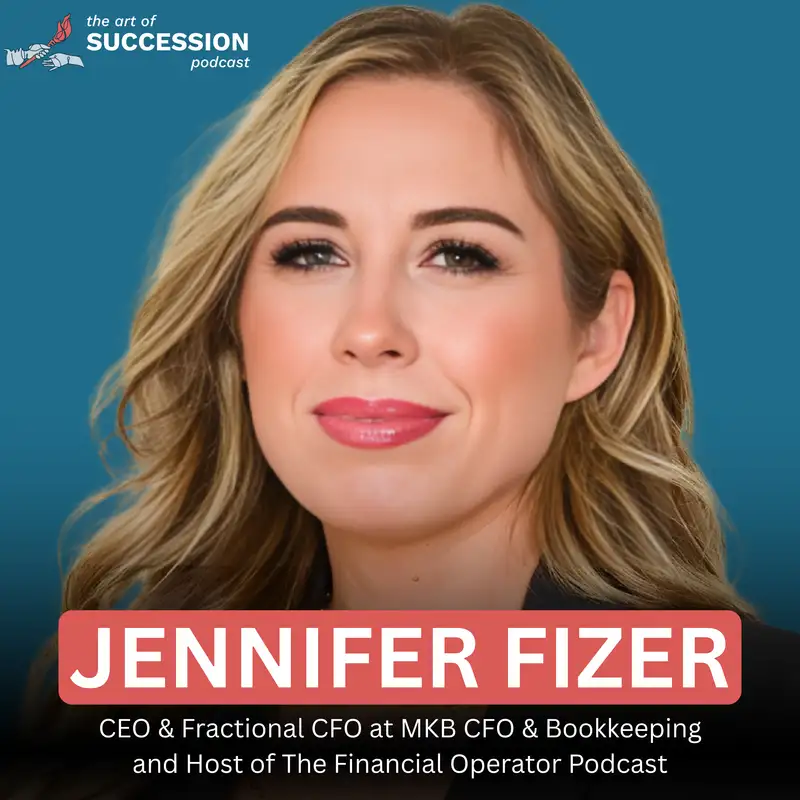
Succession Strategies for First-Time Business Buyers to Exit Profitably with Jennifer Fizer
00:00:00.040 — 00:00:11.840 · Speaker 1
Every business I've ever done has been an acquisition. I have never started a business from scratch. Sometimes it's worth spending the money on a business that's actually profitable and can pay you from the beginning.
00:00:12.480 — 00:00:29.160 · Speaker 2
Today's guest is Jennifer Pfizer, CEO and fractional CFO at MKB, CFO and bookkeeping, and host of the Financial Operator Podcast. She shares how business owners can gain financial clarity, improve cash flow, and use smarter systems to scale with confidence.
00:00:30.520 — 00:00:53.560 · Speaker 1
There are days when I feel incredibly stupid, but I think there's like the humble side of that to where you are going to get smacked in the face sometimes and you're like, no, I don't know anything. I don't know why anybody trust me. It's an emotional roller coaster. It's so easy to do and let yourself get into that cycle of, oh, what else can go wrong?
But you just have to, like, cut it short. Today is a new day.
00:00:53.600 — 00:01:02.240 · Speaker 3
Do you have any warnings or caveats to that? What could you share moving from service based businesses into a retail location like that.
00:01:02.280 — 00:01:06.640 · Speaker 1
My thought process now is very different. Um.
00:01:09.000 — 00:01:49.040 · Speaker 4
As you've been listening to this guest, you're probably starting to ask your questions. How do I apply this to our own situation, our own succession story at the company that I'm working in now at GWC. We have built a custom GPT that you can find linked down in the description below on our website. We have loaded this GPT up with all of our knowledge about public accounting and tax preparation around succession planning.
We've also included the insights from the guests from the past two years of interviews at the Art of succession. You can find all of that at the custom GPT use at any time of day. Start to apply it to your situation. Ask it the questions that are keeping you awake at night. I want to thank you for listening so far and let's get back to the episode.
00:01:49.520 — 00:02:04.360 · Speaker 5
Welcome to the Art of succession podcast with Barrett Young. Join us as we explore the strategies, stories and insights that shape the journey of leadership transitions and business success, no matter where you find yourself along the journey, this is the podcast where you'll find the tools to make it happen.
00:02:04.400 — 00:02:26.200 · Speaker 3
My name is Barry Young and this is the Art of succession podcast. My guest today is Jen Fiser, CEO of MKB, an outsourced CFO company working with service based and blue collar trades. Gen has bought and sold a couple businesses over her career, purchasing MKB from her former employer last year. And today we're going to hear about that journey.
Jen, welcome to the Art of succession.
00:02:26.200 — 00:02:27.640 · Speaker 1
Thank you. Thank you for having me.
00:02:27.680 — 00:02:34.680 · Speaker 3
Sure. I'm looking forward to the conversation. I always love talking shop with a fellow financial professionals, so this is going to get nerdy.
00:02:35.240 — 00:02:35.680 · Speaker 1
I love.
00:02:35.680 — 00:02:48.120 · Speaker 3
It. First question I've got for you is like, what is it about sharing your journey? What is it that brings you to the art of succession today? Like, what's one thing you would want our listeners to go away with from your own experience?
00:02:48.160 — 00:03:37.510 · Speaker 1
If I look back at my longish career, like my trajectory into entrepreneurship started a long time ago, and mostly it started right out of college and I had. I graduated in 2008, so right into the recession. So I had some, you know, pretty terrible jobs that did not pay very well for the first couple of years of my career.
And during that time, I was just this is like such a weird one of those, like, I don't know, coincidences, kind of. I just started a job, I was training with this guy and he was like, oh, I listen to Dave Ramsey every day. And so we were in a vehicle all day. So for the first, you know, like three days that I worked there, we listened to Dave Ramsey for three days, a.
00:03:38.230 — 00:03:40.230 · Speaker 3
Three hours daily podcast.
00:03:40.270 — 00:03:41.070 · Speaker 1
And so.
00:03:41.110 — 00:03:42.030 · Speaker 3
Radio show.
00:03:42.430 — 00:04:59.590 · Speaker 1
I say that because prior to that, I would have never thought I would own a business like I had no interest in. It was not something that I thought I would ever want to do. It was like not even on my radar. And as you may or may not know, Dave Berger talks a lot about entrepreneurship and about how that's a good way to increase your income.
And since I was making no money, I was like, well, I definitely want to do that. So it kind of like started these these wheels turning about owning a business. The problem was, I didn't think that I had the skills to start like a service based business, and I didn't have any money to buy or start a business. So it started.
I was like, I felt stuck. I was like, I don't know what's going to happen. Like, how am I ever going to have a business when I don't have any of those things? So all of that to say, there is hope for anybody that's out there and is in a similar position where it's like owning a business. Sounds like something you would love to do, but you don't know what kind of business or how you're even going to do that.
Because I would have never predicted the like trajectory that my life has taken. But it's really like all of the things have lined up perfectly to be where I'm at today, obviously. So.
00:04:59.630 — 00:05:09.230 · Speaker 3
Gotcha. Okay, great. It sounds like. Also, correct me if I'm wrong, but you didn't go to school to get into accounting either. And this first job wasn't a finance job.
00:05:09.230 — 00:06:08.710 · Speaker 1
Not originally. No. I had a degree in ag business, which was a very fun degree to get. Like, we got to, you know, all my classes were at the farm, got to hang out with the farm animals all day. So it was like learning at school was a lot of fun. But I apparently didn't put much thought into what that would mean for my life after college and what kind of jobs that would result in.
So my first job, I was a assistant manager at a tractor Supply, so working retail like 60 hours a week for like ten bucks an hour. I mean, it was like something ridiculous the next job or I was a utility arborist. So we went along the power lines and decided which trees needed to be trimmed. So yeah, again, no money.
And that one was like a terrible job. You think, oh, you're going to be outside all day. That sounds fun. But then you're outside all day and it's not very fun because you're. That means all weather, you're walking all weathers.
00:06:08.830 — 00:06:09.910 · Speaker 3
Most of it's in a car.
00:06:09.950 — 00:06:16.270 · Speaker 1
So I have poison ivy and tick bites. Nine months out of the year, it was. Yeah. God awful.
00:06:16.310 — 00:06:31.710 · Speaker 3
I mean, I bring that up just because. Also your journey, it sounds like, is it's an eventual moving in a in a direction to find, you know, where you ultimately end up to. So that can be encouraging. It's not always somebody who's like, I've worked in accounting firm for 25 years, and then I became an owner.
00:06:31.830 — 00:07:09.380 · Speaker 1
And this is where I'll say, kids, if you're listening, listen to your parents because they may or may not know what they're talking about. If I had listened to my mom to start with, I probably would have gotten here a little bit faster because she always thought she was like, you should major in accounting.
Like, I think your personality fits accounting and you make good money. You're always working inside. And these were the alarms. Like, mom, you don't know what you're talking. You don't know what I want. And turns out she was right. So while I was a utility arborist, I went back, took accounting classes, got that degree, and kind of reset my life trajectory there.
00:07:09.420 — 00:07:17.100 · Speaker 3
While thinking about I want to be a business owner someday. Is that that that was starting to become the driving motivation for the career change?
00:07:17.140 — 00:07:26.100 · Speaker 1
Yeah. I was like, well, this isn't working and it's not leading me towards anything. That's really a skill, right? Like, I'm what am I going to do? People don't need me to come identify their trees. Really?
00:07:26.140 — 00:07:30.700 · Speaker 3
Do you have the opportunity to own a business in something like that, or is that working for a utility?
00:07:30.700 — 00:08:00.620 · Speaker 1
Or so I that was really just working for the utility. I could have potentially maybe like owned a tree trimming service or something like that. But I also wasn't the one doing the tree. I was just creating the work orders for the tree crews. So like the actual trimming of the trees, I had no background in that either.
So it was kind of this like useless skill. Other than when we're driving down the road, I can name every tree that's on the side of the road. So yeah, I like to keep my skills sharp there.
00:08:00.660 — 00:08:05.060 · Speaker 3
What was after that then? So you go back to school, get the degree. Did you start? I mean, I know.
00:08:05.220 — 00:09:57.580 · Speaker 1
I got a job at a farm, and this is really where I thought I had, like, my dream job situation because I was working in a farm, which you remember the ag business degree. So this played into that. But I was working. I started off as like a finance or finance department. It was just a, you know, smaller farm. So I was doing all of their accounting.
I eventually became the CFO. I worked there for about seven years. I would say just kind of like gaining all the skills. We went through a lot of things, a lot of financial issues, a bankruptcy. So there was lots of experience that I got under my belt. That has helped me a lot. It was terrible to go through at the time, but it's helped me a lot as far as being able to help clients in tough financial situations and knowing what you can do, what you can get away with, what you can't as far as like, you know, vendors and payments and things like that and cash flow.
So that was seven years of that. And then while I was working there. So that was like 2014 to 20 through 2020. But in the meantime there I finally got my chance to buy a business. And so I bought my first one while I was still employed with the farm, and that was a coffee shop. Bought it for basically no money, which should have been a red flag.
Uh, but but I knew it was a failing coffee shop. I knew that it needed some help, but when I looked at it, I was like, they want basically no money. And I can see like five easy ways to fix. Right off the bat, things that are happening. So I bought that. And then I at the time still obviously had a W-2 job. So I was earning an income, which was helpful because then I could focus all of that money that it takes to get a business turned around on that business.
I wasn't having to pull a salary from it.
00:09:57.580 — 00:09:59.740 · Speaker 3
And you weren't working in it on a regular basis?
00:09:59.900 — 00:10:39.500 · Speaker 1
Nope. I stopped by every morning to on my way to work just to check in. I hired my mother in law. She was my manager for the first couple of years, and they had a really great staff, and I am so thankful for the staff that they had because they really, I knew nothing about coffee, honestly. And this is where I'm like, you can buy any business I have gotten.
So I'm sorry I no longer have those same beliefs that I need, like money or expertise in anything because I'm like, I can figure it out. But I knew nothing about coffee. It was a coffee shop and restaurant, so they had a full kitchen, full coffee shop. And so like, I literally.
00:10:39.540 — 00:10:41.820 · Speaker 3
Never dealt with inventory or anything.
00:10:41.860 — 00:10:47.860 · Speaker 1
I like dove into the deep end on this one because that that I was like, you know what? It's in my price range. So,
00:10:49.260 — 00:11:26.100 · Speaker 1
So I, I bought that. Um, and like I said, I owned it for five years. I actually I bought a second location. During that time, I ended up closing that one. It wasn't just. It just was not what I. The first one was full. It was a beautiful building, like on the square in our small town. That full coffee shop and restaurant.
The second one I bought was a drive through and I was like, I hate that it was an hour away. It was like, I make a lot of mistakes, apparently. So learn from my mistakes. I will tell anybody what I've done wrong. Um, but that one was also in my price range of basically free. So I was like, I'll give it a shot.
00:11:26.140 — 00:11:29.580 · Speaker 3
That was another acquisition from another. Another existing one.
00:11:29.780 — 00:11:36.460 · Speaker 1
Yeah. So every business I've ever done has been an acquisition. I have never started a business from scratch.
00:11:36.500 — 00:11:46.380 · Speaker 3
What time frame was the acquisition? Because you said there was some overlap there with the W2, and that obviously went up to 2020 and Covid. So how long had you had the coffee shop.
00:11:46.420 — 00:12:11.890 · Speaker 1
Bought the first one in October of 2019, which was terrible timing, but it was during that during Covid is when I really started that transition of I was still working as a CFO for the farm, but I kind of pulled out of that. I was like, I'm not going to come into the office anymore. I'm going to focus on like work in the coffee, like not work for the coffee shop, but be there, warm.
00:12:11.930 — 00:12:13.530 · Speaker 3
Corner table kind of thing.
00:12:13.570 — 00:13:30.689 · Speaker 1
And so that was kind of what pulled me out of that job and really got me focused on running the coffee shop more full time, I'll say. And then my husband actually passed away November of 2020. So I had I'm sorry. Yeah, that it's a little caveat to my story here where I'm like, that obviously changed everything about my life and what was going on.
So at that time, I focused completely on the coffee shop for about a year. That was, I mean, I should say, focused. I was really kind of just like I was in a lucky position that I was working for myself because I don't know if I had, like, had a corporate job at that time that I really would have been able to function very well.
Grief and things like that. As far as like being able to deal. So for about a year, ran the coffee shop pretty much on my own. And then let's see, January of 2022 is when I bought the first or the second coffee shop. So that second location and I literally kept that one open just one year. So for one closed it on December 31st of that year.
So during that year I had the two locations and both of them were actually doing pretty well. It was just the
00:13:31.810 — 00:13:50.330 · Speaker 1
time and effort in having that second location was not worth it to me. Like I said, they were an hour apart. They were two totally different styles of coffee shops, and so it wasn't really. The second one wasn't as much fun as what I'm going to say.
00:13:50.370 — 00:13:56.490 · Speaker 3
Were you at the second one at all and having an operator at the first one, or were you trusting an operator that came?
00:13:56.530 — 00:15:13.730 · Speaker 1
Oh, the second one. So thankfully it was in a college town and three of the employee, when I bought it, three of the my former employees from the first location were going to school in that college town. So I immediately hired them and they there. It was a very small just drive through one person working at any given time.
So I just kind of appointed one of them as a manager. That helped me do, you know, kind of those inventory and different things like that. But it was not a big enough location to need me there regularly. It was just kind of a, you know, small little joint and it wasn't in a great location and it just didn't have that same feeling.
I don't, I don't. The only way that I can describe that is like the first location was so cool and like, such a genuinely fun place to be. And the second one was just like, yeah, it was just everybody. Like, you don't get to talk to the customers. You don't see them. They just drive up, get their coffee and leave.
Yeah, it was just a totally different feeling. So rather than I just cut ties with that one. Um, like I said, I paid pretty much nothing for it as well. So I just kind of moved all of the equipment back that I wanted back to the first location.
00:15:13.770 — 00:15:15.330 · Speaker 3
Did you close that one then? You didn't.
00:15:15.370 — 00:15:43.210 · Speaker 1
I didn't sell it. I kind of wanted to use some of the stuff that was there. Like I pulled the espresso machine to have as a backup. Yeah, there wasn't really anything that was worthy of selling. I didn't own the building, so it was a very easy shutdown. I didn't lose any money, didn't gain any money. You know, it was just kind of a, like, gonna close these doors and move on.
But. Yeah. So that was 20. That would have been December 2022, I believe.
00:15:43.250 — 00:16:16.970 · Speaker 3
I'm going to jump in here with a question. Just because you said you have a belief that you could step into any business and learn how to run it. Do you have any warnings or caveats to that? Or I mean, I know you learned lessons, but I mean, with what you've been through for that, especially that first year as an owner.
Mixing that in with what did I buy? And, you know, what are the lessons I learned because of the situation versus the lessons, because of the type of work? What could you share moving from service based businesses into a retail location like that?
00:16:16.970 — 00:18:01.640 · Speaker 1
So one of the things that and I purely made these first two purchases because of the price point, right. Like we're going to get a business for basically nothing. I can afford that. So my thought process now is very different. I would not be looking for a deal in the same way. Right. Like, yeah, sometimes it's worth spending the money on a business that's actually profitable and can pay you from the beginning.
But if that's not the route that you want to go, and if you do want to buy like something that's either just breaking even or is losing some money, one have some money stashed away so that you can pull from that too. It's going to take you way longer to turn around than you think it will be, because you never know when a Covid is going to happen again.
Like just as we were kind of starting to like turn the tides with that first location, those first couple of months Covid hit. And that was, you know, then I'm pushed back on that by another six months. So, I mean, my thought process on when I could get it to be profitable got moved back significantly. Again, if you're going to buy a business that is honestly, this is probably good advice for a business just in general.
If you're going to buy a business and you can't think of any ways that you can improve it from the outside, like within the first 90 days, you may not be the right person to be running that business so that either marketing operationally, making efficiency changes, being able to take over some position that's being there.
Those are all the things that I kind of look at now, as far as if I were to buy this business that I foresee for sale, how can I increase the value of it pretty quickly?
00:18:01.720 — 00:18:32.640 · Speaker 3
Yeah. Because otherwise you're just buying your job. Buying a job. Right? And that's why, I mean, we work with businesses in the transition. And I'm like, don't be afraid. Even if it's an internal transition to your kids, don't be afraid of a high valuation on the business, because that means they're not just buying a job that they need to step into with 70 or 80 hours a week.
The value comes from the ability to generate cash without you being the the center hub of the entire thing. So it's a good point. Deals are not always deals. You're either going to pay with time or you're going to pay with money.
00:18:32.760 — 00:18:34.480 · Speaker 1
Right. There's a reason they're a deal.
00:18:35.600 — 00:18:51.520 · Speaker 3
Yeah. Yeah. Um, what was one of the things that maybe from the outside going into it, you're like, oh, they're clearly not doing this right. I'm just going to step in and do this. And then you found out that that innovation or that change didn't work. Any lessons like that?
00:18:51.560 — 00:19:14.240 · Speaker 1
I mean, honestly, with those two purchase, those two first purchases, most of the changes that I made worked out pretty quickly. And just to give you an idea. So for one, they were doing no, they were they had like social media and stuff like that, but they were posting like once every couple of weeks. So I was like immediately were posting every.
00:19:14.280 — 00:19:16.000 · Speaker 3
Day, not driving foot traffic.
00:19:16.040 — 00:20:46.550 · Speaker 1
Exactly. This next one was something that I was so thankful for when Covid hit, because they didn't have any online ordering setup, so you couldn't order through an app or a website or anything you had to like, physically walk in. So that was like week one. I started app ordering, which, like I said, saved us a few months later when that was the only option that people had because I didn't have to go through the process of like getting it up and running.
It was already there. It was a lot of like younger kids that were working there, which was great. I didn't have any problem with that, but they were. There was no management that was really present for the majority of the day. And so like I mentioned earlier, I had my mother in law go, and she was, you know, she'd never run a coffee shop either.
But she was an adult and she had customers, you know, she knew how to handle customers and at least keep people on task. And so that was, you know, suddenly things were more efficient. People weren't waiting a long time for their food or their drinks. So those were probably the first 3 or 4 things that I did right off the bat to really just kind of jumpstart things.
And those all worked out really well. Like I mentioned, there were definitely things though, that like over the course of time I would try out and I would they did not work out like everybody always told me. They wanted us to be open later, so we would be open later. And we tried that for like six months and nobody ever came.
So I was like, you don't always listen to your customers. They are not always right. They don't know what's best.
00:20:46.590 — 00:21:00.750 · Speaker 3
Yeah, that's a good point. Um, you know that it might be best for one customer, but not justify, you know, the extra hours, the utilities, the pay, everything because they don't represent the entire customer base.
00:21:00.790 — 00:21:02.030 · Speaker 1
Oh for sure. Yeah.
00:21:02.030 — 00:21:08.750 · Speaker 3
So so what caused you to look to move on? Uh, is there anything I'm missing here? That.
00:21:08.790 — 00:22:47.270 · Speaker 1
So I always have lots of. I have lots of overlap in all of my stories. I feel like. So then in in April 2022, still on the coffee shop. Right. But it wasn't really like coffee shops, even when they're profitable, do not make that much money. Like, not something that's generally able to sustain somebody. And at this point, as we know, I was now responsible completely for my own income.
I had to be able to pay all of my household bills. So I got a job, and that job was working for a fractional CFO firm. They're based out of New York. They worked with nonprofits. I wasn't working as a fractional CFO, but I was on the internal side. So I was helping do sales recruiting for new CFOs and senior accountants and controllers, just operationally making the business grow, and which was a really great precursor to what I'm currently doing.
So I basically learned all of the ins and outs of how to run a CFO business internally for somebody else. And so I started I was there 2022 until just this past July, June or July. But we grew that company while I was there from like 3 million to 10 million, and they sold to private equity during that time too.
So got to be part of that transition and several other mergers and acquisitions that they did as part of that before I eventually left. So I sold the car. Here's where it's got my timeline. Gets really kind of wonky here for a second. So I was working at that company.
00:22:47.310 — 00:22:51.470 · Speaker 3
You started there in 22, which is also the year you had both coffee shops?
00:22:51.510 — 00:22:52.150 · Speaker 1
Yes.
00:22:52.230 — 00:22:53.270 · Speaker 3
Yeah. Okay.
00:22:54.190 — 00:23:31.790 · Speaker 1
I, I really like to load my plate up pretty, pretty high. Um, so I had two coffee shops and started there, closed the one at the end of 2022. And then in July of 2024, I sold the other coffee to the first original coffee shop. And that was really just a kind of on a whim. A random Facebook post is what prompted the sale because I was working on a Saturday.
The men's bathroom toilet got clogged, so I spent my entire Saturday in the men's bathroom trying to unclog a toilet. And, uh.
00:23:31.990 — 00:23:35.510 · Speaker 3
Operator means operator actually exactly.
00:23:35.550 — 00:23:49.550 · Speaker 1
And I, you know, jokingly posted on Facebook. Like, if anybody ever wanted to buy Brickhouse today's day to make me an offer. And I got I got offers. So I was like, well, I'm going to take them up on this.
00:23:49.870 — 00:23:52.990 · Speaker 3
So wow. Personal Facebook or on the company page?
00:23:52.990 — 00:23:54.710 · Speaker 1
It was on my personal Facebook. Yeah.
00:23:54.750 — 00:23:55.270 · Speaker 3
Okay.
00:23:55.310 — 00:25:51.740 · Speaker 1
Wow. Um, so that was, you know, what started as a joke turned into a reality pretty quickly. And I think at that, like, prior to post, I mean, obviously, if you're going to post that, like, there's always some truth behind it, right? Like, I'd kind of been thinking that I was ready to get out of the coffee shop and restaurant business.
Like I said, you just no matter how much you're doing in sales, it's not like you're making a ton of profit. It's a lot of work. I'd given up all of my Saturdays for five years and, you know, countless other hours and things like that. So I was just kind of in that point where I was ready to just move on. So the sale came at a great time.
As soon as I sold that though, I was like, oh, I'm gonna have so much free time. And then I reached out to my friend Mills, who owned a fractional CFO business, and I said, you know, if you have any clients that you like, if she knew she was wanting to grow, we'd been friends for a while. And so I was like, if you have any clients that you you know, if you want to continue to grow, send me some clients.
I'll just do that on the side from my other job and we'll go from there. And she really took my advice very seriously. And before I know it, she was sending me more clients. Like I was basically working two full time jobs, dealing with all of that, which I was going to keep doing. I had no plans to really stop.
But then in March of 2025, she asked me if I wanted to buy the business. And that's really kind of when the rest of it kind of fell into place. I had no expectation that she was going to sell me the business I like wasn't even a thought in my mind. I just kind of thought I would continue just doing 1099 work for her and taking on some clients.
But we started that transition and I officially took over June 1st, and then I quit my job, that I was still working, um, June 30th. So I had like a 30 day overlap there.
00:25:51.860 — 00:25:52.300 · Speaker 3
Wow.
00:25:52.340 — 00:25:56.420 · Speaker 1
And since then I have taken on no other jobs or businesses.
00:25:56.420 — 00:25:58.660 · Speaker 3
So that's just the one.
00:25:59.820 — 00:26:24.100 · Speaker 3
Gotcha. Before we jump into buying MKB and that conversation and everything, what can you tell us about being on the seller side of the coffee shop? Like, any tips for that side? Um, what it's like being going through that process as the seller versus a buyer. I know that the buy wasn't a big deal. It was, like you said, barely above free.
But what can you tell us on the seller perspective that you learned?
00:26:24.140 — 00:26:27.260 · Speaker 1
Yeah, the seller is, uh, like I was I was not selling it.
00:26:27.260 — 00:26:29.140 · Speaker 3
For, especially with multiple offers.
00:26:29.220 — 00:27:19.860 · Speaker 1
So, so so what I really tried to do was, like you said, I had multiple offers or at least multiple people that were interested in it. So I like it was something that I'd put my kind of heart and soul into for a couple of years. Has anybody does with a business like, it's really hard to own a business and not feel attached to it, but I kind of try to separate myself.
And it's funny because the person that ended up buying it, the she almost like she was kind of insulted, like, I don't mean this in like she personally was insulting, but she was constantly telling me all the things that I was doing wrong and like what she would want to change. Sure. Which as a seller you're like, what do you mean?
Like, no, I've built this like like it's great. But I looked at it like, I that's what it needs, right? Like, that's what the business needs is somebody that's looking at it objectively and being like, how can I make this better?
00:27:19.860 — 00:27:22.020 · Speaker 3
You said the same yourself earlier here, right?
00:27:22.060 — 00:28:19.580 · Speaker 1
Exactly like I had to take that emotion out of it. Of, like it's a personal attack to, you know, I'm giving this business to them and it's going to be theirs like they. After I'm done, I signed those papers. I get that check like I'm no longer involved. I have no impact on it. I can't keep my fingers in it. So like I did kind of a I mean, I stuck around if she had questions and stuff like that, but I really tried to separate myself from it completely and just say, you know, I'm not I'm not going to be checking every post.
I'm not going to be like, oh, what are sales doing right now? Like, it doesn't matter once you're once you're gone. So that was the biggest probably help for both sides of it right. Like once it's somebody else's business too. Like they want it, it's theirs. And they want to be able to do what they want, what they want to do to it without like, feeling like they have somebody watching over their shoulder.
00:28:19.580 — 00:28:51.820 · Speaker 3
So I mean that that's a good point. Was she doing it as a trying to get the price to come down or any kind of negotiation tactic, or was it just more because there is some part of that. People try to downplay it or say, that's not worth what you say it is. So I'm going to offer you less. But it sounds like like I said, you shared that earlier in the interview.
You should take that as a sign of encouragement, right? Like they're excited about all the all the possibilities. You don't want somebody to buy it who's bored with the idea of running your baby and moving forward. Right.
00:28:51.860 — 00:29:45.340 · Speaker 1
So yeah. And when I, I mean, she definitely showed excitement too. It wasn't just constant negatives. And I honestly up front and I'm just a very upfront person. So I'm not going to like lie to somebody or try to like hide things from somebody to make a deal go through. So I was telling her to I'm like, if you wanted to be more profitable, I would do these things like these five things.
Like, I wasn't if I wanted to be more profitable or make more money myself, I should have been working in the business and she was going to do that. So I was like, you know, the manager that I had, she wasn't going to stay anyway. I was like, replace that manager and you were automatically making X amount of dollars per year.
And I gave her like probably a punch list of like five different things that I knew myself. I was like, these are things that I am not doing for the profit of the business for one reason or another. Either time, money, you know, having to kind.
00:29:45.340 — 00:29:45.500 · Speaker 3
Of.
00:29:45.940 — 00:30:32.930 · Speaker 1
Exactly. Um, but somebody that needs that's in a position where that's their job. Like those are easy pickings, right? So I kind of started that conversation with here. Here are the things that you can do right off the bat to make these changes. So she did take that. And then she kind of just ran with other things as well.
Which more power to her. She did, you know, a lot in a very short amount of time, which is really remarkable. But I would say on the seller side too, I was also just ready to be done. Like, it was amazing to me how once I knew that I was selling, how willing I was, just like, you know, I don't care. This isn't my problem anymore.
Um, so even though I was, like, deeply connected to it, it was also really easy to step away.
00:30:32.970 — 00:30:36.970 · Speaker 3
How long did that process take? From the joking post? Yes to.
00:30:37.010 — 00:31:44.810 · Speaker 1
That. Probably. I mean, April to like July 1st. So probably two, two and a half months total and a lot of it, some of it was negotiation and I had luckily I already had an appraisal that had been done like a year prior. So I had, you know, an I that was probably one of the things that I was grateful that I had, not knowing that I was going to be selling because I had backup of like what I was asking was not an unreasonable price.
So I'd had an outside appraisal done. And, you know, she didn't. I mean, we negotiated a little bit, but really having the appraisal was just kind of the solid, like, this is what it's worth. This is what all the equipment is worth. She was getting a lot, honestly, in the grand scheme of things. And so those were all things that played into my ease of the sale because I know, like buying and selling businesses.
Like trying to figure out what it's worth is difficult, right? Like, especially if you're just kind of throwing numbers out there, like hoping somebody will pay or buy it for what you're wanting. So having some solid numbers behind that was really helpful.
00:31:44.850 — 00:31:46.410 · Speaker 3
Yeah. Nice. Okay.
00:31:46.450 — 00:31:49.770 · Speaker 1
Any regrets about the sale? No. Honestly, no.
00:31:51.530 — 00:32:11.930 · Speaker 3
I mean, you. Less than a year, you're back in talks to become a business owner again. Was that was that weird for you at all to go from being an employer, being in charge to being a 1099, or because you had effectively maintained a W-2 job through most of the time through the coffee shops, was that a easy mental transition for you?
00:32:11.970 — 00:32:58.930 · Speaker 1
I've honestly, I've been very lucky in my career, even though I started this conversation saying that I my the beginning of my career sucked. But for the last, you know, ten, 12 years really, I've worked for small businesses where I feel like my role and my thoughts and opinions are matter in the business and in the success of the business.
So I've kind of like always been very fluid in like that owner and employee feeling. So it's just been that's one of the benefits. I feel like one of the benefits of having worked for small businesses is just like, even when you're not an owner, you feel like an owner because you have that sort of pride or contribution.
Yeah, that is contributing to the success of the business.
00:32:59.610 — 00:33:07.850 · Speaker 3
Mhm. Nice. Okay. So you're uh you said Mills was your boss's name, so she came to you first.
00:33:08.170 — 00:33:17.850 · Speaker 1
Uh, nope. So I, uh, you mean for the for the sale for MKB. Yep yep yep. So she, she sent me this text one day and she was like, can we.
00:33:17.850 — 00:33:21.410 · Speaker 3
Talk about Saturday cleaning the plunge in the toilet? She's like, if anybody.
00:33:21.490 — 00:34:35.399 · Speaker 1
She sent me it it was like a Friday morning or something. And she was like, can we talk? And I was like, oh, no, like, I like, I'd had multiple clients at this time. I was like, maybe like a client is mad at me. I didn't do something like just the way that it's it's it's like a breakup text, you know, like turning to talk.
Yeah. Um, so I was like, yeah, I got any time. So we hopped on a zoom. You know, I'm like, spilling my guts, and I'm like, oh, this client's going, well, this one's just like, trying to, like, figure out. Like, why does she want to talk to me? And then she was like, well, the reason that I wanted to talk to you was because I want to sell my MKB, and I want to offer it to you first.
And so, I mean, it was like instantly I was like, well, I'm buying it. There's no question. I, you know, as long as the price wasn't going to be like insane, I was like, well, this is what I'm already doing. This is obviously the next journey that I'm going on. So it was a very quick conversation. I gave it about a week before I told her yes, just because I thought she might actually regret offering it because it just not that I didn't trust her opinion, it just seemed like it came out of nowhere.
So I was just like, I'm going to give her a second and make sure that this is what she actually wants. But she was pretty locked.
00:34:35.399 — 00:34:42.760 · Speaker 3
In all she got off of and was ready to throw in the towel. See? Yeah. Gave her a weekend to recover.
00:34:42.800 — 00:35:38.400 · Speaker 1
Yeah. So the following week we had the conversation. She told me what she wanted. We negotiated some terms. I think we had everything lined out in like a week or two. Um, yeah. So it was also pretty fast as far as, like, getting everything lined out. That was in March, and then we did a June 1st purchase date.
So we also had about a two month kind of turnover period. I want to say where we were just, you know, working through the details, making sure that she had everything because it's a very client based thing, like with a coffee shop, you're not having to I mean, you're telling employees and things like that, but for the most part, the business is running regardless of who's owning it.
Right? Right. Um, but with this, it was much more like we have to notify all of our clients and, like, make a whole transition. As far as the business was originally named. Mills knows bills. And so I was like, well, Mills is not going to be here anymore, so we can't call it that.
00:35:39.800 — 00:36:00.120 · Speaker 1
So, you know, name transition logos like all of that kind of stuff was also in the works. But it was about a two month. But it's been very easy. It's probably helps that it's not my first time going through a transition and knowing, you know how to run a business, but it's been very smooth since then and I have not regretted this at all either.
00:36:00.200 — 00:36:19.040 · Speaker 3
You said it came out of nowhere like she wasn't there weren't comments or anything that she entertaining other acquirers or anything in the 3 to 4 months to the actual acquisition. Did she indicate, did you have any conversations about why she was ready to to get out?
00:36:19.080 — 00:37:20.600 · Speaker 1
Yeah. well, that was literally my first question to her. I was like, why? Why would you do this? And and her and I had been we met in a like mastermind kind of group. So we had literally before I even started working with her, we were on weekly calls with each other about like growing our businesses, and we had a whole group that was meeting, but so we knew each other pretty well at this point.
And the reason that she gave is not something anybody could ever argue with, because she's got some little kids and they wanted they want to have more. She's currently about to have their third, and she just wants to be at home with her kids. And she didn't want to have to focus on, like, growing a business while also raising, you know, 3 or 4, however many kids they want to have.
And I was like, well, you can't argue with that. And also, it's not one of those things that's like, they're probably going to regret that decision either. So, you know, it was easy to understand where she was coming from.
00:37:20.640 — 00:37:37.360 · Speaker 3
You said your decision was immediately. Yes. I mean, you're working alongside her. You've got your own clients. Were there any, like other than. What's the price? Did you guys end up getting an evaluation done on that because you said that that helped you as the seller put an actual.
00:37:37.360 — 00:37:38.080 · Speaker 1
We didn't.
00:37:38.080 — 00:37:38.520 · Speaker 3
Together.
00:37:38.520 — 00:38:10.520 · Speaker 1
But it was. She did not offer it. She moved for free, unfortunately. So that was not like the the low level, um, purchase price. But it also was I knew like when she said the number, I was like that. It was like the same number that I had already had in my head. I was like, that's what I would be willing to pay for it.
So when she said it, that's part of the just immediate. Yes, because I knew it wasn't an outlandish number. And as you may do, I don't know how often you look at it. I look at business listings all the time, so.
00:38:10.920 — 00:38:13.680 · Speaker 3
I try not to. It makes the employees nervous, but.
00:38:15.480 — 00:38:19.680 · Speaker 1
Just for funsies. I knew it wasn't. It was below market multiples.
00:38:19.680 — 00:38:20.720 · Speaker 3
Looked like. Yes.
00:38:20.960 — 00:38:37.800 · Speaker 1
And, you know, I knew it was beneficial to both of us. She was offering, you know, a down payment plus seller financing. So I didn't have to go out and get any sort of loan or anything like that. And so it just made sense. It was like it was such an easy yes that I couldn't think of a reason to say no to it.
00:38:37.840 — 00:38:48.440 · Speaker 3
Gotcha. Any other concerns or any other hangups that needed to be resolved before moving forward? Was there going to be a turnout or anything like that, or she was ready to be done as soon as the papers were signed?
00:38:48.480 — 00:39:51.510 · Speaker 1
Yeah, she was she was done. So June 1st when we started, like I came, I mean, we the transition of me into the CEO role, we started basically immediately making sure that like, I was the becoming the face of the business and then transitioning her out. And then on June 1st, I mean, she just kind of walked away.
So I had take I took over the clients that she did have. I was already handling the majority of the clients. We made sure to hire another CFO in that transition period so that I could bring somebody on to to. Like, I knew I was going to be already at capacity. So brought in another CFO, so got him kind of trained and ready to go so that new clients would have a place to go.
And from there she made introductions to anybody and everybody that she used, you know, had his referral partners. And I mean, it was a very easy and like, very sincere way to part. Like there was, you know, genuinely both sides were very happy with how the transition went.
00:39:51.550 — 00:39:56.790 · Speaker 3
Okay. That's great. It was just you and her at the time. Or did you already have other employees too?
00:39:56.830 — 00:40:25.830 · Speaker 1
So it was just her and I that were the CFOs we had. I think actually I had a bookkeeper that was like at one of my clients that I had hired part time to work kind of under me already. So like she was working for the company, but I was already paying her. So that one was an easy one. I did hire a second bookkeeper, and then her assistant became my assistant, which, as we talked about earlier, was like mine.
One of my favorite pieces of that.
00:40:25.870 — 00:40:53.950 · Speaker 3
Yeah. Um, I mean, you'd already been working for another, the New York Outsource CFO. So you for a number of years, you saw the inside of, you know, what's possible. And you you guys scaled that one tremendously. So kudos. Kudos to your efforts there. Did you have kind of the same list of these are some of the things that Mills hasn't been addressing or hasn't been taking advantage of for whatever reasons.
When you there was started walking into this business.
00:40:53.950 — 00:41:39.710 · Speaker 1
I would say in this one, first of all, it was a profitable business that I was buying. So I didn't have that same going back to that. Like, sometimes it's worth paying more for a profitable business that can pay you from the first day. So that was beneficial. I did have just kind of some. It was a much smaller checklist.
I did have a checklist of things that I was going to change and tweak just that, like so they would fit my personality and the way that I do things a little bit different because Mills and I have very different personalities as far as how we just operate and think. So there were some things that I did. I changed our path.
I didn't really change our packages much in the sense of like what was actually being delivered, but I changed the names of them so they were clearer to potential clients.
00:41:39.910 — 00:41:44.030 · Speaker 3
I mean, any pricing changes? You guys are pretty much aligned on that.
00:41:44.230 — 00:42:53.190 · Speaker 1
We're we're fairly aligned on that I did change. She didn't offer bookkeeping as a standalone service, so I did change that. So that was probably one of the biggest things actually. And she had always charged extra for bookkeeping for CFO clients. And I included in my pricing. So I actually, in a lot of ways reduced the pricing.
But I also made my job a lot easier by making sure that the bookkeeping was done. So that was a change, you know? Just little tweaks to the packaging. I changed, you know, logo and and branding, things like that obviously, because that was changing the name. I changed I did update our software systems a little bit so that the way that we were sending reports we were using, I would call them more updated.
We had just been using like a word PD and then PDF ING it and sending it to the clients, and I used some. I used a new software that kind of creates that for us. So a little bit less manual work on me each week, but allows me to like look at the numbers better, but like very minor tweaks this time around.
00:42:53.230 — 00:43:05.790 · Speaker 3
Okay, great. It's been less than a year even as this is released. Lessons learned or something that you didn't expect. Moving from being a contractor in this business to being the owner of it.
00:43:06.710 — 00:43:09.430 · Speaker 1
There are days when I feel incredibly stupid.
00:43:11.790 — 00:43:13.150 · Speaker 6
And I'm same.
00:43:13.190 — 00:43:16.070 · Speaker 3
So you're not alone in that, okay. How so?
00:43:16.110 — 00:44:05.230 · Speaker 1
Though, uh. Uh, just days where I'm like, I am questioning. You know, I told you earlier, I believe I can run any business pretty much now, or I can learn to run any business. But I think there's, like, the humble side of that to where you are going to get smacked in the face sometimes and you're like, no, I don't I don't know anything.
I don't know why anybody trusts me to do anything like they're it's an emotional roller coaster. But I think one of my biggest strengths is that I have a very short memory. And so, like what happened yesterday has no effect on my today. And so, you know, each day I can wake up and be like, all right. You know, yesterday I thought I, you know, had no business doing this, but today we're going to have wins.
00:44:05.230 — 00:44:16.460 · Speaker 3
So that's great. Yeah. Resilience grit or just. Yeah, not dwelling on things. That's something I still try to struggle through and work on.
00:44:16.500 — 00:44:31.460 · Speaker 1
So easy to to do and let yourself get into that cycle of like, oh, what else can go wrong? But you know, it's you just have to like, cut it short and be like, oh, today's a new day.
00:44:31.500 — 00:44:32.860 · Speaker 3
Oh, what about victories?
00:44:33.060 — 00:44:34.900 · Speaker 1
Oh, gosh, I actually, um.
00:44:35.180 — 00:44:38.940 · Speaker 3
Confirmation. Yes. This this was the right decision. This was awesome.
00:44:38.980 — 00:46:05.420 · Speaker 1
I know I have a lot of them, actually. And one of the things that when I was, uh. So I will tell you, I, I am an eternal optimist. My boyfriend tends to be a pessimist. And so when I was originally floating this idea to him that I was going to buy the business, he was telling me everything that could possibly go wrong.
Why I would why would I buy a business when I could just, like, start doing this myself? And I was like, well, because from day one, this one's already got money and I don't have to go through, like, all of the process, right? But there was a short stretch this fall where it just felt like I was losing clients left and right.
And they weren't they weren't reasons like like we weren't fulfilling what we were supposed to be doing. But, you know, the business sold or. Yeah, or like, um, partners were splitting up outside forces were allowing this to happen. And and that was like probably a solid 3 or 4 days where I was like, what have I done to myself?
Like, what am I doing? But then immediately, like, I just started getting new clients, like new client after new client or client. And I love these new clients. Like they're not that I didn't love the ones before because I did, but it was they were suddenly the people that I was attracting and I was bringing in as clients.
And there is just nothing like a sale that to get your endorphins going.
00:46:05.500 — 00:46:05.780 · Speaker 3
Right.
00:46:05.820 — 00:46:06.420 · Speaker 1
And that.
00:46:06.700 — 00:46:07.540 · Speaker 3
Sign proposal.
00:46:07.540 — 00:46:12.220 · Speaker 7
Comes through, you're like, oh, I want to quit. I mean, I'm done working for today. I want to go eat.
00:46:12.420 — 00:46:36.140 · Speaker 1
Um, so, I mean, I just feel like cultivating a group of clients that, you know, even though I lost some of the clients that were creating the worth of the business, like creating this group of clients that I have brought in personally has been the biggest one, because I know they're the ones that like, mesh the best with my personality and the way that I do business.
00:46:37.060 — 00:46:52.820 · Speaker 3
Yeah, you closed them. They they don't. They're not comparing you to Mills even even if the comparisons were, you know, positive and everything like that. But you said you both had very different personalities and that hearing that on a regular basis. Well, this is not the way it was six months ago.
00:46:52.860 — 00:47:00.140 · Speaker 7
Can get. Nobody wants to hear raining. It's like, well, she's not coming back. So this is what you got.
00:47:00.180 — 00:47:21.860 · Speaker 3
So but yeah, you, you close the new clients and they're used to you. They came in with those expectations. So yeah that's great. I know you hired a CFO in the the transition process just to take the amount of work, because you were effectively doubling the amount of work. And that's not good for a business owner.
But did you go into it saying, I want to grow this thing?
00:47:21.900 — 00:47:30.580 · Speaker 1
Oh, absolutely. I mean, that's kind of my and probably most people's natural inclination, right. Like you buy a business, it's like, let's grow.
00:47:30.700 — 00:47:34.380 · Speaker 3
Did that come from working for the New York one and seeing the scaling over there?
00:47:34.420 — 00:48:41.450 · Speaker 1
Well, and that was, I think, one of the biggest positives that I had going for me as I was like, I've already seen this at a much larger scale and know how to operate it, right. Like I have been part of that. And so that was really what was appealing to buying my own version of that, because I got to see it and I already, like I had already been through a lot of the like seeing what's worked, what works, what doesn't, knowing personality type like and what I kind of haven't told in this whole story.
Like throughout my career, I had all of these really random skills that I was learning. Like, I worked for a staffing agency briefly where I was doing hiring and recruiting and things like that. I obviously had worked for small businesses where you just learn every how to do every piece of business and owning a coffee shop.
All of those things don't necessarily feel like they're on a path for anything. But looking back, it's like I was learning how to be a business owner in so many ways that I would have never known. Like, I maybe I don't want to be the one that's doing all of those things, but I can do them.
00:48:41.530 — 00:48:42.010 · Speaker 7
Yeah, I.
00:48:42.010 — 00:48:52.170 · Speaker 3
Talked to I, I talked to my team. I talked to my clients about it. It's like, no, nobody would set this path in front of you as part of like an MBA to business owner program, because.
00:48:52.170 — 00:48:52.490 · Speaker 7
That would.
00:48:52.490 — 00:49:35.410 · Speaker 3
Be insane. Nobody would sign up for that. But even if you close a business, even if you fail, you're still a better professional. You're still a better person. You're going to be a better business owner on the other side of it. So, you know, I closed my company after 5 or 6 years of running it and came here, and I struggled internally.
I'm like, I'm a failure. I'm no longer an entrepreneur. Who am I if I'm not a founder? But now I'm an employee who can sympathize with my, you know, at the time, employer, now partner in a way that other employees couldn't. So you're always, like you said in retrospect, looking back, it's like I'm successful today because of the wins and the losses that brought me here.
00:49:35.410 — 00:49:38.850 · Speaker 7
I wouldn't wish that on anybody. But you need to go through your own journey.
00:49:38.850 — 00:50:40.090 · Speaker 1
I have learned a lot of lessons. Um, but I also think that's what makes me a really good CFO for my clients. To is, first of all, I have not only worked someplace where everything works out and there's always lots of money and we just can pay the bills as they come in, right? Like that's not been my experience, which sounds bad.
But on the other hand, I'm like, no, no, no. Like we we will figure out how we can pay these and it'll all work out. We'll work on the cash flow. Like I am not judgy. I have always seen worse. Right. Like so. Which makes people at ease. Because, as you know, like, money is such an emotional thing. And people are.
People get embarrassed by the positions that they may be in or like they don't even want to ask for help because then somebody else is like peeking behind the curtain and seeing what's really going on. And I am just like, it doesn't feel like I have. Trust me, I've seen worse. So like like it puts them at ease to know.
00:50:40.130 — 00:50:40.330 · Speaker 7
That.
00:50:40.370 — 00:50:42.210 · Speaker 3
I've been in worse my own mess.
00:50:42.250 — 00:51:00.010 · Speaker 1
I've also not been able to pay my own bills running my business. So like, you know, there's been days where you just need to have that experience and that, like, I understand the position that you're in and you will get through it. Like it will get better. We just have to make sure that we play the cards right.
00:51:00.050 — 00:51:18.170 · Speaker 3
Yeah. Nice. I mean, Jen, this conversation went really fast and we're running out of time before we move on to the lightning round. Was there anything that you wanted to add or anything that I didn't? I do have one more question, just about what the future holds for you guys, but was there anything else that you wanted to add to the conversation before we move forward?
00:51:18.210 — 00:52:13.250 · Speaker 1
I mean, I think that just in general, like as we've talked, like obviously I have a very professional sounding job and career now, but it's like that's it's such a crazy path to get there that I like. I am constantly just telling people like, go for it by like and don't even it doesn't even matter what it is that you don't feel like you have to have all of the experience in the world before you jump, like that's not necessarily right.
Like now in some cases, like, don't go open a doctor's office and you're not a doctor, but like, you know, you can learn to run a coffee shop. It does not take like any skills whatsoever to be able to figure that out. Maybe skills. It does take some skills, but like, you know, it's not something that's unattainable.
So just pick something and go do it. And you can always redirect.
00:52:13.970 — 00:52:20.490 · Speaker 3
Yeah. I mean it's the same. Entrepreneurs are the ones foolish enough to jump off the cliff and assemble a parachute. Exactly right.
00:52:20.970 — 00:52:22.330 · Speaker 1
You will figure it out.
00:52:22.930 — 00:52:46.250 · Speaker 3
Whether you can or you won't. Is. I mean, whether you can or you can't is right. Right? If you feel like I can make this work, you probably will. If you feel like I can't do this, your your mentality is going to defeat you before you even get started. So it's a it is that weird mix. You mentioned it earlier. Just a mix of the arrogance and the humility that that entrepreneurs, you know.
00:52:46.290 — 00:52:54.770 · Speaker 1
When you said this, you like the failures like don't look as at failures as like, oh, I have to stop now. Like the,
00:52:55.810 — 00:53:23.160 · Speaker 1
the mark of like a good entrepreneur, I always feel like is you just keep going And that might mean it doesn't mean that like, oh, you sold your business, or you close your business and you're failing. No, you learned from that. And you're going to figure out, like in your next business, how is that one going to be more successful or how is that one, how are you going to change whatever you did wrong in that first time, fix it for that second one.
So on and on and on and on because it will go forever.
00:53:23.200 — 00:53:27.280 · Speaker 3
Don't make the same dumb mistakes. Let's go out and find new domestics.
00:53:27.720 — 00:53:29.160 · Speaker 1
Yes. You're what?
00:53:31.120 — 00:53:40.160 · Speaker 3
Yeah. I always say entrepreneurship is is a pursuit of better problems. Like, I don't want to be doing first or first year problems anymore. Exactly. Doing. Yeah. 10th year.
00:53:40.320 — 00:53:40.840 · Speaker 1
Move on.
00:53:42.840 — 00:53:51.760 · Speaker 3
Nice. Um. So what? I mean, what does the future hold for MQB? You're coming up on a year of ownership, like Eternal Optimist. What's that looking like for you?
00:53:51.800 — 00:54:44.040 · Speaker 1
Well, you know, we're we're in the beginning of the year. So it was like when I was working on my goals for this year, I actually had this moment of like, oh, these are boring. But I actually think that's good, right? Like, I, I set good goals when I bought the business and really I'm just like, I'm just going to stay on the same tracks.
There's no reason that I need to completely change what I'm doing. We're just going to continue to grow at a stable pace and, you know, make the little changes that we need to as things come up. But, you know, ultimately I'm looking at like, I'd love to work like 15 more years. Who knows? I will say that I will retire.
But that was probably who knows that that'll happen. But you know, that's kind of my trajectory. I was like, I've got 15 years to make this the best business that I possibly can, and then we'll see what happens from there.
00:54:44.080 — 00:55:06.640 · Speaker 3
Yeah. Awesome. Yeah, I'm looking at about the same timeline myself, and I'm just like, I'm halfway through my career. What do I want to do with the second half now that I'm not in chaos mode? Panic mode, you know, all the early not knowing what I'm doing kind of thing. Searching for new problems. What are the new problems of a, you know, of a business owner that I'm excited for?
00:55:06.680 — 00:55:10.760 · Speaker 1
So there's actually some fun in not having chaos in your life. So like.
00:55:10.800 — 00:55:38.000 · Speaker 3
Yeah, it's yeah. Chaos is bad. Mhm. Problem solving is fun and that's you don't want you don't want no chaos. You don't want boredom. But we don't need to introduce chaos just to solve problems. There are plenty of problems that are going to come along without you blowing everything up yourself. So yeah okay.
Awesome. Anything else? Jen, before we jump into the lightning round, I've really appreciated this conversation in your journey. Anything you want to add?
00:55:38.080 — 00:55:42.080 · Speaker 1
Yeah. Just confidence. Hope go get it.
00:55:42.080 — 00:55:49.160 · Speaker 3
Awesome. All right so let's get into the lightning round now. So first question for you coffee or tea and how do you like it prepared.
00:55:49.160 — 00:56:04.200 · Speaker 1
Well coffee obviously. Um I am very boring though in the way that I drink coffee. If I'm ordering it from a coffee shop. It's a mocha, a hot mocha, and if I'm making it at home, it's just coffee with creamer.
00:56:04.240 — 00:56:09.000 · Speaker 3
Okay. Gotcha. Um, pie or cake? And do you have a favorite kind?
00:56:09.760 — 00:56:16.880 · Speaker 1
I'm going to say cake. I do like both. I like yellow cake with chocolate frosting, oddly enough.
00:56:16.920 — 00:56:21.960 · Speaker 3
Okay. All right. Uh, do you have a favorite holiday and why?
00:56:22.000 — 00:56:33.920 · Speaker 1
You know, I'm not a big holiday person, but honestly, I feel like New Year's is probably a good. Like. It's just that fun, fresh start. Like, you have all.
00:56:33.920 — 00:56:35.400 · Speaker 3
Of this back for you.
00:56:35.440 — 00:56:42.960 · Speaker 1
Yes. It's like you have so much that's like, yes, I can accomplish all of this. It's like such a great feeling kind of day.
00:56:43.480 — 00:56:49.760 · Speaker 3
Yeah. Nice. I like it. Do you consider yourself a morning or a night person? And do you have a favorite routine?
00:56:50.000 — 00:56:52.680 · Speaker 1
I am an afternoon kind of person.
00:56:55.360 — 00:56:56.400 · Speaker 3
So what's that mean?
00:56:56.480 — 00:57:12.120 · Speaker 1
Uh, I do not get up in the morning raring to go. It takes. I take some coffee first, and then I usually am in bed by, like, nine, 10:00. So I've got a really solid middle of the day that I enjoy.
00:57:12.320 — 00:57:21.680 · Speaker 3
I've learned over the years, don't schedule early morning meetings. Like, give me some time to warm up. I am a morning person. I love mornings, but I don't want to talk to people.
00:57:21.720 — 00:57:24.440 · Speaker 1
Yeah, I like mornings. That's my quiet by myself.
00:57:24.920 — 00:57:38.680 · Speaker 3
Yeah, and I'm not ready to jump into work right away. It's gotta. I gotta warm up into it. Yeah, I get it. Maybe I need to put that as a third option. I might be an afternoon person because my kids know I can't stay up past nine, so.
00:57:40.800 — 00:57:49.040 · Speaker 3
Um, you've shared a couple of them, but just what? One opportunity here. What is a common belief among entrepreneurs that you would want to challenge.
00:57:49.200 — 00:58:28.990 · Speaker 1
Get help before you need it? And I see this. You've probably seen this as a lot to like working in people's finances. Like if you it's going to be very specific here, but if you wait until you are desperate, we can't do a lot to help you in the moment. Right? Like it's going to be a long transition. I usually get people that are like, I can't make payroll in two days.
How do I fix this? Or, you know, my book, it's January 10th, then my books are a mess from last year or I didn't, you know, didn't prepare for my taxes. All of these things like get the help before you realize you need it.
00:58:29.030 — 00:58:34.270 · Speaker 3
Yeah, because it's going to take you twice as long to dig out of the pit that you keep digging. Right.
00:58:34.310 — 00:58:34.830 · Speaker 1
Exactly.
00:58:34.870 — 00:58:43.310 · Speaker 3
Yeah. So what is one thing that you would want your successor maybe at MKB or just in general to remember you for?
00:58:43.310 — 00:59:37.710 · Speaker 1
I love being like people's favorite boss or people's favorite, whatever. So like the employees that I do have, like I give them full autonomy as as long as they're doing their job. I don't care when they're doing it, where they're doing it, whatever. And the same for clients, too. Like, I think a lot of people, when they're thinking about hiring a CFO, they think they're hiring somebody that's going to yell at them for all of the bad decisions that they've made or the position that they're in.
And I am not that way at all. I'm just like, take it for face value. Of what? Where we're at. And if you tell me that you want to do $5 million in year one and you have no structures in place, I'm not going to tell you that's a stupid idea. It may be, but they're like, all right, let's figure out how to how to do that.
So like, just positive vibes.
00:59:37.750 — 00:59:41.430 · Speaker 3
Yeah, I like it. Um, where are you finding creativity right now?
00:59:41.550 — 01:00:13.870 · Speaker 1
One of the really fun aspects of working with several clients is that it's like, I get to I get to help run a lot of businesses, right? Like and so entrepreneurs are some of my favorite people obviously. And the creativity that they and ideas that they can come up with and things that they want to try always just sparks creativity in mind.
And maybe you have this too, where it's like if you're talking to somebody about their business, but then all of a sudden, like, all these ideas are coming.
01:00:13.910 — 01:00:16.070 · Speaker 3
I'm like, I do like this.
01:00:16.110 — 01:00:21.990 · Speaker 1
Like there's so many things. So I really just conversations with other people sparks creativity for me.
01:00:22.030 — 01:00:28.590 · Speaker 3
Nice. Yeah, I love those conversations. I do not love the wise office supplies so high.
01:00:28.950 — 01:00:29.830 · Speaker 1
Like, right.
01:00:29.990 — 01:00:37.790 · Speaker 3
It's like, can we move past that into like, the where do you want to take this company? Yes. You know, what would expansion look like? What? How would you you know, how.
01:00:37.790 — 01:00:42.150 · Speaker 1
Do we make you more money? Where you get to keep more money, you know? Yeah. So those kind.
01:00:42.150 — 01:01:03.830 · Speaker 3
Of where, you know, an office supplies going up $4,000 is not, like, so crippling anymore. Like, let's focus on the top line here. Yeah, I love it. It's a different kind of draining, but it's it's a, you know, energizing kind of draining to those conversations. So. Yep. Awesome. What do you have coming up in the next year that's got you really excited?
01:01:03.870 — 01:02:05.140 · Speaker 1
Well, much like my New Year's resolutions here, I don't have anything that's like a new and exciting thing. Really. My focus this year is just keep plugging away. What I'm already what I'm already doing, which I'm looking at as a very exciting task adventure ahead of me. Um, because like, you know, it's been less than a year that I owned this business, so, like, how much can I do in one more year?
Like, when I look at my years over year over year, like my personal accomplishments, I am always amazed at how different my life is every single year. And so part of that is like, I have this map of my life and what I want to achieve, already created in my brain and written down on paper. But it's always surprising to me, like how far I get along that journey without realizing it.
So as far as just, is there anything like on my calendar or workshops or anything like that?
01:02:05.180 — 01:02:08.340 · Speaker 3
No, a trick or anything? No.
01:02:09.020 — 01:02:34.540 · Speaker 1
No, I'm just kind of a I don't want to say go with the flow because that's like I am, but like I have intention, but not like I just kind of like take opportunities as they arise and make sure that I'm prepared to be able to do that. So I can't tell you where I'll be for a year from now. I know that I am on the path of growing MKB as much as I possibly can, but aside from that, I don't have anything planned.
01:02:34.580 — 01:02:48.980 · Speaker 3
I mean, that excites entrepreneurs too. It's like I have this foundation. It was a good purchase and I'm excited to, you know, see what we can do with it. So yeah. Awesome. Jen, where can people go and find out more about you?
01:02:49.020 — 01:02:51.940 · Speaker 1
So our website is MKB CFO
01:02:53.220 — 01:03:07.060 · Speaker 1
and you can email me Jen at MKB CFO. You can find us on Facebook, Instagram, TikTok, all of the different places. YouTube. But really? Yeah. Follow me on my personal stuff, whatever you want.
01:03:07.100 — 01:03:08.220 · Speaker 3
And you have a podcast too.
01:03:08.260 — 01:03:31.700 · Speaker 1
And I do have a podcast, The Financial Operator. So I much like this podcast. I interviewed business owners, listen to their stories. We talk about how they can help give advice to help others, like avoid the roadblocks or financial issues that they might have had along their journeys. But it's a it's a fun podcast, I think, you know.
01:03:31.900 — 01:03:42.020 · Speaker 3
Yeah. Awesome. Well, we'll put the links for that in everything in the show notes too. But I just want to say thank you, Jen, for being on. I've really enjoyed this conversation and digging into your story just a little bit more.
01:03:42.020 — 01:03:43.140 · Speaker 1
Thank you so much.