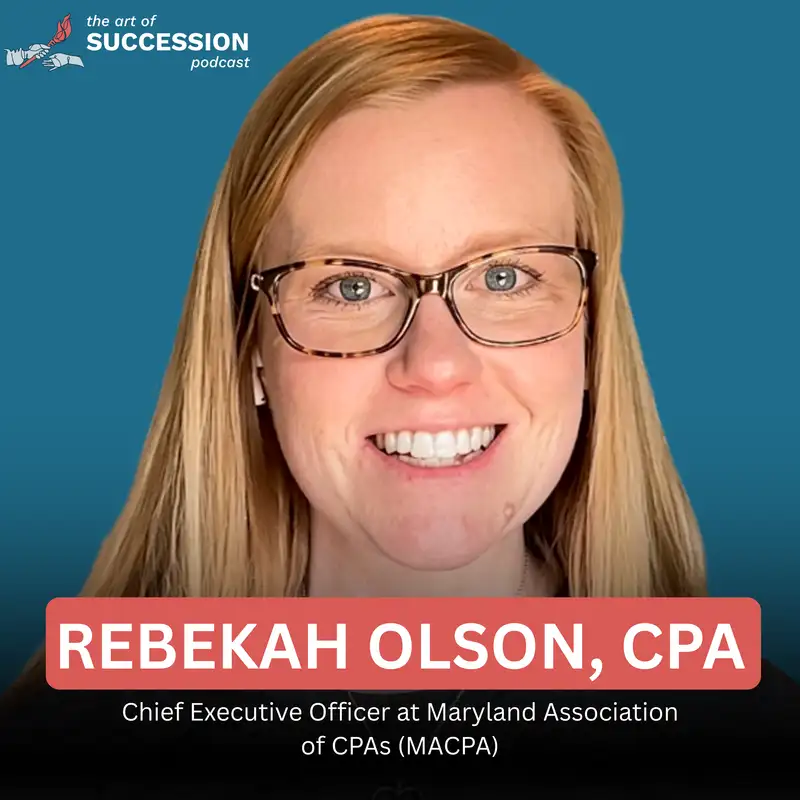
Succession Planning for CPA Firm Leaders to Future-Proof a 125-Year Legacy with Rebekah Olson, CPA
00:00:00.040 — 00:00:17.720 · Speaker 1
I was a lot more burned out, I think, than my colleagues were, and I didn't know exactly why, but I knew I had energy and passion when I was creating something. There's good days and bad days. There's things that feel overwhelming and there's things that I get done doing whatever it is. And I go like, I feel like I was made for this.
00:00:18.720 — 00:00:49.000 · Speaker 2
Meet Rebecca Olson, CPA, the CEO of the Maryland Association of CPAs, a CPA leading a community of 8000 plus professionals within a 125 year old institution. From public accounting to association leadership, she's focused on building community, developing the next generation of CPAs and guiding the profession through change.
A people first leader, she's redefining what leadership looks like in modern accounting.
00:00:49.000 — 00:01:19.610 · Speaker 1
I've always kind of likened my career path to Lombard Street in San Francisco. Looks crazy, but it's designed like that on purpose. It's actually how you safely get to the bottom of that hill, right with those switchbacks. When I think about my career and I think about where I am now, I have arrived here safely because of the things along the way.
On Tuesdays, for about 3 or 4 hours, I have a block that nobody can schedule time. That's supposed to be my time to really think about the bigger picture.
00:01:19.610 — 00:01:30.250 · Speaker 3
How do you practice visioning if you don't see yourself as a visionary, or if you don't see yourself as good enough of a visionary to inspire people? How do you do that?
00:01:30.290 — 00:01:31.690 · Speaker 1
I guess it goes back to that.
00:01:33.290 — 00:02:13.300 · Speaker 4
As you've been listening to this guest, you're probably starting to ask your questions. How do I apply this to our own situation, our own succession story at the company that I'm working in now at GWC, we have built a custom GPT that you can find linked down in the description below on our website. We have loaded this GPT up with all of our knowledge about public accounting and tax preparation around succession planning.
We've also included the insights from the guests from the past two years of interviews at the artistic session. You can find all of that at the custom GPT. Use at any time of day. Start to apply it to your situation. Ask it the questions that are keeping you awake at night. I want to thank you for listening so far and let's get back to the episode.
00:02:13.340 — 00:02:14.340 · Speaker 2
Welcome to the Art of.
00:02:14.340 — 00:02:28.300 · Speaker 5
Succession podcast with Barrett Young. Join us as we explore the strategies, stories and insights that shape the journey of leadership, transitions and business success no matter where you find yourself along the journey. This is the podcast where you'll find the tools to make it happen.
00:02:28.500 — 00:03:01.030 · Speaker 4
My name is Barrett Young and this is the Art of succession podcast. My guest today is Rebecca Olsen, fellow CPA and the CEO of our Maryland Association of CPAs. Rebecca is a long time friend of mine and a fantastic advocate for the future of our profession, and she's now at the head of 125 year old organization.
In our conversation today, we're going to get into taking on the responsibility of stepping into an existing organization and guiding that into the future. Rebecca, welcome to the Art of succession.
00:03:01.030 — 00:03:03.470 · Speaker 1
Thank you so much, Baron. Yeah, great to be here.
00:03:03.470 — 00:03:20.950 · Speaker 4
I have my specific reasons why I want to have you on the show and the way that I see this conversation going, but I just want to hear from you as the guest, like what excites you about this conversation? What brings you to the Art of succession podcast? What do you want our listeners to take away from our conversation most?
00:03:20.990 — 00:04:13.720 · Speaker 1
Well, it's interesting, you know, because I obviously have stepped into this role almost four years ago, three and a half. And it's a little bit different, right, because an association so a nonprofit association. And so really just a steward of something that's been built for a very long time by a community of people, not just by like an owner or a even a family.
Right. So to step in and to lead 8000 plus CPAs and members across the state, I mean, something that a lot of people put their trust in their careers in is a unique challenge, but also just a wonderful delight because I love being able to work for the CPA profession, which I love so much and that I'm a part of in a different way.
Right. I don't work in it. I'm not serving in a firm. I'm not in accounting finance team inside a company. I'm leading a community of people. So a little bit different. But it's been a unique journey. So happy to share what I've learned along the way.
00:04:13.760 — 00:05:12.160 · Speaker 4
That's what I'm most interested in, unique to family businesses. But really succession planning, and this is the thesis behind the Art of succession podcast, is stepping into the shoes of somebody else who precedes you. And I think you the further down you get into third, fourth, fifth generation family businesses.
But then especially you're talking 125 year old member organization, third or fourth, maybe sixth in the nation, something like that, when the profession was just getting started. That is such a unique mantle, such a unique responsibility. And I know I feel that, as you know, future managing partner of an 80 year old CPA firm.
And that's what I've really loved about these conversations. I was on the founders side, starting a brand new business from scratch, and now it's like a whole different skill set needed to guide a cruise ship that's already in route to its destination. Right? That's kind of how I think of it.
00:05:12.200 — 00:06:05.250 · Speaker 1
Great example. In fact, I've said it a couple times over the last like month or so, just strategy wise. Like the seas, things are going things are changing. The profession that we serve or I serve as Makeba has shifted so much. And so it's like we need to move this ship in the right direction. But the North Star, the destination, has always been this community of thriving accounting and finance leaders, right in Maryland.
And so kind of that navigating and moving that ship. And, you know, you have a lot of people on board, people that are brand new and excited and innovative about what they want to do. And then you have people that have been around for a really long time and have amazing wisdom and legacy in terms of what they've built.
And so it's like trying to make sure that you're able to lead throughout that pretty wide range of professionals. It's definitely a challenge.
00:06:05.330 — 00:06:28.610 · Speaker 4
I mean, that's our conversation. I'm excited to have it. Let's get some context here because I want to know, like how did you get started in the profession? How did you come to the CPA? At what point did you say, I want to be here for my career? You know, let's talk a little bit about that. So provide me just a little bit of background.
We'll provide our guests, our audience for a little bit of background about Rebecca.
00:06:28.650 — 00:07:28.020 · Speaker 1
Yeah. So gosh how far back do we want to go. I always like even as a child was super business minded. So I knew I wanted to do something business. I think I probably started like five little companies before I was 12, you know, like I was just that kind of child when I went to college. I was and I still am a big sports fan.
And so I actually went to college with the idea that I would be majoring in sports management, and so I actually have a degree in sports management, but I have a double major and a sports management and accounting, because when I got there, I was able to kind of create a specialization within the business school at Ohio State for sports management.
But then, you know, as part of that, started taking accounting classes and fell in love with the language of business. Right. And so I saw that that would be kind of my superpower. And going into what I dreamed was the NFL offices and asking for a job, having accounting and understanding the language of money and business would be my my superpower.
Right to stand out.
00:07:28.060 — 00:07:28.740 · Speaker 4
Gotcha.
00:07:28.820 — 00:09:35.160 · Speaker 1
Uh, so that's what got me into accounting originally. Um, obviously, I didn't choose to continue down the sports path. I'm in a much different role. I'm still a big sports fan. But, um, what landed me, um, really in this role was first going through and working in public accounting. So I worked for a top 100 firm in Maryland as an auditor after interning actually at two top 100 firms.
Um, and then about three years into that. So I was promoted to senior. I got my CPA. Um, I just realized that I had all these other passions and interests and things, um, particularly around, um, supporting, um, and raising up the next generation with inside, um, our firm. And so I was doing a lot of, um, intern and new hire, like, training and, and things like that.
And at the same time, you know, I had my, like, client work, um, piling up and, um, I just one day kind of looked around and realized I was a lot more burned out, I think, than my colleagues were. And I didn't know exactly why. Um, but I knew I had energy and passion when I was creating something to to teach other people about, you know, the onboarding or or even right to recruiting.
Talking about the profession more. Um, and then we did a, um, a leadership assessment type thing in one of our CPE trainings. Um, with all of my, you know, senior colleagues, the people that I had actually interned with, and we all got the job at the same time. It was this great cohort of friends, um, and this assessment that we did in this training, um, described me as spirited and considerate, which I thought were great words like, who doesn't want to be spared and considerate?
They're not the first two words I think of when I think of the CPA profession, or like a firm partner or leader. But, you know, I thought, does that sound more like a kindergarten teacher? My sister was a is a kindergarten teacher. So I thought like, crap, what happened here?
00:09:35.160 — 00:09:36.400 · Speaker 4
I'm in the wrong profession.
00:09:36.440 — 00:09:37.120 · Speaker 1
Yeah, it was a.
00:09:37.120 — 00:09:37.280 · Speaker 4
Little.
00:09:37.280 — 00:12:22.630 · Speaker 1
Scary. Um, but then the kicker was, every one of my colleagues, all of my friends that I had, you know, interned with and things like that came out as direct and systematic. I was like, okay, now this is maybe starting to make a little bit more sense. Um, it's not that I can't do this work. Um, I can, but I just maybe go about it in a different way.
Um, and to me, it was kind of shocking at first. Like, this is different. And to them, they're like, of course. Yeah. And we all have, have known that you're totally weird and different. Um, and nobody told me, but it was just that moment where I was like, you know, I'm trying to to do something in in an environment, in a structure that isn't maybe the best place for me to thrive.
Um, and I had some other things I wanted to do, and the firm was amazing, um, and supported me, but it just wasn't the right fit at the right time. And so I decided to leave public accounting. I actually got a career coach at the time who, after interviewing me and talking with me and working with me. Um, basically said like, is there a trade association you can work for?
Like, you love this profession, you understand it, you speak the language. Um, but you would do really well working for advocating for, um, you know, in a different way, instead of kind of working inside the actual, you know, work. Um, and there was, um, the, the tricky thing about it, um, which we'll get into probably later, um, as well, is I had been around the association in Maryland for CPAs my entire life because my mother worked there.
Um, my mother was it was not a CPA. Um, you know, obviously that had an influence on how I saw accounting because I had been around CPAs. She was a communications public relations person that started the NAACP. Um, before I was born and had a 40 plus year career there and ended up, um, retiring as the CEO. Kind of an interim CEO.
Um, well, we can have that whole story later. Um, but had been the CEO for a very long time, and so that was complicated then, like, what do I how do I just go work for this local association, which would be a great job and a great fit for me. But I can't just that. There's issues there. Right. Um, so I actually ended up talking to some friends that are at another state society, so a different state.
I actually talked about moving to another state where I'd be the CFO of another state society. I'm really glad that didn't work out.
00:12:22.790 — 00:12:25.590 · Speaker 4
Yeah, we almost lost you. I didn't know that. Yeah.
00:12:25.630 — 00:14:08.120 · Speaker 1
Um, I, I love my home. I'm a homebody. Um, so, uh, but I looked at a bunch of different things. Um, and at the same time, um, when I thought, you know, Macba is not an option. Basically, I need to look at other state societies or the AICPA or other, you know, relevant association or groups. I started helping out with a particular need at a CPA that they had, um, and it was part time.
A couple hours I was putting together like a curriculum, basically for a big conference, a national conference. Um, that someone had come to them to ask to, to help with. So I started doing that part time, and I just kept on doing that. And then I did some more of that. And then one day, um, the CEO at the time, uh, came to me and said, I really want to hire you full time like that.
You fit here. You know what you're doing? You're doing great work. Um, you can speak to the profession in any unique way. Um, he was at the time doing a lot of student presentations and would take me along. Um, because, you know, I was the young person, and so they he wanted me to get out there and tell students about what it's really like and my experience and how I pass the CPA exam and all of those questions.
And so I would go to these just to help him, and then he'd end up pointing to me and say, Becca, stand up and tell him about this, or tell me. And I ended up speaking in front of people, which is not something I ever thought I would do. I did not go to school to be in public speaking, right? Like as CPAs, there's not many stages you get on, uh, generally.
Uh, but I found myself doing that all of a sudden, a lot more. And so
00:14:09.480 — 00:15:32.010 · Speaker 1
one day just came, um, and my mom actually was out of town on business, and he called her, and, um, she he told her, hey, I'm just going to hire Becca full time because I. So this is happening, and you're out of town, so you can't do anything about it. Um, so that's how that happened? Uh, so I started working. I was on the business Learning Institute side, uh, doing mostly curriculum planning and training, but also on the membership side with student staff.
Um, just going to to colleges. Um, really promoting the profession that evolved. Um, and I started doing more, um, both actual public speaking, creating of content, um, as well as strategic planning, um, facilitation and then more and more membership things. There were some changes in the organization, and they had an opportunity came to do to be the membership manager.
Um, so I stepped into that role. That role evolved, and we ended up building up our CPA foundation more. Um, so I took on that. And so I was the director of development and then, um, let's see. And then Covid hit. And so I was director of development, which was always kind of hard to explain. And development sounded like the, the best,
00:15:33.050 — 00:15:53.300 · Speaker 1
um, broad term to use because I was in charge of membership. So we had, you know, 8 to 9000 members throughout the state that I helped develop. I was in charge of doing some content teaching CPE classes. Um, that felt like development. I was in charge of all of our, um,
00:15:54.620 — 00:17:27.069 · Speaker 1
uh, Student Pipeline Initiatives foundation. That could be term development as well. And so development was the general term I used for me and the various things that I did. Covid hit, um, and the organization, like many organizations, had to shift. Um, and we did and we did really well, I think, um, and at that time, our CEO got an opportunity to go up to the national organization to to leave me CPA and kind of represent the profession nationally and actually internationally in his role.
Uh, so he went to do that at the time. Um, Jackie, my mum. Um. The board selected her to kind of move into the CEO role. She knew she only had, I think she had 2 or 3 years before she wanted to retire. So she was kind of kind of take that, um, on. And at the time, with just the shift in, um, resources and the change in just the business model.
Um, the part of the transition to selling of, um, the Business Learning Institute, all of those things meant we didn't hire a CEO. So then we had just this leadership team model that worked really well. And then, um, my grandmother actually got sick, and my mom kind of used that as an opportunity to say, you know what?
I actually kind of retire earlier than I thought. Uh, and so that brought the opportunity to my to my plate. Um, we
00:17:28.230 — 00:19:17.690 · Speaker 1
had talked, um, I think succession planning is something that the board Five, six years ago. Seven years. Ten years ago. Was worried about. And so they had talked a lot about it and my name had come up um, at times. Um, and so there was a kind of a plan in place of how an intentionality, I guess, of mentoring.
Um, everybody on the team. Right. But, um, I think that was, you know, I, I guess maybe I've been here, what, 14, almost 14 years, probably six, seven years into the career, I thought, I don't want to work for another association. Like, I'm not going to be an association person. I don't know that I want to work for another organization.
I love the CPA. Here's this is my career. I'm going to kind of made that shift from like, this is a job and I'll figure things out to to that. Um, and so I was part of that next generation of leadership kind of idea. I don't know that I was CEO material at all, but I knew I wanted to be here. And so then when the opportunity came, I thought, well, this is earlier than any of us thought it would happen.
I think Covid kind of sped all of that up. Um, and I thought, but man, what a leadership lesson that I just get over the last two years navigating an entire association through Covid, right? Um, so being in those conversations, being part of transitioning our team, um, that was huge. And so I thought maybe I was ready.
Um, so I put my name in, in the ring. Um, and then of course, there's a whole national search, um, huge process. Um, lots of interviews, all of that. Um, I probably answered way more than you want on that question.
00:19:18.130 — 00:21:40.550 · Speaker 4
Yeah. I mean, that's that's the foundation. Yes, that's that's the background of the context here. But a couple of things that stand out to me, like Becca even just talking about this, like how much to divulge about your mom's involvement, how much the family relationship there, even just with Tom, your predecessor?
I mean, Jackie was there before Tom was. Jackie was like Tom's mentor, even as he's stepping into the CEO role 30 years ago at this point. So Tom's watched you grow up. Tom saw you, you know, go off to school and probably was just excited as your parents when you picked a minor in accounting. But that is the reality of succession planning.
That is the reality of small business. I mean, personally, my story, I did not want to get into accounting because my parents were accountants and I'm like farthest thing from that. But there so there's like a running away from it. And then also just an acknowledgment. You have a base, you have an organization right in your backyard as you're looking at other states and everything.
And it kind of took somebody to snap you out of that and be like, this isn't like nepotism. This is an opportunity. This is an this is a perfect, suitable, perfectly suitable for the gifts that you've already identified where you saw right here, ready for you and you have earned your position. I would just say as a board member and as a member of the CPA, you've earned your right to be the the CEO and the head of the state association.
Um, it wasn't handed to you. And that's always the fear when you're working in succession planning. Like, I have that fear. I'm like, what did my employees think about me? Do they just think that I'm Sam's pet project that, you know, got handed this position? No, I mean, you were there with the association and we'll get into a lot of these stories because this is all about stepping into those shoes.
You were there with the association when it shifted from annual dues to monthly subscription. You were are there with the association when it moved away. Uh, moved towards remote learning, which positioned the association to be able to survive Covid and remote remote broadcasting. So
00:21:42.190 — 00:22:17.670 · Speaker 4
all of if you come in day one and it's like you're going to here's the company tomorrow, you're the new CEO. That's completely different than stepping into that, gaining that benefit of being mentored by a CEO like Tom, proving your ability to lead departments, your ability to, uh, you know, take on these roles that that, uh, head of development role.
Um, and like you said, position it for success for the next generation. So I just wanted to comment on that and encourage you just a little bit in there, because I know there is always the,
00:22:18.710 — 00:22:29.800 · Speaker 4
um, that struggle, the imposter syndrome of what if I'm not the right person for this company? I'm just Sam's favorite at the right. Right place, right time for this thing.
00:22:30.040 — 00:25:50.910 · Speaker 1
A very unique thing. Right? That that. Realizing that this role and, you know, there's good days and bad days, like, you know, there's things that feel overwhelming and there's things that I get done doing whatever it is. And I go like, I feel like I was made for this, like, and I don't know that I like I would have recognized that ahead of time.
Right. Until you're like in it. But, um, you know, I'm a huge person of faith. And, uh, when I talk to students in particular about your career path because so many of them have these amazing goals and dreams, and I just want to and then some of them are like, I don't know where I'm going. And they're like, freaked out because they're either like extreme, like, I have to have this job and this many years planning or they're like, I don't know what I'm going to do tomorrow.
Um, and I've always kind of likened my career path to Lombard Street in San Francisco, which, like, looks crazy, right? Like, you look at it and you're like, somebody was not well when they designed the street, right? But it's designed like that on purpose. It's actually how you safely get to the bottom of that hill, right, with those switchbacks.
And when I think about my career and I think about where I am now, I have arrived here safely and I still got a long road still ahead, but I've arrived here safely because of the things along the way, like because I majored in accounting, even though I was like, I think I'm going to do sports management. Let me like just do a double major, right?
I then that got me to be able to take the CPA exam. If I didn't have those three letters after my name, I probably wouldn't be in this position, right? I wouldn't, um, demand the respect, I guess when I walk into a room or when my bio is up on a page, right? Um, if I hadn't had those years in public accounting. Right.
Um, I wouldn't have created a lot of great relationships, but also just experience of what it's like for our members, um, and what the inside of a firm looks like and how it runs and, and how it can improve. Um, which I got really passionate about when I left. Like, I, I recognized that there was nothing wrong with the firm, but there was nothing really wrong with me either.
And so I knew there had to be a way that, you know, this business model of the firm could be a place that I could thrive in the future, or me in the future, could thrive with that unique kind of skill set and personalities. Um, and I've actually seen that come to fruition. I know firms now, lots of firms that hire roles, like the one I tried to like, almost create inside this firm that are this hybrid, um, you know, experience that person that is really there to mentor and bring along the next generation.
And by the way, because they have the three letters and they know the work, they can do some client work too. But like that person that's really there to support the employees. Um, and so I've seen that role happen, if, you know, I hadn't, you know, gone through, um, all of the public speaking that I did not ask for, that I just got pointed to because I happened to be in the room with Tom.
Right? I wouldn't be as comfortable as I am now doing it. Um, which, by the way, it never is fully comfortable for anyone.
00:25:50.950 — 00:25:51.590 · Speaker 4
Fully. Yeah.
00:25:51.630 — 00:25:52.190 · Speaker 1
Yeah.
00:25:52.630 — 00:25:59.670 · Speaker 4
Tom, Tom would also say, I know because I've asked him he, you know, still gets the pit in his stomach depending on the audience. And the tom.
00:25:59.710 — 00:26:05.790 · Speaker 1
Never goes away. Never goes away, gets easier. Um, you prepare less and less compressed. Probably isn't a good thing.
00:26:07.910 — 00:27:05.000 · Speaker 1
Um, the preparing less and less is is probably a dangerous thing. But also Covid like total game changer in in doing presentations right, doing virtual presentations, how that works. Like that's a whole nother skill set of how you engage in audience virtually versus in person. And just all of those things that I've learned along the way, um, the passion for the next generation of CPAs.
Um, when I was hired, the biggest challenge facing the profession, and arguably still one of the biggest challenges, is the talent pipeline and how we will attract the next generation. And so for me, it just felt like all of these things coming into place. Um, and I that's why, you know, I feel like I've made a mark and will continue to steer this, this giant ship.
Right? Um, because I have the faith that God has, has brought me to this place and prepared me for it in a lot of ways.
00:27:05.040 — 00:28:21.860 · Speaker 4
I definitely want to get into guiding the ship. Um, and we'll probably spend the rest of the episode talking about that. Like, what can I do when this organization has existed 90 years before I even came around. Um, because that is the need that is the need of a CEO is to to say, I'm in charge of the ship now. What what about it was for you with the CPA and looking at other organizations, looking at other opportunities, because you could go and become a CEO of any state society with your experience with with what you've learned, your skill set, everything like that as you looked at the CPA, other than it's your hometown, it's, you know, we have the best flag out of all the states, all that kind of stuff.
Uh, what was it about the CPA that you were like? This one is uniquely positioned. Right place, right time. You know, ready for ready for me as a leader. Not going to be banging my head against the wall. You know, had you come to the CPA 30 years ago, ten years ago, different, you know, all those challenges.
What was it? Right place, right time for you. When you looked at the MCC as an organization.
00:28:22.020 — 00:29:55.750 · Speaker 1
It's probably the people like Maryland. And we're super Maryland proud. We love our flag. But, um, the CPA and it I get to be a steward and a guide and a facilitator of really, really fantastic people, not just the MCC team, which are amazing. Right? Uh, the we have an amazing organizational culture and team.
Um, but the members like as an association, we are um, a collection of, of people. Right. Like our our asset, our product. All of that is all, all relationally based. Um, and the Maryland in, in, in a unique way. And the MCB, I think has some of the most forward thinking and passionate, uh, CPAs that I've ever met.
And so I I was confident in our board of directors. I was confident in our our membership and our leaders in the profession in Maryland. Um, then that made us unique, um, and made us stand out. And I think continues to, um, when I hear when I go travel throughout the country or whatever, and people talk about Maryland or the CPA and, um, it's it I always point back to our leaders, like we have had fantastic, diverse, uh, collaborative, really inspirational and innovative leaders.
And that's intentionally created. Right. Um, but it's it's that community that attracted me, I think, the most.
00:29:56.070 — 00:32:17.170 · Speaker 4
Yeah, I guess that's probably how I would reword that question is you talked about, you know, succession planning has been on the board's mind, been on Tom's mind going back ten years. You've been in the in place for for kind of thing. What is it that the previous generation. Do you think did so successfully to to enable the success of the next generation as we think about family businesses?
Um, I can say from my perspective, you know, iOS putting something in place like that where leadership is not just at the top level, it's not just the CEO and the CEO doing everything. Um, you talked about raising up internal leaders as far as like the chair, because you guys have a public board. You guys have a board of 12 members that we as members of the CPA sit on that and help guide the decisions and help provide, you know, context and, um, guidance to you guys as an organization, even just something like you took a personality profile, uh, that's been ingrained in the CPA as long as I've been there with the Strengths Finder and the get to understand yourself as a CPA, we don't all fit the direct.
What was it? Direct and methodical or direct and systematic kind of personality. I remember taking my first personality profiles 10 to 15 years ago. Now at this point would be like, what am I doing in this profession? But then saying this isn't like a yes or no, you should be a CPA. This is like, how should you be a CPA?
How should you lead an organization with your specific skills? So. So those are some of the things from the outside I've seen. And then also organizationally or operationally moving to subscription model, moving towards remote at the right time, seeing things that are on the horizon too. Um, what would be your like guidance to other state societies out there that are just like, I can't get anybody under 50 interested in being on the board in in being involved in our state associations, which drastic steps do they need to take possibly to turn their own cruise ship and get it, set it up for success, for somebody to be able to come in and guide it.
00:32:17.210 — 00:32:51.410 · Speaker 1
So I'm going to go like a two part here. So the first part you mentioned like what did I inherit or what what structures were already in place that enabled meta to be successful. Right. You mentioned EOS. Um, and that community, that board that I talked about, those people were established. Those leaders in our profession in Maryland were established way before me.
Right. And that was intentional inclusion and belonging that happened in the Macva, the culture of how things happened. That was way before me. Right.
00:32:51.450 — 00:32:53.290 · Speaker 4
That's like a 30 year project.
00:32:53.330 — 00:36:13.250 · Speaker 1
Exactly. Like if you want to have, you know, a chair of your board in in 30 years, it is an intentional creation of space where people feel welcomed and valued and can collaborate and have input. Right. And so that is something that I both inherited and that I love about the CPA. And I want to continue to cultivate.
Right. So that people, when they come, they feel welcomed. They feel a part of something. That's the first part. The second part is a little trickier because if I had all the answers, I certainly would share them, but I don't. It is a unique challenge. I think right now in our profession and particular my profession of a association for CPAs.
Right. Because I think of the CPA profession and the transformation that it is going through, right. Things like technology, just demographics in general, the business community, all of those things. The profession is changing rapidly, right, and transforming itself. At the same time, the association world is too.
Right. Things have disrupted that Covid being a huge force in that people no longer getting together in person for a significant amount of time. Losing touch, losing relationships, you know, instant access to things. The quick and easy way of doing things. All of that technology involved. And so sometimes that is a disconnect of community, right?
Like, I can get my community online or why do I need an expert when I can just ChatGPT that, that those two things happening at the same time is honestly what keeps me up at night, right? Because not just the people that I serve and the profession that I serve is transforming, but the association place the unique lens or the unique community that I'm trying to create within that profession is changing.
And so it's hard, like you're asking people that are probably some of the busiest people in their, you know, life stage, right? They're working hard. They are, you know, maybe that senior to manager level in a firm. Maybe they're on the corporate side. They have young families and that's our target market.
Like, we have to engage those people so that we have leaders for the future. And it's hard. It is really hard. And I think in a lot of ways, the community aspect got hurt a lot with the busyness of the profession in a lot of ways, because one of the things that I remember, if I look back at our like historic leaders like legacy, our past chairs, a lot of them came to the association because somebody tapped them on the shoulder at their firm, at their organization and said, hey, I'm going to an Macba committee meeting or I'm going to this event.
Let's go. In a Covid era, in a remote working era, in a busy time, those things just didn't happen. And so we have this like lost group in the middle. And so how we cut through the noise to bring those people together because I think they are, in a way, starving for community that matters. It's hard. Like it is hard to get people in person for things.
And I think that's real community happens. So it's a tricky thing.
00:36:13.250 — 00:37:53.420 · Speaker 4
You talked about the people in the middle there just I know our profession, our state society is very involved with the student pipeline, you know, trying to solve that pipeline, very involved at both the college level and even younger into the high school level, you know, making sure our members are recruiting in there and just talking about what it means to be a CPA, to get rid of the stigma of, you know, what a CPA looks like in media or sharing some of the, you know, you could study accounting in sports management.
At the same time, you could be the CFO of McCormick spice. You could be, you know, the financial I don't remember what its title is, but the guy that we're going to have this coming, well, actually, by the time this release is that we just had a week ago for our conference with the Savannah Bananas VP of finance.
I couldn't remember if it was finance director or yeah, VP of finance. So all of those things. Every organization has an accounting function. So being involved in that in school and showing this is what accounting means, it doesn't always mean tax or audit. And then we also have the other side of the bathtub or the other side of the barbell of the retired members, the ones that have got the capacity.
Maybe they're, you know, in a director or partner capability within their firm, but they're no longer the ones operating in it. And so they have the time to give back. They have their thoughts or on the legacy thing. But you're talking about the majority of the involvement of the profession is missing from that middle generation, that middle like probably 30 or maybe even 25 to 50, 55.
00:37:53.460 — 00:37:59.060 · Speaker 1
Which is always really unique because I think those are my friends. Like, that's me, right? That's like I am.
00:37:59.220 — 00:40:28.400 · Speaker 4
You guys always ask me, you're like, why are you so involved in the CPA? And how do we get more of you? And I'm like, I don't know why they're not involved. I don't have an answer for why my peers aren't involved. I can tell you why I'm involved, and maybe that's what I want to get to, is you said there is a longing for to be involved.
You can't just assume it. Like maybe you could back in the old days of, you know, if you want to be established in business, you join your chamber, you join your bowling league, you join your professional organization, you join your church. Like that kind of assumption there. But for me, Maryland has always been local connections in my profession.
And if I want to know what business owners are facing, especially business owners around the Beltway and how we're advising those business owners, it's the connections that I have through the CPA. For me, I can do it online. You know, CPAs that are serving around the country, that's not unique. Value proposition to me of, hey, we have an online community.
I need a localized community that you know is online. I interact mostly with them on LinkedIn, but we can get together in person, at conferences, at lunches, just drive up, you know, drive an hour and a half and we can have we can spend the afternoon together, something like that, or we can do local golf events.
So that's what it is for me. But it's the value of the context and the connections. And where I am in my profession is 100% right place, right time due to the CPA. And I will say that I look at peers that don't have are frustrated where they're at in their career and they're not involved in a state association, whichever state they might be in, they're not involved in finding somebody outside of their own firm to pick the brain of, to be connected, to, say, what are you guys doing over here?
Even if it's just as simple as what software are you guys using? Like, there's this huge resource there that you're not tapping into that you do need to. And one of the things I love about the MCP and I didn't know this existed, our listeners probably don't know this existed, but you guys are have an association of associations.
And that just cracks me up because you guys are not out here trying to make it up as you go as the CPA. Either you guys have peers in 54, 55 something jurisdictions of how are you guys facing this? How are you guys handling this? What's your approach on this?
00:40:28.440 — 00:42:23.500 · Speaker 1
It's an amazing community. So it is crazy. I didn't know that there was an association for associations until I was in an association. And so there's actually two. Right. So there's the AC which is the association or the American Society of Association Executives. So that's of all associations. Right.
And then I think what you're speaking about is actually the association of CPA associations, which is real unique and specific. But there's a Rebecca in 50 other states and some of the jurisdictions. And so. The fact that I can have colleagues and I was just with several of them last week to share ideas to, um, you know, advocate together.
Right. Because the CPA, of course, is is a state based license. And so a lot of the advocacy work is, yes, done and in Annapolis, but off also, of course, it federally as well. Um, and so we collect, together with the AICPA and other associations for the accounting and finance profession, to all advocate for the profession in DC as well.
And so that community of people, um, is just the best, the best thing. It is a phenomenal resource. Um, and and friends honestly like folks that that care deeply about me personally but also of the CPA. And I've always said, you know, I think every state society has, you know, their mark of what they're really good at.
And we all struggle in different areas. And so that's why it's really great when we get together, because I can learn from somebody that's doing phenomenal things in one area. And, um, we steal from each other all the time. It's like how we work, right? Like, oh, then you work did that and it worked really well.
Okay, I'm going to try that too. Um, and not everything translates, you know, in, in unique markets. But, um, it's certainly a huge, valuable resource.
00:42:23.540 — 00:44:00.080 · Speaker 4
Yeah. I think that idea of we're all succeeding in some areas and struggling in other areas is a is a key part for me of the peer to peer sharing, because there's always this impression of, like, I'm going to join this thing and all I'm going to do is give like all they're all going to steal my ideas. I'm not going to get any ideas from them.
It so like I've got a mentee through the CPA, you guys connected us a year and a half ago, and I've gained so much from having her as my mentee, as she feels like she's only she's gained from having me as her mentor. But it's been like it's been that two way street. It is like what's working here in California?
What's working in a Nebraska? How can we apply that to our context? And they're gaining something from what's working here in Maryland that they're looking to apply to their context to. And it's not just it's not stealing in the sense of you can just take it and plug it in and it works 100%. We all have our individual context.
And this is why I feel so strongly about sharing across companies. Even though we're technically competitors. My clients are not your clients. My team's not your team, my target audience. My target client is not your target client. My city is not your city. Like there's so many different variables. My personality is not your personality.
So there are going to be clients out there that love your personality and want to do business with you, that are not going to feel the same way about us. And, you know, my personality.
00:44:00.080 — 00:44:02.600 · Speaker 1
So there's enough work to go around.
00:44:02.920 — 00:44:03.600 · Speaker 4
So much work.
00:44:03.880 — 00:45:03.090 · Speaker 1
There's so much work, right? And so, like, I think we only benefit from collaborating and being in community. Absolutely. Um, yeah. And I used to go to those meetings, and I still do. I'll go to meetings with colleagues and, uh, without a doubt, I'll walk away at some point and have the thought like, we're not doing anything right.
Like, oh, they have this and they have this and they do that. And I have to, like, remind myself. It's like it's the opposite of what you talked about. Like, but remind myself, like, if I walk away from this time with 2 or 3 ideas of something to try, and I was able to give somebody 2 or 3 ideas like 100% worth it, right?
Like, and sometimes community is just about having somebody that understands what you're going through. Um, I think that is, um, undervalued sometimes. Um, there's something about being able to talk through something with someone that doesn't have skin in the game, but that gets it. Um, is a unique value as well.
00:45:03.090 — 00:45:52.580 · Speaker 4
I think that's the part of it that's unique that that's why it's a community also, rather than just we all get together and compare scorecards and see who's winning like it. That is defeating. That is just I go away from there and I'm like, we, I thought we were further along than we are and we're so far behind.
But no, it's like like I said, you have your unique context, I have mine, and we're all trying to be better than we were last year. Um, in this general direction. So with what time we have left, I want to talk about that. Like you are guiding a 125 year or year old organization. You're not doing it by yourself.
You have a leadership team. You have a board, you have 50 other peers who are providing context and helping you make those decisions. But how do you
00:45:53.700 — 00:46:33.380 · Speaker 4
wrap your brain around that responsibility? How do you say we need to shift this? We can't just keep it on cruise control because that's what the previous captain or the previous 125 years of captains, right, have had in place. How do you work through that? Obviously, you and God and your quiet times and stuff like that.
But just like the professional side, how do you look at decisions and and also wrap your brain around just the people that are like, I've been here longer than you've been alive. I don't think that's the right decision. And you're saying, I'm sorry, but I'm the CEO of the organization and this is the right decision.
00:46:33.420 — 00:46:42.539 · Speaker 1
Leslie, I don't think I've had very many of those conversations. Um, which is great because, um, because I probably wouldn't do that. Well, I'm not a
00:46:43.860 — 00:50:03.490 · Speaker 1
as strong as maybe I should be, Um, but I think part of it is, um, the people that I surround myself with and knowing myself, you said that earlier, like the taking of the, um, the, you know, personality assessments or whatever. Um, I recognize that I had the profession knowledge. I had the profession passion.
Um, I have a pretty good idea of the target market. We talked about, you know, I am the target market. Um, what I recognize I didn't have was the association. Stuff like that. That is a whole career job industry, right? And so I made a hire two years ago, a little over two years ago that has challenged me in all the best ways.
Right. And so I recognize that, you know, when you when you think about decision making one, I look at it as, yes. Does the buck stop with me? Will I make ultimate, you know? Yes. Um, well, with the board, of course. Um, but surrounding myself with people that maybe think differently or have a different approach to it, that balance out my, um, you know, tendencies, um, fresh perspective.
I think that was really needed in the organization as well. Bring in somebody completely outside. Um, has really changed that process. Um, because we needed somebody to say, like, why are you doing it that way? Explain that to me. And there's something about just, like, really great, great questions that get asked, whether they have the answers or not.
It's like somebody questioning me helps me to think through it. Um, if you haven't already heard or, um, seen, I am a, um, out loud thinker, uh, which can really frustrate people sometimes, but that's how I process things. Um, and so having someone to do that with really, really helpful really made it made a difference.
Um, there is somewhat of like, a gut check moment on things. Um, and there's a that stewardship, um, emphasis like, I don't want, um, this association to, um, be I want it to be here 125 years from now. Um, and I want to make my mark on it, but not my mark on it so much that it doesn't exist without me. Or it looks completely different without me, if that makes sense.
Um, you know, it's it's. I have a role and a visibility and things like that, but, um, we shouldn't do things. I'm a CPA. Should not look different. You know, when a new CEO comes in, in my, in my opinion, you know, there should be, you know, things will change or it looks slightly different. But the direction that I'm trying to steer us in is the is the direction for the next 125 years, not the direction for when Rebecca gets to retire.
And so making decisions with that in mind, with the team and the membership and the, you know, the the state of Maryland in mind. Honestly, if I think about just the business context and the things that our members represent. Um, and that's a huge weight. Um, but it's also a great privilege. And so being honored to, to be able to do what I can to steer that in the right direction.
00:50:03.530 — 00:50:44.780 · Speaker 4
It's for sure a challenge. I mean, it makes sense to me because I live in this context and I advise in this context, but it is the idea of you are the CEO for the moment. You are the CEO that the moment needs right now. And there are going to be very difficult decisions, very difficult places where you need to say yes or no, but that's very different from it's my association now.
In the next 15 years, we're like Lombard Street. If Lombard Street completely doubled back on itself and just was like all over the place, it wouldn't be purposefully moving in a given direction even though it needs to change course. You know, based off of.
00:50:45.820 — 00:51:19.100 · Speaker 4
To get there. Yeah. Um, other than just keeping it in mind, it you have advisors around you and you are you approach decisions with that weight. Like do you study other advisors? Do you study change. Do you like what's what's what's your diet for how to have these kind of bigger picture longer term? Because most of us don't wake up and think like what should be in existence 125 years from now?
00:51:19.460 — 00:53:30.719 · Speaker 1
Yeah. I mean, I think one of the things that I get access to as part of this profession is some great content and learning opportunities. I've heard some amazing speakers that then recommend amazing books. Um, I was away for ten days right before this, and so I came home with two new books and, you know, like.
And I will admit, I know you're a huge reader. I, I struggle with that. Um, sometimes they're just a little long for me. I'm more of a Ted talk kind of gal. Um, but the concepts in them, um, the things that we've I've learned. And this, again, I inherited. But as an organization, we went through the anticipatory organization, um, and, and worked with a global futurist and Dan Burroughs.
So those things stick with me as well, those concepts. Um, and honestly, just sometimes it's just like LinkedIn. Like I follow some really great people that post some really interesting things that challenge me, um, that I get excited about. Um, and so it's like one of the things on my calendar on Tuesdays.
Um, for about 3 or 4 hours, I have a block that nobody can schedule time with me during, because if I didn't block it, I'd get meetings scheduled. Right. Um, and that is my time. Hopefully not to just catch up on tasks. Um, that a lot of times is Friday afternoon. I can just like, you know, bang out a couple of things that I, you know, didn't get to during the week.
But that's supposed to be my time to really think about the bigger picture. Things to read, um, to work on more of governance strategy type things. And if I didn't block that in my calendar, which is something that I learned from Dan Burrus, um, I don't know that it would get done because my days are meeting after meeting after meeting.
Um, and so that's one like real practical small thing that I do. Um, I don't do it perfectly. And tomorrow I don't get to have it because we have our leadership L10 tomorrow or not at ten, our quarterly planning. Um, but those are the types of things that I think have have helped me kind of have that bigger
00:53:32.080 — 00:53:32.760 · Speaker 1
outlook.
00:53:32.800 — 00:54:24.810 · Speaker 4
I guess we've touched on it just a little bit. I think Sam and I both knew about iOS, and then to see the CPA go through it, and then we just all started using it last summer, so we're still within the first year there. How do you translate that 125 year vision down to a ten year vision, down to a three year, down to a year, down to quarterly, down to what do I need to do this week?
Because my week is blocked with meetings also, and it can feel so much like I'm in, I'm either in the weeds or I'm at the 10,000 foot view. But like connecting the two is so hard. And I know that that's the point of iOS and the reason we need both sides of it, or we need both personalities, the integrator and the visionary in there.
But how have you learned how to do that to
00:54:25.970 — 00:54:32.570 · Speaker 4
if you only are in the weeds, spend the time zoomed out, or if you're only ever zoomed out making sure you're connecting?
00:54:32.610 — 00:55:05.460 · Speaker 1
Yeah. So one of the tools that is really helpful, um, that we use is asana, which is a project management tool. Um, but all of our, um, um, blanking on the all of our rocks are in asana. Our L10 runs through asana. So like, we check off tasks as we run through the meeting. Everything's there. Everything's, you know, documented.
Um, and then our, um, veto is in asana.
00:55:05.500 — 00:55:09.020 · Speaker 4
Vision traction organizer for anybody, not the EOS.
00:55:09.220 — 00:55:09.900 · Speaker 1
Yeah.
00:55:09.980 — 00:55:14.980 · Speaker 4
Which is supposed to be your two page, like, driving decision framework for everything. So.
00:55:15.020 — 00:55:22.939 · Speaker 1
Yeah. So it's all there to go and reflect on. Um, I think we
00:55:24.100 — 00:55:40.540 · Speaker 1
it's interesting because the, because an association is a little bit different. Right. It's not we're not making widgets. We don't have like a, a goal of this many widgets by this date and things like that. So there's a little bit of our, our vision is, um,
00:55:41.780 — 00:56:18.540 · Speaker 1
you know, big and broad and we want to do these things, but it doesn't have the same kind of metrics as a, you know, manufacturing company would which or even a startup which the OS is really is an entrepreneurial operating system, right? And so the nonprofit, um, this kind of gets a little wonky when we talk through some of those things.
Um, but just laying out and it's amazing. One of the things I love about us is those quarterly, which starts with going through the whole veto. And part of it's like, okay, we know this. Yes, I can recite this by like I it feels routine, but it is so,
00:56:19.580 — 00:56:38.110 · Speaker 1
uh, the right focus to be able to then go into the details of the next quarter. It's like reminding yourself of the work that we've done and where we want to go. Um, and so that I think has been helpful just because it's all in one place. Um, and just
00:56:39.230 — 00:56:40.510 · Speaker 1
trying to think what else?
00:56:41.790 — 00:56:42.910 · Speaker 1
Tool wise.
00:56:42.990 — 00:57:25.309 · Speaker 4
How do you how do you start to see yourself as a visionary? I guess I want to ask that because a lot of people in our profession conversations I've had with my team, they they're not thinking ten years out. They're only thinking to the end of this tax season. They're barely thinking to the end of this year. And you know, I thought I was coming into a position working for somebody that I saw as a visionary.
Um, and to accept that mantle passed down from her. Um, you work for somebody who's one of the top visionaries. You worked under somebody who was one of the top visionaries in the profession, as he was the CEO of the CPA. So how do you practice
00:57:26.550 — 00:57:36.280 · Speaker 4
visioning if you don't see yourself as a visionary, or if you don't see yourself as good enough of a visionary to inspire people, how do you do that?
00:57:36.320 — 01:00:22.699 · Speaker 1
I guess it goes back for me. It goes back to that, like thinking out loud, I have to, I can't, I can't brainstorm or visionary stuff by myself. It's always in community or in collaboration with someone. And so whether that's like ChatGPT and I have in a conversation or in the context of our leadership team, or meeting another association leader and talking about the future, I think that is what works.
Um, for me, I struggle with this part of it. Right? Because I am stepping, I have stepped into the shoes, into someone who is like known for being visionary and known for, you know, being ten years out there, right. Um, and I think I can play in that space some and I can play in the, like, integrator space some, and I can play in the details, but it's like knowing when to play, watch, roll.
Um, it has been helpful for me. I don't always get that right, but I think just having the conversations, reading about different organizations, being inspired by what colleagues around the country are doing. Um, and honestly, it comes back to like people for me, I think my, um, the sweet spot that I saw and when I worked in public accounting, um, and what I do at Macba is all about getting to know people and, and making positioning them the best for, for success.
Right. And so I want other people to succeed. And so in, um, thinking about the CPA, I think about our members and I think about what would make a really great member experience, what would make, um, what can I create so that when people come, they feel like they belong and are included? Um, and that is a really, like, big concept, but then I break it down to, like, I'm meeting one member at a time and helping them with, you know, sometimes it's as silly as, you know, like introducing one member to another like, oh, wow, you're in this field.
Oh, you can do that. You know, like, but I feel like that's that is my, my superpowers connecting other people to each other or to resources that they need. And so I see that as the future of the CPA, the future of the CPA is people like we're an organization that's built for people. That's what associations do.
Right. And so whether that's five years down the line or ten years or 50 years down the line, if we're creating spaces and creating, maintaining and creating relationships, then we're succeeding as an organization. And I think that's one thing, that
01:00:23.830 — 01:00:43.950 · Speaker 1
Innovation there. Certainly within that like tools you can use and things like that. But if you focus too much on that, you lose the like human contact part. Um, and so that's what I it's just like one member at a time, one student at a time, creating relationships and then connecting them to the bigger picture.
01:00:43.990 — 01:01:26.520 · Speaker 4
Yeah, I like that. It's like it's the focus or it's the core values or whatever you have there that this is what's consistent across and that's, you know, an organization or a, a membership organization or a business organization should be hiring for a vision, a core values that are consistent with where they've been in the past.
It's like everything else is the context that's going to shift, whether it looks like remote learning, in-person learning, peer to peer learning, and roundtables and, you know, whatever that case might be, that has to shift with whatever the environment is, whatever our members are, or whatever the context for that specific decade or half decade looks like right?
01:01:26.560 — 01:01:29.160 · Speaker 1
It keeps you from getting driving.
01:01:29.200 — 01:01:34.080 · Speaker 4
Are we connecting people? People? And that's that's the consistent focus there.
01:01:34.120 — 01:02:19.720 · Speaker 1
It's easy to get distracted by the shiny object, you know? Non-news revenue is like a a huge part of associations. They talk about it all the time, like, what are we doing to drive non-news revenue? And it's like, yes, we have to have that. But like, that's not our purpose. Our purpose is in helping make, um, successful, you know, accounting and finance professionals in Maryland.
And what does that look like? What are the building blocks of doing that? And if we don't have the personal relationships with that community of people, it doesn't matter if we create the coolest CPE course ever or the most innovative product or sponsor relationship. That stuff is all, um, value building, but the community has to be there first.
And so that's that's what drives us as the people.
01:02:19.800 — 01:02:44.610 · Speaker 4
That's great. Um, Becca, we've we've already come up to the end of our time. Um, I know, just because I love talking to you, we could have many more hours of conversation, but we can't do that on one episode. Um, before we move on to our our lightning round and wrap this episode up, is there anything that you wanted to add that I have not yet, um, touched on or brought up?
01:02:44.810 — 01:02:50.250 · Speaker 1
Nothing I can think of. I hope this helped. And this is what you were thinking of when you invited me.
01:02:50.290 — 01:02:56.650 · Speaker 4
This is to two visionaries talking about organizations that are bigger than themselves. So that's exactly what I expected.
01:02:56.690 — 01:02:57.290 · Speaker 1
Yep.
01:02:58.490 — 01:03:10.250 · Speaker 4
Awesome. Right, people? Right time. So. All right. Um, so thank you again. And we'll jump into the lightning round now. Okay. All right. Um, coffee or tea? And how do you like it prepared?
01:03:10.290 — 01:03:12.730 · Speaker 1
Coffee. Dark roast, black.
01:03:12.730 — 01:03:16.570 · Speaker 4
Pie or cake? And do you have a specific favorite cake?
01:03:16.610 — 01:03:25.090 · Speaker 1
It needs to be gluten free. Probably carrot cake. Really? because the cake is just the avenue for cream cheese. Icing is the best thing ever.
01:03:25.210 — 01:03:27.370 · Speaker 4
Do you have a favorite holiday and why?
01:03:27.530 — 01:03:35.010 · Speaker 1
This one tripped me up. I'm gonna go with Thanksgiving because it combines two of my biggest passions, which is eating and football.
01:03:35.050 — 01:03:40.410 · Speaker 4
All right. Very good. Are you a morning person or a night person? And do you have a favorite routine?
01:03:40.450 — 01:03:42.409 · Speaker 1
I am a
01:03:44.170 — 01:03:59.650 · Speaker 1
mid morning person. I don't stay up too late, but I don't want to get up at like before. It's super dark, but I would probably prefer morning and I do love just like some quiet time in the morning to read and journal and have some good coffee.
01:03:59.690 — 01:04:02.650 · Speaker 4
Gotcha. So like a 8 a.m., not a 4 a.m. kind of.
01:04:02.690 — 01:04:08.810 · Speaker 1
Yeah. I mean, seven is fine. Just not like a 4 a.m.. Like, that's not the morning. That's the middle of the night.
01:04:09.570 — 01:04:15.650 · Speaker 4
All right. Very good. What is a common belief among entrepreneurs that you would want to challenge?
01:04:15.850 — 01:04:43.100 · Speaker 1
That you have to Sacrifice everything and not sleep. That's one of the things I see most in an entrepreneurs or leaders. They're like, yeah, I'm good on four hours sleep. And it's like a bragging right? Some people can do that. That's fine. That is not me. I need at least eight hours of sleep and to be my productive self.
And so I think there is a way that you can be successful as an entrepreneur, as a leader, and still be able to sleep.
01:04:43.100 — 01:04:46.180 · Speaker 4
What is one thing that your successor to remember you for?
01:04:46.220 — 01:04:54.580 · Speaker 1
Back to people. I want people to remember how I made them feel, that they were included, that they were valued. That's what matters.
01:04:54.620 — 01:04:56.540 · Speaker 4
Where are you finding creativity right now?
01:04:56.540 — 01:05:13.260 · Speaker 1
Probably in like the outside. It's getting warmer. I'm getting ready to do a pretty big landscaping project. I love to garden in the summer and grow some vegetables and make pickles and things like that. So I can't wait to be able to to do more of that as it gets warmer and warmer.
01:05:13.300 — 01:05:18.510 · Speaker 4
Final question what is something that you've got coming up in the next year or so. This got you. Really excited.
01:05:18.550 — 01:05:35.070 · Speaker 1
Is it fair to say the same thing, this like landscaping project I'm really excited about? I built a house two years ago, and landscaping was not part of the, you know, like it was. We'll figure that out later. Getting like a real raised garden, you know, with a, like a gate. I'm very excited about it.
01:05:35.110 — 01:05:39.310 · Speaker 4
Very methodical and laid out and purposeful. Purposeful.
01:05:39.590 — 01:05:50.270 · Speaker 1
Laid out. Yeah. I can't wait to pick veggies and things like that. I love like working outside in the summer. Like just there's something very therapeutic about that.
01:05:50.310 — 01:05:54.510 · Speaker 4
Becca, where can people go to find out more about you and the Macba?
01:05:54.550 — 01:06:01.990 · Speaker 1
Macba.org is our website. You can find out all about us there. And then my LinkedIn profile is probably the best place to find out about me.
01:06:02.030 — 01:06:08.270 · Speaker 4
All right. Very good. Becca, again, thank you so much. It's been a pleasure talking to you. And thank you for being on the artistic session, I appreciate it.
01:06:08.270 — 01:06:09.430 · Speaker 1
Thanks so much for.