How Young Entrepreneurs Take Over Businesses and Succeed in Succession Planning with Colin Sanburg
00:00:00.000 — 00:01:12.069
One of the biggest things I promote to people, not just for entrepreneurship, but for anything you want to achieve in life is having other people who are on a similar journey who are willing to be open. Share with you the good, the bad, the ugly. I'm just so passionate about the power of that. It's absolutely changed my life.
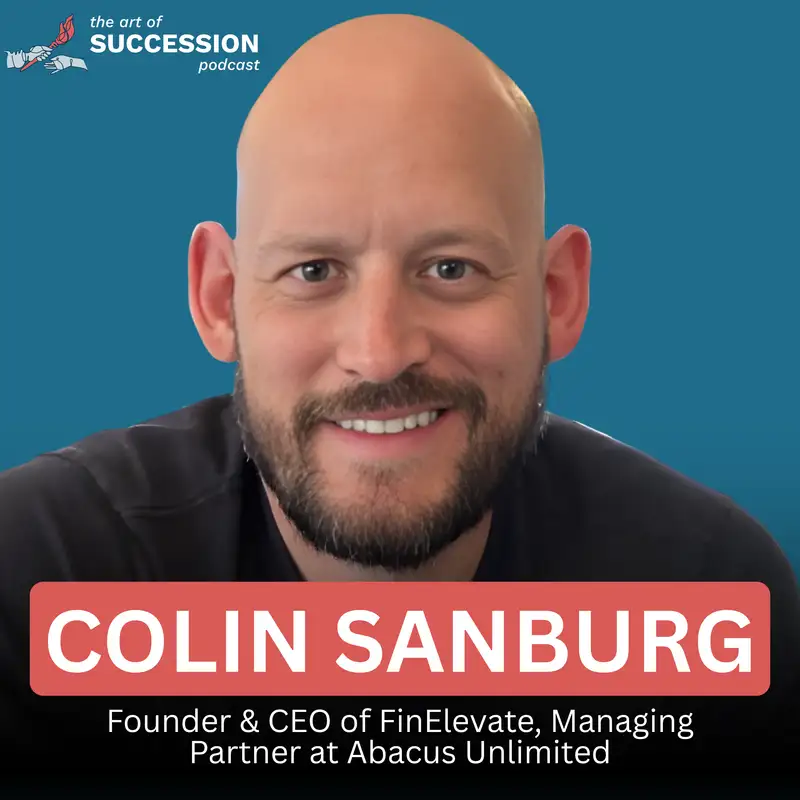
Today we're joined by Colin Sandberg, managing partner at Abacus Unlimited and founder and CEO of elevate, a fractional CFO firm helping entrepreneurs build stronger, more financially confident businesses. Talk to me about like a leadership lesson, something that you screwed up. I think the biggest thing that I learned is that the tone that is inside my head is not something that everyone can receive.
And if you expose that to people who are not wired for it, it is very demotivating. It is very intimidating and overwhelming. Being the number one guy, when you let your frustration show or your anger show, they receive it as he's mad at me. And so it took me a long time to figure out how to better handle that.
What's something that you didn't expect. The experience of founding a company that's different than stepping into all the existing businesses that you've done over the past 20 years. Oh man, that is the question. So I will tell you, starting a business is
00:01:13.990 — 00:19:20.339
if you're like most of our listeners, you love the idea of running the show, but you're constantly second guessing yourself if you're ready or the person for the job. Are you missing a key skill? Are you aware of the things you need to know, like reading a financial statement or financing the operations of a business?
We are here to solve that for you. Our new Free Ownership Readiness diagnostic will rank you from 1 to 4 on five foundational pillars of successful business ownership. It is the ultimate confidence builder that will tell you, yes, it is time to have that conversation or know these are the areas that you might need a little bit more time to develop.
If you're interested in taking that assessment, you can find the link for that down in the description below. Welcome to the Art of succession podcast with Barrett Young. Join us as we explore the strategies, stories and insights that shape the journey of leadership, transitions and business success no matter where you find yourself along the journey.
This is the podcast where you'll find the tools to make it happen. My name is Barrett Young and this is the Art of succession podcast. My guest today is Colin Sandberg, founder of Fin Elevate, a fractional CFO firm. Colin's been an entrepreneur his entire life and has both bought companies and is in the process of selling one.
And now he's on a mission to help business owners build better businesses and create more freedom in the process. Colin, welcome to the Art of succession. Thanks so much for having me, Barrett. Excited to be here. My pleasure. So I want to start off asking you, like what brings you to the art of succession?
What's like the most important thing you'd want to convey to our listeners? What do you hope they get out of today's episode? You know, I'm kind of an all around entrepreneur. Like you said, it's all I've ever really done. And, you know, I've loved kind of every different part of it. I'm big on Uh, acquisitions and, you know, and just kind of the, the way people get into.
Entrepreneurship, I always think, is a unique story for each person. And I would say that for me, it's, you know, the finance side is where I've kind of, uh, landed and spent a good chunk of my career. It was kind of a neglected part of my first business that I got involved with. And so it was just kind of next man up.
And that was me. I was decent at math, and there I was. But yeah, I would say that, you know, most entrepreneurs are risk takers and most entrepreneurs have have a bold vision. But I would just say that, you know, you cannot lose sight of the financial and and you have to kind of be a pro about your numbers. All right.
So just to put listeners minds at ease, two finance pros this is not don't don't turn off the episode already. Just warning. Yeah. And I definitely want to get into how you made that decision because you're coming at it from a different direction than I would myself. So we'll definitely get to that. But I want to like go back to Why?
Entrepreneurship. Did you have a parent that you were modeling? You know that modeled it for you? What is it because you you started your first business or acquired your first business at 21 years old? Yeah, I actually got involved in a family business. So it was kind of a it's kind of an interesting story.
I'll run you through a real quick version of it. So I was a troublemaker. And as a kid I basically, you know, was kind of looking back, kind of a classic entrepreneur story where I was getting in trouble. I didn't like school. I wasn't, you know, a conformist in kind of the way they wanted me to do it. And so I ended up not being on a great track to go to college.
And I ended up, you know, working a job right out of high school, wasn't happy, tried to put myself through school, ended up moving to Austin. I was I grew up in North Texas and I moved to Austin, wanted to go to the University of Texas and found out after I had just signed a lease and moved to Austin, that the University of Texas was the biggest school in the country, and they were locking out any transfers for two years.
And so the fact that I, you know, there's no way they would have taken me straight from high school. And the fact that I'd put in a year or two of, of, you know, really working hard and getting disciplined as a student at a local community college ended up working against me where it was impossible for me to get in.
And so that that kind of created an interesting path in my life. I'd moved back to North Texas, had to apply for my old job back, which was a really big kind of, uh, humility moment. I was working for a mail order pharmacy and a job in a call center that I hated, a job that I didn't enjoy. And so here I am interviewing for my old job, back from the same people who used to employ me, like a year earlier.
And I was sitting in the middle of a conference room waiting to interview for my job, and there was an ink magazine laying there. And so I started looking through the ink magazine. I'd never heard of Ink magazine, didn't know what it was. And I come to this article and I just started reading it and I'm like engrossed in this article.
Basically, the article was about a guy Who had been part of a small business, and he had cratered that business. It went out of business and it went bankrupt. And and so he had debt collectors calling him and harassing him. And he talked to a friend. And the friend said, you know, hey, here's a little side hustle you can do to make some money.
And the side hustle was going down to the courthouse and buying people's debt and calling them up and being friendly and being encouraging and being open minded to what they needed to do to work out of their situation. And he said, you know, you'll find that these people are. They're good people. It's just been a really tough go for people.
And so he started doing that in the in the third, second or third time he went to the courthouse. At the auction he bought his own debt. And it was like his own debt. He didn't realize his own debt came up for sale, and he bought it for like $0.20 on the dollar. And he said, you know, it was just he he basically cut it up, you know, tore it up, burned it whatever, forgave himself and moved on with life.
And for me, as somebody who had been in trouble as a kid and kind of just, you know, on a wayward path, somebody who would, you know, thought I could get up for a moment. And then it felt like things crashed back down. It was a lightning bolt moment. Like literally sitting in that conference room, I knew this, what I was going to do with my life.
The minute I saw that, it just showed me that here's a path where it's about what you're able to come into, not just where you've been, and that redemption is possible, and you have the chance to rebuild and make things right. And and this guy ended up becoming a billionaire. He he grew that debt collection company into one of the most successful debt collection companies, and one that actually was known for being good and reasonable and treating people with dignity and respect.
And anyway, that that changed my life. I took the job. I mean, I still interviewed and got my job, but the minute I did that, I was like, what's my shortest path to entrepreneurship? I've got to get into service on the front lines, and I had a family member who I did not have a good relationship with, but I basically just, you know, sucked up my, my, my pride and went and asked for a job and said, hey, this is what I want to do with my life, and I want to come here and learn for a year.
And, you know, I'll go out and do my own thing. And a year later, I was thrown into the financial side of that business. That's my first business that I ended up buying and I still owned today. So I'm in the process of selling that business. But that was my journey into entrepreneurship. And so from taking and getting into this business that I was thrown into the finance in because it was struggling, because the business was really in a bad spot.
And so it just gave me a very like boots on the ground appreciation for the financial side of business, not the textbook. Like you said, dealing with me does not sound like you're talking to an accounting textbook that you want to avoid. It's all just from practical experience. Okay, so a couple of things there.
It wasn't necessarily the the debt collection side of the story that set you off and was like, oh, I could do this. Like, you didn't go replicate that. Nope. And then the family member that you ended up going and talking to, like you said, bad relationship there, but you're like, that's an entrepreneur.
That's somebody who's been working for themselves. So I'm going to go start there. And like you said, swallow the pride and say, teach me your ways. So what what kind of business was that and how long, you know, how long had they been running it? And did you. Yeah. Just talk through that because that's been been a few years since since you bought that one or walked into that one.
Been quite a few years. Yeah. So it's an airport conveyor business. So like what you claim your bags off of at the airport? Okay. Like making repairs and maintenance. Oh, manufacturing. Yeah. Actually manufacturing. Producing the parts that go on those units as well as some entire units. And, uh, the business had been around for about five years when I started.
It was more of like a parts broker at the time. More so than a true manufacturer. Didn't really produce as many of its own products. It was a lot of like buying and selling and that sort of thing. And so I went to that business. Like you said. I really just looked at it. This is a is this an uncle? Is this a cousin?
It was actually my stepdad, okay. My stepdad, who I was, uh, did not have a great relationship with. I, you know, left the house when I was done with high school and it was not a friendly exit. And somebody who I just, you know, again, for my most of my childhood and not had a great relationship with. But I was so desperate to see it on the front lines and learn, like I looked around as the only person I knew who was an entrepreneur.
And I've I've really I've been fascinated in talking to entrepreneurs ever since, because I feel like there's a proximity thing to entrepreneurship. Like you, I've never met anyone who says, yeah, I just decided to be an entrepreneur. I'd never met anybody who was never. It's it's kind of that is going to sound funny, but it's kind of that saying where, you know, like when you see somebody up close, You're kind of like, well, they can do it, like it then.
Then I've got to be able to do it right. And and you know, that really started the the beginning, the early parts of my career where it was like it was almost the anti mentor in the sense that it was the person who you you saw them do it every wrong way. And you thought, well I don't know what the right way is yet, but that's not it.
I'm not doing that right. We'll get into the financial side of it as we as we took, you know, turn towards future endeavors. But what took you from working in that business and learning it and only playing it on being there for a year to eventually acquiring that business. How do you make that jump? You know, I showed up 45 minutes early my first day of work.
I sat outside, the chain link was still locked. You know, it was kind of had a yard type of a setup for that. I sat there in my car for at least half an hour before anybody showed up. You know, I was I showed up like I owned that business. That was my mentality that when I started. And so I approached everything with that kind of mentality.
And again, I was a 21 just turning 22 year old kid at the time. So I knew nothing about anything. Right. But I knew and I learned from just the experience I had that, you know, the ambition kind of paired with discipline is in short supply. And when when people who are on their journey see someone coming up who looks like that, that they, they want to they want to channel that, they want to get a piece of that and turn it on, you know, the the challenges or the opportunities that they're pursuing.
So I, I showed up that way my first day, my first day actually cleaned out the closet. Believe it or not, it was like a supply closet. But man, I it was like the the most important thing I'd ever done. And I just took that attitude to everything. And so within short order, whatever the biggest challenge or opportunity in that business, I was the one getting thrown at it.
You know, I came in with, like, I'm going to do something in marketing or whatever. You know, some just really generic type of, uh, type of title. And within about a year, you know, it was the financial part of the business was not working. I didn't know anything about it, but I was kind of like, look, I don't know.
I'm going to go figure it out. I can't be in it. And sadly, I was like, I can't be worse than the person who's doing it. Who I later found out was embezzling from the company, which was kind of another fun, fun twist in the story. But, you know, I think that was it. It was just being close to people and saying, you know, I could do that.
I see it, I think I can do that. How long did it take? I mean, did your stepdad bring up the option of buying? Did you bring up the subject like, still, we're still missing that connection between the finance department. You're the go getter. Everything is. Yeah, but that's a big step from. I'm going to take advantage of my stepsons labor forever, you know?
Yeah. Um, you can be an employee in family business for forever and never actually step into ownership. So. So how do. How did you get there? Yeah. So the full story or I guess the simplified version of it is I was there for about a year, a little over a year, got thrown into the financial side of the business because the business was struggling and failing.
The minute I got thrown in there, I was like, oh my gosh, you know, this is my stepdad business. My mom's gonna be in the poorhouse. It was like, I'm all of my dreams of, I'm just going to be here for a brief moment, learn a few things and go out on my own, suddenly evaporated when I realized that, you know what that would do to my mom if this business failed.
And again, the anti mentor, he was doing everything the wrong way. You know. Right. We could go through the whole list. But uh, in summary he's doing everything in the wrong way. So I stay there two years three years four years or so in. I then had found a mentor who actually was a CPA, but not like any CPA I've ever met since.
Uh, not a technical guy, just a really, like, you know, simple, kind of almost a business professor, kind of in a way that I had really tapped into. It just changed my mind. I mean, he taught me about and he's still in my life. He's amazing. But as I connected with that, I basically got to the point where I said, look, here's the problem in this business, and you keep recreating it.
And this is what I said to my dad, I don't want to keep trying to fix. And we're working against each other. And so it was like, hey, this this isn't really working anymore. We have to figure out something different. And basically the, you know, he offered me an ownership stake to buy an ownership stake as kind of a, you know, golden handcuffs.
Basically. He didn't want to lose me. He knew that I was, you know, I was kind of running short on on patience to wait around. And shortly after he ended up leaving the business and I took it over and, and then bought the remainder of it over a couple more transactions. But it was the classic, you know, young, kind of young up and comer and the, you know, guy was looking to retire.
He already had one foot out the door and just thought, man, this is easier to try and use this as a mechanism to keep him happy now. I don't recommend that to people, even having been, you know, the one. I've been on both sides of that type of transaction now, but it's not necessarily the cleanest or best way to go.
Yeah. How old are you at this point when you first stepped into the the partial ownership? 2425. Oh, wow. So pretty quick. Then after stepping in there. Oh, yeah. Yeah. Five years after I started, I was, I was CEO and I and he left and he never worked another minute ever from the day he left. And so yeah, it was it was kind of an interesting very fast ride of getting in and learning and you know, and of course I there's a million things I didn't know then that I know now and a million things left that I still don't know.
Obviously the state of the business was disarray. There was embezzling going on in the finance, but I mean, what kind of a structure was there, what kind of a relationships, you know, what were you stepping into at the time? Five employees, 50 employees. What what did that look like? And then where did you get it to eventually.
To the point where you now looking to sell it? Yeah, it was 10 to 15 employees at the time. Okay. And and you know, we were making the mistake that many small businesses do is trying to be everything to everyone. Right. There were huge companies in our space. Siemens, for example, which is a multinational, you know, multi-billion dollar company was in the same airport conveyor space.
And so when you're in a space like that and you're trying to be everything to everyone, it's just an absolute losing recipe. So what I did with the way I looked at it was I better understood the numbers. And just on a really simplistic right, like I always say, the the numbers in in business, you don't have to have completed all the highest levels of mathematics that are available.
It's like addition, subtraction, Division, multiplication. Fifth grade math. Fifth grade math. That's pretty much with some statistics. Yes. Yeah. When you're getting fancy, you can mix in some. But understanding some really basic parts about what was working in the business and what wasn't. And there was a part of our business.
We had 12, let's say, 12 employees at the time. There was a department being run by one guy, and I could prove on paper it made money and the rest of the business, the business combined didn't make as much as that one department made. And so I'm like everything else, we're losing money. Everything else is we're chasing the revenue and the and the vanity of it and these big projects.
And the reality is that one guy kind of in the closet back there, just working the phones and brokering parts till he makes money, everybody else loses. And so that was really the, the I think the, the big part of kind of trying to make that transition. And so I had to my very first day as a CEO, I had to let some people go.
I had to trim down the business. I had to make some really harsh decisions. And, you know, candidly, I didn't always probably handle it well. I was very, very driven, very men on a mission, very take no prisoners like you're with me or against me kind of thing kind of mentality, which was my bunker mentality.
I thought at the time I needed, I think elements of it were needed, but it was just I was young, I was inexperienced, I didn't really yet know how to lead people. And so yeah, that was that was kind of where it all started. And there was probably a five, five additional years. I mean, it took a total of probably ten years to turn that business around and get it to where it was doing well.
Yeah. Okay. So talk to me about, like, a leadership lesson, um, something that you screwed up and maybe got a second chance or
00:19:21.690 — 00:41:04.160
Because you saw your stepfather was doing things that you're like, I don't want to do that. But then it's so easy when you're in those in that position yourself to become the boss that you're like, I never thought I would become that guy, but but sometimes, like you said, there's a portion of it that's necessary.
But there's a there's a right way to do it and a wrong way to do it. So. So share a story there and just how you learned maybe from your mentor or somebody else in the company. Yeah. So you know, number one, I love what you said because, uh, it was jarring when I went from being the number two guy who everyone talked to, everyone you know, was trusted.
Everyone trusted. Everyone saw that. Like, well, if you if you want to get something done around here, you bring it to Colin, you explain it. If it's good for the business, he'll go fight for it. He'll make it happen. And then all of a sudden, you're the number one guy. And all of a sudden everybody and they stop and.
And I couldn't really understand that. And it took years, really of reflection back to figure out part of what was happening is just, you know, the stakes are different when you're talking to the number one boss. And as that boss, you don't have the. I'll see what I can do. I understand your side. You know, people expect you to give straight answers and be straight up when you, uh, you know.
And so it was a really it was a that was a hard adjustment. Um, I think the biggest thing that I learned is that, you know, every person has different personality styles. Obviously, we know that that's now in vogue, by the way. You know, we're talking about 20 years ago when I took over the company, the disc profile and the in the Enneagram and all that stuff was not being talked about.
It was not well understood, at least not commonly understood. And I realized now and I this is still something I have to work on. The tone that is inside my head is not something that everyone can receive. And I am a very like, turn it on myself, have a harsh kind of tone in the way that I think about things. I'm very kind of unrelentingly exacting what I'm trying to assess what's working and what's not.
And if you expose that to people who are not wired for it, it is very demotivating. It is very intimidating and overwhelming. And what I found out is that when you're that type of person and you said it, it was like I saw this wasn't working. As with the boss, I could kind of hide and be the number two guy, and it was a lot easier to be.
Everybody liked me and respected me and knew that I just wanted good things. And I wasn't, you know, manipulative or any of that kind of weird stuff. So people trusted me. Being the number one guy, when you let your frustration show or your anger show, it feels like it's directed at people. They feel it. Instead of it being like, I'm frustrated with you at this.
They receive it as he's mad at me and he's big guy and he's intense and he's. And so it took me a long time to figure out how to better handle that. And I'm not perfect by any stretch. Yeah. That's good. I mean, who's helping you through this other than the the CPA who'd become your mentor? Who are you in a mastermind group, or are you just reading books?
How are you learning this kind of stuff other than just screwing it up and having to say, I'm sorry? No, that's a fantastic question. So the mentor for sure. Um, and and the other thing that was absolutely breakthrough was I did get introduced to mastermind groups when I was 23, 24. Nice. Probably about halfway through the period where I was at the company and really deep in the problems, but not yet running the company.
And that's life changing. And I'm it's still to this day, one of the biggest things I promote to people, not just for entrepreneurship, but for anything you want to achieve in life is having other people who are on a similar journey who are willing to be open. Share with you the good, the bad, the ugly. I'm.
I'm just so passionate about the power of that. It's absolutely changed my life. Nice. I totally did not set you up for that question. But yeah, I know, just in my experience as well. Just peers because you can't talk. You can't talk to your employees. They take it the wrong way. You can't talk to a spouse or a family member that's not in that they they don't necessarily understand it either.
And sometimes they worry about things that you don't worry about as an entrepreneur, but talking to other peers that are like they don't have a stake in the game, like their business is not going to collapse because yours is in the process of collapsing. But at the same time, they have a stake in you and it's like they're like, I want to see you succeed because you succeed, I succeed.
I learn something from helping you succeed. It kind of. Yeah. So awesome to hear that, um, especially at 23, 24 years old, having that influence early in our lives to guide us makes us a better 40 year old, makes us a better 50 year old. Oh no doubt it was, like I said, life changing. And yeah, I was 23, 24 and most of the guys in the group were 50 and they were running their companies and they were on the opposite kind of end of their career.
They were looking at what the end would look like. And for me, you know, they were some of them were in their 60s. And that also I kind of mentioned that earlier. That really reinforced that. One of the most under utilized opportunities in life is asking people for help. Just be willing to ask. I mean, when I was that age, I invited those guys out to lunch, the guys who ended up becoming my great mentors, who I still am in touch with, the ones who are still around and and just reach out to him.
And I remember one of them was, you know, really blunt guy. And he goes, what, Colin? You know, we had a nice lunch. We're chatting, we're catching. He was calling, invited me here for lunch. What do you want? What do you want? And let's get to the point. And I love it. And I said, Mike, we've spent two hours now talking.
Yeah, You look everything in the world. But you haven't gotten to the ask yet. And I said, Mike, man, I don't need anything from you. All I want is your advice. All I want is that, you know, you've seen things that I can't even imagine yet, and I. I don't want to wait until I'm there to kind of figure it all out.
And I see what I see who you are. I see the way the group looks at you and you talk. I know that you have their respect for a great reason. And and that's it. That's all I'm here for. And man, you you would have thought I had just given him, you know, the best Christmas gift. And I tell my sons that and and my daughter when she gets older, we'll have to hear a lot about that.
But it's like, you know, just again, being that up and comer, being that person who's somebody sees the ambition and the drive and the hard work and the willingness and then opening yourself up for the vulnerability to say like, hey, I don't know it yet, but there you might be able to help me is the most flattering.
You want to talk about getting somebody on your team and willing to run through walls for you. Like, that's literally all it takes is to ask. And so few people do it. Yeah, that's really good. All right. So I want to get to the position you're in now is now selling this company after 20 something years. But I want to get there in the second half.
But before we get there, you've started other companies and you started Thin Elevate too. So yeah. What took you from I'm successful with this company. You know, it took you ten years to get that turned around. What took you from that to it's time to start other ones rather than just focus on the one company?
Yeah. So I actually had this guy that I met pretty early in my career, and I didn't I didn't like a lot of things about him, but I really admired the way he had structured his businesses. He owned multiple businesses and he didn't work at any of them. And when I saw that, I thought, man, that guy has something figured out.
That's really cool, because even though I was still pretty early in my years of of my first company, even though I was, you know, in the day to day, I mean, deep in it. Right. 70, 80 hours, whatever it was. I saw that, and I thought, man, that's smart. There's something to that. And didn't love the way he went about it, but I admired that element.
And so when I got to the the first company to where it was successful enough that I could make investments, that was kind of what I went out looking for. And so I actually did not start another business right away. I bought into another business as a partner for someone I met through a mastermind group. And it was, you know, basically a business that I could bring some of the lessons I learned.
He my partner needed some of what I brought to the table that was different than the experience he'd had. You know, he knew the product. He knew the customers. He knew the day to day operating of the business. And so that was kind of more the way that it evolved was me acquiring other companies. Um, with that in mind.
Gotcha. So most of these are in your network. It wasn't like you started going out on the job market or the websites or anything and buying up distressed businesses or anything. These are talking to people and saying ten, 15, 20% share whatever the case might be. Yep. The first one was, the first one was the or.
My second business was a minority stake that I still have. My third business, I acquired a business in the industry in the airport conveyor industry. So back in that space acquired more strategic, then more of a strategic acquisition, bought the full business in that case. And yeah. And then and then finally to my first startup, which came from I got to that place that I were, the original guy I saw had been where I had my own office.
None of my I never talked to any employees, any customers, any vendors within the first three businesses. And I was just basically the kind of the the, you know, home office, if you will, my partners and the people who ran those companies would come to my office to visit to do kind of Strategic thinking and planning.
And yet, even though I got to where I said I was going to get to this little idea in the back of my head about what eventually became Fin elevate was just kind of nagging at me that I had this area of the business I loved. I was passionate about that. I wanted to kind of bring to market, and I didn't. I didn't see anything like it when I looked out, and I actually tried to solve that problem myself by finding someone and could not find what I was looking for, what I eventually started building.
Okay, the second business that you bought into the minority stake there is that was that like the financial skills that you brought, or was it something else that was complementary with that business owner? Yeah, it was. I would say it was mainly the kind of the financial skills, the turnaround experience that I'd had in my first company.
It was kind of all of that side of business. Yeah. Gotcha. So within elevate, you're like, well, I could acquire businesses, but most businesses don't want a minority stake in them. And so there are just some that want to pay me for this service also. And you're like, there needs to be this company doing that.
Yeah. And and going back to you mentioned, uh, masterminding. Right. We talked a lot about that. I realized that I just love dealing with entrepreneurs. It is just my passion is these are my people. All my best friends are entrepreneurs. Once I got into masterminding and kind of like learning from other entrepreneurs and reaching out to them, all my best mentors, all my best buddies have come through that.
It's just people I relate to and that I understand. And so I didn't want another business that sold outside of that market. I really identified, like I want to be dealing with entrepreneurs. And it was kind of this perfect aligning of the stars. I thought about the business model that I would want to be in, and I thought that I, you know, I would go on a big trip every summer with my family.
I needed to be able to work from anywhere. I want to be able to hire from anywhere, find clients anywhere. And so I just kind of like put down this list of criteria, and when I came back, it ended up being a fractional CFO service, which perfectly suited this kind of unique way that I look at business and allow me to work with entrepreneurs.
So it was like the dream to kind of figure it all out. Talk to me about those early days. I mean, you've got a couple of other businesses that are cash flowing and everything like that. How did you start to then talk to people and say, well, no, that's what I do over here, but I've got this new thing that I want to I want to pitch to.
I've got this new thing that I'm trying to do and then just talk. Do talk about just the not not the barriers to entry. I hate to say it like we're like, walled this off. It's only CPAs or something. But just talk to me about the different approach because you're coming at it. As a business owner that knows finances versus most CPAs are like, I know finances and I've learned business, or a lot of them never do.
So. Yeah. Just talk to me about starting that and what conversations looked like. And then just how you how you identify the right clients and and priced into it and everything. Yeah. So it really happened very organically. Like I said, I was on this mission to kind of learn about. I've always just been a really passionate learner.
That was one of the things my first mentor just got me onto was like business books and learning and thinking about things differently. And so I just I really recognized from some of the struggles from my own businesses that there are just very different business models, very different ways to approach the market.
And so, like I was saying, I built kind of my criteria list and eventually came back to this idea of, okay, I'm going to do this fractional CFO service. It had all the criteria that I was looking for. It was in this wheelhouse that I was really comfortable with. But it it really happened organically because I actually when I was outside of my first three companies, I basically was working as the fractional CFO for my own companies.
So that was always a part of the business. You know, the partners or the people running the company would come to me. And that was kind of my spin on it. I knew all the other areas. I mean, I've learned everything I could possibly learn so far about sales and marketing and ops and people and on and on. Right. It's just part of being an entrepreneur.
But I, I always was that finance guy. And so actually, ironically, Covid had a big impact. It really hurt my business, obviously the airport conveyor business. But when the PGP was happening in the early days of the URC and everybody's trying to figure out what these things are, what they mean, what's happening, everybody's talking.
I was just fielding tons of calls and reach outs from entrepreneur friends who thought of me as a finance guy and said, this guy probably has a good opinion on this and knows what's coming or has, you know, has some thoughts on it, and it just kind of put me in that seat a little bit informally, you know, just a friend and advisor.
Yeah. But it kind of opened my eyes to like, huh? That's that's an interesting twist, because these guys call me, and they. They just openly admit, like, I don't really do any of this stuff calling. I don't know what any of this stuff means. I'm just looking at my bank account. We either have money or we don't.
And so that kind of gave me this, this inkling of an idea. And my first handful of clients just came as friends who were like, you're already advising me on this. Like, I heard you're launching this business. Can you help me? And so obviously I did it for my own company. I started doing it for friends and just kind of referrals from those friends, and then eventually started marketing it and working on growing it.
Nice. Okay. How how was that conversation from. I'm giving you this advice for free. And now you're going to start paying me for it. Was that was that a tough shift or were they willing I mean, jumping right into it, willing to do it because you'd already proven yourself? Yeah, I think they were excited because they kind of saw it as they were going to get more of the, you know, more of what they what they valued.
And, you know, we help. I mean, obviously, fractional CFO, I would say is, is kind of that go between between your bookkeeping, your CPA, your vision for where you want your business to go. Right. Some of the the challenges and opportunities that always present themselves. It's kind of in the middle of some of those things.
And so we we help some people with kind of getting their books cleaner, getting some of that figured out that I just happened to come up through that part of the business. And so I understand the accounting very, very well. But it's always been strategic to me. In other words, it's not getting excited. And they're not about debits and credits.
It is like what happens if we have to write off inventory? What would it mean? Let's face it through. What's the mean of the balance sheet? What's the need of the bank? What does it mean to the PNL? The tax return? On and on and on. Like there are ramifications here that we have to get our arms around. And so most people haven't had those opportunities or haven't spent the time on it.
And so they're kind of like, man, if I can tap into that, like, yes, I need to make a decision like, please, let's, let's do that. Just talk to me just a little bit about your differentiation or who you work with. And then also like people get confused when you say fractional CFO because there's fractional comptrollers.
There are bookkeepers like you mentioned, there are CPA firms that do your taxes and can do bookkeeping, things like that. So who's the ideal client for a fractional CFO, where you might talk to somebody else and be like, you don't need a fractional CFO, you need a bookkeeper. You're not at this level yet.
Talk talk a little bit about that with. Yeah. With with your company. Well so we we primarily target companies that are between 1 and 20 million in revenue. Uh, it just as a kind of a simple qualifier, obviously, you have to be big enough where the the value that we add is something you can actually realize, right?
And I always say it's when people have basically outgrown the I live out of my bank account as kind of my primary accounting system. To your point, if the books are a mess, they need that first. That has to be. That's kind of a prerequisite of us being able to do a great job. And that's not uncommon, that it's a mess.
If there's something wrong, it's off. We help with that, you know, a little bit. And mainly, you know, direct people to someone who can actually help them solve that problem. But to your point, believe it or not, we were in business for probably a year and didn't know what to call ourselves. We tried all kinds of weird names and eventually landed on fractional CFO because it was understood enough that people would go, oh, okay, I know that's something financial and I know what it is, but I don't really know what it means.
And so it was vague enough. We could then say, but here's what that is for us. Here's what we do. And and that's where making it palatable for the entrepreneur. It's a huge part. It is not like let's go in and micromanage together. Sit here and you watch me. Micromanager. Three page personnel like that is not what we do.
And so I think that's part of why entrepreneurs really love working with us. What's your specialty or what you're like ideal service that you guys are doing. Is it acquisition? Is it moving into new territories like where have you where have you really identified? Like this is who we do work best for? Yeah, I think that we work best for you know, we we we kind of say better business, more freedom.
We work best for, uh, entrepreneurs work with a lot of people from like strategic coach or who are on run on iOS. Basically the people who have realized that they are not the, you know, one person multi-tool, Swiss Army knife that has to try and solve every single problem. Right. And so in terms of the types of businesses, types of services or where they're at in that challenge, usually it is I like to say we're going to create a, a financial GPS for you.
You're going to stop looking just backward and we've got to start looking forward. And so that means obviously getting into more budgets and forecasts and cashflow forecasts and things like that. But then that's not the end all be all either. It's really to boil those things down, handful of of core metrics that can be on a dashboard and get your team involved in solving these problems.
So I think a huge amount of small business problems come from the fact that the owner feels like they're the they can't share the information with anybody, and yet the team is making real financial decisions on your behalf without knowing they're literally doing it blindfolded, without knowing what the results are.
Yes. They don't know what the what they're trying to do. They don't know what the results are. They don't have the education to know if it worked or not. And so there's kind of this pull and push that happens because of that. And so we look for creative ways to solve that, of basically building metrics that are really tied to the real financials, but that you're comfortable sharing with the team and that we can teach the team how to pull those levers and get better results.
What's something that you didn't expect? The experience of founding a company that's different than stepping into all the existing businesses that you've done over the past 20 years? Well, I mean, that is that is the question. Um, so I will tell you, starting a business is wildly different than buying a business or buying a business.
What I was used to my entire career, from the first business I stepped into, to the ones I bought, was that a business has a momentum, and a lot of times we're not happy with the momentum that it has. So we're trying to like, fight the momentum to turn it into what we want the business to do, right. That could be fighting the momentum of what the customers expect.
Or the team could be, you know, trying to reshape our product, offering business terms, whatever those things are, there's some existing momentum. You're just trying to divert it and change it. Yeah. You show up in a new business that you you create from the ground up and there is zero momentum and you're like, wait a minute.
I mean, I got here, I got a great idea. All my friends say, this is something everybody needs. I've gone out to my mastermind groups, my mentors, my, you know, everybody's like, yeah, yeah, yeah, this is it. This is great. And I know that it has the the fundamentals. And yet day two nobody cares. Nobody notices.
It's not right. Nothing's happening.
00:41:05.320 — 00:53:41.340
And so the the amount of energy that it takes I, I am getting in year two and a half going on year three where I thought I would be in the first six months. And it is just and I don't just mean that in terms of client acquisition, I just mean that in terms of everything. Like every single thing you have to figure out.
And and because when you're changing the momentum, you're kind of triaging, like what matters to change today? What's the hottest thing I needed? Everything else just keeps its path. And with this, it's like if you're not actively pushing and working on it, it is. It goes to zero. And so that's a different that's a very different experience.
I mean, you you're too soon into it for me to ask if you have a favorite buying or starting. But I guess I do want to emphasize it takes different skills and both skill, both sets of skills are needed. Like in my case, I started a company before I decided I was better as an acquirer. I was better with the existing because like you said, you have to go out and and that's the thing.
There's it's very easy when you're the founder to also start momentum in the wrong direction. And then you look at something and you're like, why is it this way? And it's like, oh yeah, that's my own fault. I, I'm the one that put it that way. Or I like the joke. It's like, as soon as you get your second client, you now have legacy clients.
It's like, why am I letting them treat me this way? Oh, yeah, that's my fault, I did that. Yep. I like stepping in. And you know, most things are moving, and and I found that I was much better, like Picking something and fixing that without everything. Like like you said, require me to push on it constantly for it to just keep even, just inching forward.
So yeah, it's it is a very different, uh, different thing. I will say that I am a huge fan of acquiring companies. Unless the company that you want does not exist. Okay. If the company that you want does not exist, then obviously it's not an option. That's how basically how I felt was that I had a very unique way I wanted to go about the fractional CFO service.
You didn't want to you didn't want to buy a bookkeeping firm and see exactly. CPA firms step into their existing exactly roadblocks and and mental pictures and everything. So yeah, and in some ways that would have been faster. Just like, you know, the actual financial numbers would have started higher and I would have been able to have some of that momentum.
And I would I would have gone into that kind of like, how do I change all of this kind of mode, which to your point, I'm more comfortable with and maybe better suited for. Honestly. But I was so passionate about the kind of product development, like what the the intellectual property of the way I looked at it and how we were going to build around that.
And that's one of the great opportunities of, of a startup, is that you have the luxury of being able to work on that. But yeah, I think if, if you if somebody tells me like, I want, you know, whatever, just name any random business, damn, I want, I want to start a landscaping business. It's a buy all day long by one.
Probably getting that one. Yep. Get that, get that head. Start that 3 to 4 years of momentum already locked in that will take you you know, that long to get to that point. Yeah. Yeah. You're mitigating your risk with that. I mean that's you're buying revenue. You're mitigating a lot of risk in because there are a hundred hurdles that you may not overcome right.
In, in starting a business. And I had the fortune of I had made money elsewhere and so I could do a funded start up my own funds, but I could do a funded startup. Not a true like bootstrap. It's just me. Until the day that I can afford to bring. Like, I didn't have to go that route. Yeah. Um, and so that that also changed the equation versus the, you know, a lot of people having to start up.
Yeah. Awesome. Um, I mean, we're getting towards the end, but I do want to get into just the, the sale of a company. What brings you to the point of saying this has been working for now, ten years into 20, that you've been working on it. What gets you to that point of it's time to offer? It's time to offload this.
It's time to harvest some of the value in that business. What what brought you to that point? Yeah, I think it is the the emergence of the new business. And that's where I want to focus my time and energy. I also think that, you know, I, I had I've been guilty of this many times. You probably have as well of having this romantic idea of what something would be until you're, until you're actually living it.
Right. And so I had this romantic idea of what it would mean to own all these different businesses. And let me give five businesses and ten businesses and, you know, 100 businesses, and you realize you're just kind of crowdsourcing problems at some point. Yeah. And so you mean passive income isn't passive?
Is that what you're trying to say? Okay. I will tell you my biggest. My biggest beef that I go around telling people is like, we somehow went from this, like, rising grind kind of nonsense of 10 or 15 years ago of like, you know, you're only celebrating if you're working 200 hours a week. You know this nonsense.
Yeah. To mailbox money. Like the pendulum swung so far that it is. It's like, oh, you could just turn that business into a passive business. And let me tell you, there is no such thing in this world as a passive business. If you're not working your business, somebody else is, and they probably don't have your best interests at heart.
Right. That's good to riff on that for a minute. What do you mean? If you're not working on your business, somebody else is, because I totally understand it. But our audience might not. Yeah, absolutely. So. You know, small businesses are different. This is not you know, if we hire somebody and it's, you know, we're in a fortune 500 company, there's, you know, depth of management.
And those people's careers are made on the results that are shown. That is a different environment than what happens in a small business. And the reality of small business is there's a weird psychology that is kind of unavoidable. That is like I'm working with the owner or I see the owner over there. Oh, the owner must be rich, you know, we just gotta land a new job.
Business could be losing its shirt. And there's this misconception. So there's something different about small business and this idea that you can just turn it into this passive entity is not realistic. For my experience. I'm not saying no one has ever achieved that, but that doesn't make it realistic just because one person did it once.
Right. And so I think that you have to have an owner's mentality present in that business. It is just part of the lifeblood of a small business. And so you have to ask yourself, if I'm not willing to do that or I'm not interested in doing that. Is like, what is going to be the cost to the business? Right. And, and one of my mentors, just kind of a friend that I met along the way, I thought was a really wise guy named Barry.
He told me one time, he said, there's no solutions, just trade offs, right? Yeah. And I was like, dang, that's good. Like that's real. That's Thomas Soul right there. That's okay. That's economics right there. So to that point, right, what am I trading? Like I'm not solving. What am I trading I'm trading getting some of my time back.
With this perception that the business won't be harmed, won't change, will still have the same drive, the same energy. And that is not realistic. And so when you when you look at it that way, okay, if it doesn't have that soul, doesn't have that drive, doesn't have that, like passionate finger on the pulse.
What does that do to my risk profile. And so at some point, you kind of come back to this realization that I did anyway, that I would be happier having one business that I love, that I'm really building, and I still have other investments and do other things. But one business that I love that I'm really pouring myself into, then 100 businesses that I can tell people I own but don't have anything to do with.
Yeah. That's good. And those businesses that you're still invested in, they have that operator they have you are just the minority stake in those businesses. But it's kind of like the idea of you have a company culture. You're either intentional about it yourself or your employees or building it your your loudest clients or building your suppliers are building it.
There's somebody that's building that. When you're not actively, intentionally building that, you're right. That's what you're. That's what you're talking about here, is you're not actively building that company anymore. And so it's being built around whoever the person is that's operating it the loudest.
So yeah. Yeah, a group of people, I mean, every time you hire somebody or let somebody go, the culture in a company shifts in a small business, every single one is can change everything. And and I think to your point, there's 2 or 3 things that an entrepreneur or small business owner really has to own. And you hit on it.
One of them's culture, right? I think one of them's the vision of the business. Like, where is this business going? Another one that's equally important is that culture. And so how can I how can I do that? Right, I love strategy, you can stop me on the street and, you know, give me a quiz. Hey, here's the situation.
This, this, this. What do you think? And I'll pop off an answer. Right. That's that's fun. That is not good business when it comes down to it. And so the idea that I can be somehow so disconnected from this business that it's mailbox money. And yet I'm keeping my finger on the pulse of and able to help direct the vision or the culture of the business.
That's not real, that you can't do that. I feel like I've proven that myself just from trying that. It just doesn't work that way. And so again, when you make those trade offs, if that's what's needed from an entrepreneur or from the the owner of the company and you're not providing it, you really have to ask the question, then why am I an owner of this business?
Like what am I what what value am I adding to the business to make this a good reciprocal relationship? Nice packaging up this business for sale. Just very briefly on that because we are out of time. Are you are you already in due diligence with someone? Is it are you looking. Is are you going for a strategic acquisition by somebody else in the industry?
What are you what are you looking for there? Yeah, it's actually selling to the existing management of the company. Oh, okay. Interesting. Yep. Definitely an exit plan that a lot of people don't think about. sir. Yeah. Through like an Esop with managed limited shares for management or 2 or 3 people in the company, you're going to buy it.
Yep. The latter a small number of people. And, uh, so yeah, that's the that's the plan. They're, they're, they're in, in it, they're setting the culture. They're doing all those things. And so yeah. And for me, it's just a chance to kind of regroup and put all my energy back into elevate and keep, keep growing it.
What would cause you to go back into acquisition mode again in the future? You love and founding mode right now and you're seeing the benefit of it and everything like that. But yeah, I mean, I think right now I'm loving my business, right? That's that's not necessarily founding mode, but founding mode has been fun.
Um, again, I love learning. So to me it's just an opportunity to learn through doing something different. I am still very much a proponent of acquisitions, like I think that is the best way to get into business. And so I think when I get to the point where my first business is is generating enough capital and I want to diversify it.
And I've got, you know, I will be very intentional with the kind of industry, the kind of business model that I get involved with. But and so I think that's it. It's just a it's kind of a seasons of life kind of thing where when I'm in a different place, that'll be that'll come back around. Gotcha. Okay. Um, I mean, we have it's been a great conversation call, and I appreciate your openness on this and just talk and shop and everything like that.
Did you have anything you wanted to cover that I haven't covered before? We jump into Lightning Round and wrap up the episode today. No, I don't think so. This has been great. All right, well, I appreciate it again. Let's get into the lightning round. So, um, do you prefer coffee or tea? And how do you like it prepared?
So I'm a coffee guy. I go cream, no sugar, and, uh. Yeah, just I've got a little frother. So this is how I've taken my. My cup at home to the next level is just the frother that that, you know, heats the milk and frosts it. And then you mix that in with the. And it's like night and day versus just splash of cream. So.
Awesome. Okay. Um, pie or cake? And do you have a favorite kind? Man, I'm a cake guy. So my my family thinks I'm weird because I'm not a big fruit person. And I don't like the syrupy sweetness of pie that normally is associated with pie. And so I would say for cake, give me like the really doughy, cakey kind of stuff, like a, like a cinnamon crumble cake kind of.
Mhm.
00:53:42.500 — 01:01:53.230
Gotcha. Yep. Okay. Do you have a favorite holiday and why? You know I love Thanksgiving I think it's it's got all the family elements. But it kind of cuts out some of the get a bunch of stuff, you know pile of stuff and trash and stuff everywhere. Um, and it's just kind of it's kind of a weird thing. Obviously the cooking is going on, but you're just kind of killing time together, which I think just feels very wholesome somehow.
Yeah. I think Thanksgiving, over the course of two year and a half of running the show, I think Thanksgiving's got to be in the lead. Okay. It is. So it is my personal favorite as well. But I also consider at the start of the Christmas season. So it's just the whole thing for me. So. Yeah. Um, are you a morning person or a night person?
And do you have a favorite routine? I would say I'm probably more of a night person. I'm not one of these big morning routine people. I would say that the biggest routine is that I take my kids to school every day. I still have two kids in elementary school. I know those days are fleeting. I got a fifth grader and a third grader, and I also have an eighth grader, so I see what it looks like on the other end to kind of not have that anymore, but I've just built that into part of working from home.
And part of the way my business is structured now is that I have that ability, and that's been really 2 or 3 years that I've been doing that. And it's just it's completely changed my life and my experience with them. It's there's something so different about feeling like you're integrated into kind of the that day to day of it, instead of just trying to make everything the fun.
High notes. Yeah. That's awesome. Um, what's a common belief among entrepreneurs that you would want to challenge common belief without going too far down the rabbit hole? So there are only two types of profitable business in the world that I've ever seen. One has massive scale and low prices. One is a normal business that any of us have ever run or seen, and the only way to make it successful is premium prices.
And that's it. And I think people get that mixed up and they think like, I can be the littlest and the cheapest and the most unique and the specialist and and it's such a weak sales mentality to think that I've got to like, figure out where the market is and underpriced them by $10. And that's a secret recipe.
No, you will start cutting corners everywhere you turn out of necessity. It will be experienced that way by the people you do business with, and they will place a lower and lower value. You start basically negotiating against yourself. So that would be my biggest thing that I see. A lot of people have that misconception and I just push, push, push.
You've got to have a premium price. If you don't and you don't think you can. You have to figure out what would what would change that. That's an underlying fundamental problem in your business that you have to address. Your pricing is the byproduct. Now I love that because it is like, well, nobody will ever pay premium prices for tax preparation.
And that's like, well, not the way not the way you've framed it, not the way you do it, but you have to figure it's on you to figure out how do I frame this? How do I do it in a way that they will? So. Exactly. Yeah. Because we can't all be unless you're going to be number one in the world. Amazon, Walmart, you know, whatever this is, you can't go for the volume when you're 15 people.
Not at all. And I would say the yeah, the most exceptionally successful businesses somehow have figured out both. Right. They've got they've got premium prices sometimes hidden. Amazon's premium price is not their product. It's that everybody keeps paying them for Prime right. That's how they actually make money.
Same as Costco that it's that model. It's the membership model. So but the most successful sports leagues and all those kind of things, they somehow have scale and premium. Those are the businesses where you really make the just like gobsmacked kind of money. But for the rest of us, you just want to eke out a really nice business and a good living, and you want to be successful in a normal realm.
It's not possible without premium, I just don't. I've never seen, never seen anybody pull it off. Nice. I like it. Spoken like a true CFO. I love it. Yeah. Had to work with it. Yeah, right. What is one thing that you would want your successor to remember you for? Ran the business with integrity. Hmm. Let me explain just a little bit on that.
Yeah. I think that, you know, part of that we talked on that. We touched on the word culture. And I think that I'm a very task driven guy, kind of described, you know, some of the challenges I had early in my career, not always being the friendliest, not always being the some people tell me I don't suffer fools.
Well, right. So like, not not always pulling punches when when it's time to give an honest assessment of what I think is going on. But I try to conduct myself every day with integrity. I don't care if it's somebody who is a friend or a foe. I will not, you know, take cheap shots and I will not go that route. It's just not what I'm not the way that I believe that things should be done.
And, you know, it's it's kind of, I guess maybe the father in me, it's like I want my kids to be proud whether they know what I'm doing or not. Like, I want to conduct myself in a way that I can be very proud. Great. Awesome. Thank you. Um, where are you finding creativity right now? I am finding probably the most creativity in trying to learn things not at a rapid pace.
There was a time in life where I was just trying to consume things as fast as I could. But I tell my son this because I've got my my eighth grader who's he's he's a smart kid. And so some of his classes are not very challenging. And he's like, man, this is boring. I'm like, hey, go deeper. Like you're you're saying that the superficial kind of surface level information that they're trying to convey to you is boring, but like, look under the hood of what's really going on there because there's always more depth.
And I think that's where we learn the big kind of profound lessons. And so for me, whether it's looking at somebody's financials or a challenge a business is dealing with or a subject I'm trying to learn, I've been coaching all my kids in soccer. I never grew up playing soccer. There's so much creativity and learning something and trying to understand the depth of it that you didn't know before.
That just sparks creativity all over the place. I end up talking to all my businesses about soccer, you know, which has nothing to do with what they're doing. But there are lessons to be learned that you can transfer anywhere. Nice, I like it. Colin, what do you have coming up in the next year or so that's got you really excited?
We are building a better kind of product and experience for our clients. So that's I think dashboards think tools think connectedness between their accounting software. And what's funny is everything we do, I like to describe as you have to go out in the world and understand it for all its complexity, so that you can come home and simplify it, simplify so many people.
Early in my career, I skipped that second step and I felt like, hey everybody, look how complicated things are. And I figured it all out, you know? And and man, nobody's got time for that. Certainly not my clients and or even team members. So it's trying to figure out how to solve for problems. And there's a technology, obviously wave that's just changing the world with what's going on with AI.
But how do we bring it back and make it a human element? Because for all the tech and all the exciting stuff that's happened in this world, it's just going to make us more desperate to actually have that human connection as we're going through these things. So that's that's to me, what's I'm excited about is build out product, not to automate and eliminate humans, but to empower humans so that we can do our job better.
Love it. Awesome. Um, on that note, Colin, I just again want to thank you for being on the show. I appreciate it. Where can, uh where can people go to find out more about you? Yeah, the easiest way. I mean, I'm on LinkedIn all the time, so LinkedIn is is a good one. Or you can just go to you know, fin elevate com and kind of check out what we're doing.
I love like I mentioned I love entrepreneurs I love dealing with entrepreneurs. I don't I'm not one of these guys who like everywhere I turn I'm trying to convert everybody into a client. That's not that's not my vibe. So I love, you know, dealing with other entrepreneurs or fielding questions like, I mean, I'll tell you whatever.
I think you don't have to. You have to pay me to have a conversation. So if somebody has something they're working on, even if they don't think they're a good fit as a client, but they they would like another perspective. I'm always open. Awesome. Well, I appreciate it. Thank you so much for being on the show.
Absolutely. Thanks so much for having me. Thanks.